Ahero youth revives failed 1990s rice-fish technology, doubles harvests
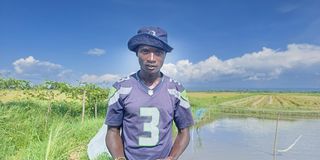
Abdon Rafic, a rice farmer who has since ventured into fish farming at the Ahero Irrigation Scheme, displays some of his harvest. He says practising aquaculture within the rice farm offers him an extra source of income as well as a variety of foods for his family and the market.

What you need to know:
- In the early 1990s, a researcher introduced the technology in Nyando, Kisumu County, but many farmers feared it would interfere with rice farming.
- The expert explains integration can be done either by introducing fish directly into the paddy or by building a pond within the farm.
At the Ahero Irrigation Scheme in Kisumu, rice plantations stretch like a green carpet. Farmers are busy harvesting or scaring off quelea birds, a predator that can cause total loss, they say.
Six kilometres from the main bus stage, two young men tend a fishpond in Ombeyi, Muhoroni Sub-county. Abdon Rafic and Tobias Aketch’s pond borders rice farms, with an empty harvested field across it.
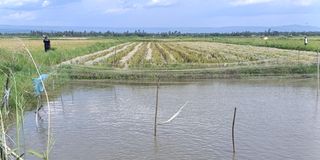
A fishpond constructed inside the one of the rice farms at Ahero Irrigation Scheme.
Rafic is the first in the scheme to integrate rice and fish farming, a technology tried in the 1990s but rejected due to local unwillingness.
A CCTV camera mounted next to a fingerlings pond monitors the isolated farm 24/7, connected to Rafic’s phone to deter nighttime theft.
Last December, Rafic made his first harvest. Of 3,000 fingerlings stocked. He harvested 1,500 fish, earning more than from an acre of rice. His next harvest is due in two months.
None of this was his plan. The 28-year-old holds a 2022 diploma in Health Records with Information Technology. He wanted to work in a health facility, but every hospital turned him down, citing only one employee needed with his background. He eventually gave up on employment.
He returned to his parents' home in Ombeyi, where the only income was rice farming. For months, he worked at the one-acre family farm. In the afternoons, he scrolled social media.
Then he saw a Facebook post by someone in Singapore practising rice-fish integration on the same land. He sent a friend request, was accepted, and began engaging immediately.
“He shared tutorials and answered my many questions,” Rafic says.
He shared the idea with fellow young farmers and decided to build a demonstration farm. After approval from the irrigation board, Racif rallied local youths to construct a 20-by-20 metre pond on his one acre. “Studying agriculture in high school helped—we had a unit on fish pond construction.”
Because of chemical use in rice production, he positioned the pond at the main water inlet, letting water pass through the pond before flowing into the rice farms.
He sourced fingerlings from Mbita, Homa Bay County. By June 2025, he had stocked 3,000 fingerlings, each weighing five grams.
He continued growing rice on the remaining land. The result? “I always harvest around 30 bags from one acre. This season, even after giving up space for the pond, I harvested 36 bags.”
The harvest, he says, also weighed more per bag than before. Rafic credits the nutrient-rich water from the fish pond outlet. “Unlike other years when I would use three bags of fertiliser, this season I used only two.”
Dr Nicholas Outa, a fisheries and aquaculture expert at Maseno University, says rice-fish integration has long been practiced in Asia—Pakistan, Japan, China, and the Philippines. The difference in Kenya is the fish species: tilapia and African catfish.
In the early 1990s, a researcher introduced the technology in Nyando, Kisumu County, but many farmers feared it would interfere with rice farming. The expert explains integration can be done either by introducing fish directly into the paddy or by building a pond within the farm.
Also read: Kemri and Israeli scientists pioneer natural solution to snail invasion devastating Mwea farmers
With direct introduction, fish eat insects and parasites, aerate rice roots, and their waste fertilises the farm, reducing pest control costs. With a pond, nutrient-rich water flows from the pond outlet to the rice.
The practice also conserves water by reusing pond water and captures nutrients that would otherwise be lost. “If one venture fails, the farmer benefits from the other,” Dr Outa adds. Other advantages include diversified nutrition (protein from fish, carbohydrates from rice) at family and market levels.
Earlier this year, Rafic engaged a self-help group to raise fingerlings within the irrigation scheme. The goal: supply local farmers, cutting costly travel to Mbita and reducing fingerling mortality.
“Travelling to Mbita is costly and increases mortality. Now that we have fingerlings within the scheme, farmers have easy access,” says Tobias Aketch, the group’s secretary.
He adds that rice farming in the scheme is threatened by yellow virus disease and quelea bird invasions.
The rising cost of farm implements is another challenge, he says. “There are cases where farmers abandoned their rice farms after bird invasions caused massive losses.” He urges the government to support farmers in adopting the technology.
Dr Outa cautions that the practice requires safe water since contamination can kill fish or accumulate chemicals in their bodies, harming consumers. He recommends constructing ponds at irrigation inlets to limit contamination and using organic alternatives like neem extract or a pepper, garlic, and ginger concoction.
“It is time the government and farmers embraced this venture while applying necessary precautions to enhance food production and tackle nutrition security,” he says.