Beach bandits: Illegal sand harvesting creates crisis for Homa Bay's fishing communities
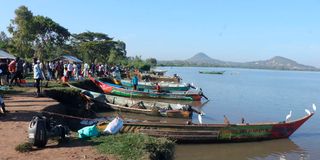
Fishing boats dock at Achich Beach in Homa Bay Town on March 18, 2025.

What you need to know:
- Homa Bay County has abundant sand deposits that attract harvesting, but the lack of proper regulation has led to widespread environmental degradation.
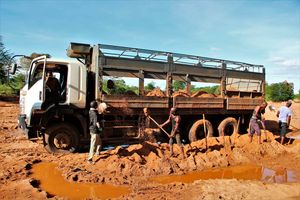
Under the cover of darkness, armed with shovels and hidden from authorities, groups of sand miners descend on Achich Beach in Homa Bay Town. They scoop sand from the shoreline, load it onto waiting lorries, and disappear before dawn—leaving behind a devastated landscape that threatens both the environment and the livelihoods of local fishermen.
"We would dock easily when sand harvesting had not started. Now the beach has cliffs that make it difficult for boat operators to dock," says Erick Otiende, Achich Beach Management Unit Chairman.
By day, Achich Beach bustles with fishing activities. The conspicuous heaps of fresh sand seem out of place in an area dedicated to fish trade. These piles are telltale signs of the clandestine operations that occur after sunset when government oversight ends.
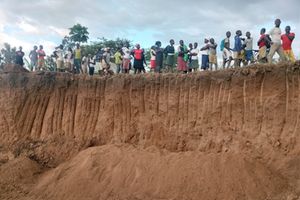
The illegal mining has dramatically altered the beach's topography. Where once a gentle slope allowed fishermen to easily dock their boats—part on land, part in water—steep slopes and cliff-like edges now make landing difficult and dangerous.
"Fishermen have to step out of the boats and stand in water when offloading their vessels," Mr Otiende explains, describing how a once-routine task has become hazardous.
Victor Odeny, a fisherman at Achich Beach, points to additional dangers. "The soil easily collapses when hit by waves. Some trees that once stood at the beach have fallen after their roots became weak," he says.
"It's dangerous to walk on the beach because it can easily crumble, causing you to fall into the lake."
The miners have also left large gullies in the lake bed, creating underwater hazards for unsuspecting waders who risk tripping and drowning.
The issue extends beyond Achich Beach. The National Environment Management Authority (Nema) has identified Kaswanga, Luanda Rombo, and Gingo as other areas where illegal sand mining has severely damaged beaches.
Homa Bay County has abundant sand deposits that attract harvesting, but the lack of proper regulation has led to widespread environmental degradation. According to Nema, nearly all sand mining operations in the region occur illegally.
Josiah Nyandoro, the county’s Nema director, explains that only two sites in Kendu Bay and Mbita have been properly licensed to extract sand from the lake bed—not the shoreline.
"Under the sand harvesting regulations, harvesting should be done from the bed of the lake or river, but not from the bank," Mr Nyandoro emphasises.
Kenya's Environmental Management and Coordination Act requires environmental impact assessments before any sand mining can legally begin. The Constitution classifies the land between high and low water marks as public land held in trust by the National Land Commission.
"If harvesting has to be done, it should be conducted with an environmental impact assessment. As of today, none of the operators at Achich have been licensed," Mr Nyandoro says.
"As a result of harvesting happening at the bank of the lake, we find that wave impact is clearing the land and causing significant problems."
Nema has criticised the Homa Bay County government for inadvertently enabling the illegal activity. "County revenue officers collect money from miners, which encourages them to scoop more soil. We cannot prioritise revenue at the expense of environmental integrity," Mr Nyandoro states.
In 2023, Nema gazetted regulations requiring transporters to obtain permits costing Sh3,000 for a 90-day period. Violations can result in fines between Sh2-4 million or imprisonment for two to four years, depending on the violation's severity.
Environmental groups are now pressing the county government to accelerate the formulation of sand mining regulations. Willis Omullo, an environmentalist based in Rachuonyo North, believes regulated sand mining could benefit local communities.
"Some sand is bought at a cheap price and sold to construction companies at multiple profits. The money should trickle down to communities impacted by the practice.
"If there were guidelines, people would harvest in a regulated manner. Currently, sand mining is done indiscriminately."
The county government has drafted regulations to address these issues. Francis Odalo, county Mining director, confirms that county assembly members are reviewing the policy.
"I cannot provide specific timelines for when the document will be ready. However, it aims to address all challenges facing the mining sector, especially regarding sand," Mr Odalo explains.
The situation at Achich Beach represents a classic tension between immediate economic gains and long-term environmental sustainability. As construction booms across Kenya, the demand for sand—a key component in concrete—continues to rise, making illegal extraction lucrative despite the risks.
For fishermen like Mr Otiende and Mr Odeny, the consequences are immediate and severe. Their livelihoods depend on a functioning beach ecosystem that is being undermined nightly by unregulated extraction.
Without proper enforcement of existing laws and the implementation of county-specific regulations, the damage to Homa Bay's beaches will likely worsen. The need for balance between utilising natural resources and preserving vital ecosystems has never been more urgent for Lake Victoria's coastal communities.
As the sun sets over Achich Beach each evening, the race between environmental protection and resource exploitation continues—one shovelful of sand at a time.