Beyond pigeon peas: Women farmers in Kitui find wealth in beehives
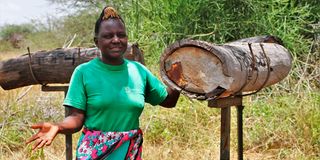
Elizabeth Munywoki stands near her beehives in Mukuanima village, Kitui County.

What you need to know:
- In drought-stricken Kitui, farmers like Elizabeth embrace beekeeping as a climate-smart livelihood alternative.
- Beekeeping empowers women, providing food, income, and conservation amid erratic rainfall and deforestation.
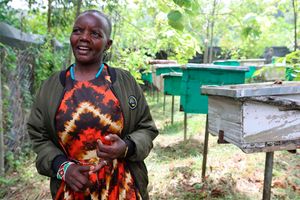
August marks the peak of the pigeon pea harvesting season in Kitui County, but in the sleepy village of Mukuanima, Elizabeth Munywoki has little to show for her efforts.
A failed rainy season has left the peasant farmer with only 50 kilos of pulses from her two-acre farm on the sprawling Yatta Plateau. Her bare farmland tells the story more graphically, yet the mother of three remains unshaken. “The poor harvest does not worry me because I am armed with a Plan B,” Elizabeth says.
The smallholder farmer, who also runs a tailoring shop at the nearby Mukuanima market, refers to beekeeping—an economic activity that has swept across the region bordering Tsavo East National Park. “The money I get from selling honey goes towards buying food for my family. It also covers other household essentials,” she explains.
Elizabeth is part of a growing rural farming community that has embraced beekeeping in response to climate change, which is manifesting through erratic rainfall. In a society where beekeeping has traditionally been considered a male enterprise, she raised eyebrows when she ventured into the practice in 1999.
Starting with just two traditional beehives, she has since expanded to 65, making her one of the largest beekeepers in the region. Her inspiration came from her father, who had used honey proceeds to educate his children.
“In a good season, I harvest up to 15 kilos of honey per hive. Besides buying food, the proceeds go towards educating my children. Over the years, I have purchased two acres of land for my main apiary, acquired two dairy cows, renovated my house, and bought three sewing machines from honey sales. I plan to increase my hives to 150 and set up a honey aggregation centre to boost my income,” Elizabeth says.
Elizabeth’s fortunes have changed significantly thanks to an apiculture programme introduced by Dorcas Aid International, a nongovernmental organisation promoting environmental conservation. Supported by the World Bank, the International Centre of Insect Physiology and Ecology, and the county government, the programme has positioned beekeeping as a climate-smart, environment-friendly economic activity.
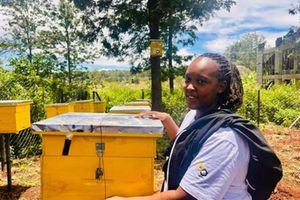
A key aspect of the programme is dismantling retrogressive stereotypes that barred women from beekeeping. Training has helped farmers realise that hives do not need to be placed high up in trees. Modern hives have increased both the volume and quality of honey, translating into higher incomes. The programme has also streamlined production by organising beekeepers into a vibrant cooperative society that has secured markets for their honey.
“We see beekeeping as a superior economic activity because it is environmentally friendly. With the training I have received over the years, I am now completely comfortable with it. I am no longer afraid of bees. I harvest honey on my own at any time of day, as long as I am clad in a bee suit and armed with a smoker,” Elizabeth says.
Promoting practice
The Muangeni Rural Development Programme, a community-based organisation working closely with Dorcas Aid International, has enlisted Elizabeth and other beekeepers to entrench the practice in the region. “In Kitui South, we are not only producing honey but also sustaining humanity by supporting creation. Bees are the world’s greatest pollinators. We are encouraging farmers in arid and semi-arid areas to take up beekeeping because it requires little rainfall,” says David Mutunga, an environmental conservation expert and programme coordinator with Muangeni Rural Development Programme.
The beekeeping campaign has gained ground at a time when charcoal production in Kitui has triggered unprecedented environmental degradation. To prevent deforestation from threatening honey production, the Muangeni Rural Development Programme has launched an ambitious conservation drive involving the planting of acacia tortilis and other indigenous trees, which are vital sources of bee forage. “Instead of cutting down mature trees, communities are now realising there is greater value in using them to hang beehives,” David says.