Botched tooth extraction by quack sends Nairobi man to ICU
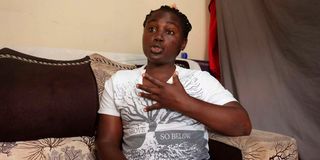
Vivian Nanjala, wife of Amos Isoka who underwent a botched tooth extraction at "Life Clinic" in Kawangware, speaks during an interview at their house in Kawangware on January 12, 2026.

What began as a dull ache in his jaw on December 30, 2024, became a fight for Amos Isoka’s life within days. Today, the Kawangware resident lies in the Critical Care Unit (CCU) at Kenyatta National Hospital, saved by minutes after a botched extraction by an unlicensed medic triggered a catastrophic infection that nearly strangled him from within.
On New Year's Day, seeking quick relief, Isoka visited Jamii Clinic in Kawangware. He was redirected to Life Clinic nearby, where a man identifying himself as a dentist extracted his tooth for Sh1,000. By January 2, something had gone terribly wrong.
"Isoka had swelling on the neck, on the opposite side of the operation," his wife, Vivian Nanjala, recounts.
When they returned to Jamii Clinic for answers, the medic dismissed the symptoms as normal.
"Ni hali ya mtu kutoa meno, itakuwa sawa (It's just part of the process. It will be fine)," he told them.
It was not fine.
By January 3, Isoka could no longer swallow. His throat had ballooned. He was gasping for air. When the family pleaded with the man at Life Clinic for a transfer letter, he reportedly became rude and refused.
Desperate, they turned to Wema Maternity & Nursing Home, where staff suspected sepsis caused by unsterilised tools. The family paid Sh1,000 for pain injections that offered only hours of relief before the agony returned. They kept going back.
By January 7, the pain had become unbearable. Isoka paced their single-room house, his head wrapped in a cloth, unable to find relief. Friends and family rushed him to Kangemi Eagles Hospital, where a legitimate dentist delivered the devastating truth: Isoka had been treated by a quack.
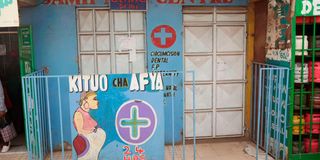
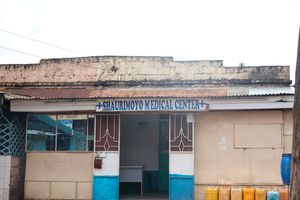
Jamii Med Centre in Kawangware owned by an unlicensed dental practitioner who performed a botched tooth extraction on Amos Isoka at "Life Clinic" in Kawangware was closed on January 12, 2026.
"The dentist asked Amos what kind of chair he sat on. When Amos said it was just a normal chair, the doctor told us he had been handled by a quack," Nanjala says.
The dentist demanded Sh4,500 — money the family did not have. They returned to Wema Hospital, where medical staff examined him and delivered an urgent verdict: Isoka needed to be transferred to Kenyatta National Hospital (KNH) immediately. He would not be allowed to go home.
With assistance from the facility and Nairobi County, funds were secured to clear his bill and arrange an ambulance.
Isoka arrived at KNH in the early hours of January 9 in a grave condition. He could not speak. He could not swallow. His neck was massively swollen. The surgical team immediately identified the condition: Ludwig's angina, a rapidly spreading and potentially fatal infection of the submandibular space.
The name angina derives from the Greek word for strangulation. The infection raises the floor of the mouth and swells the neck until the airway is completely blocked.
Dr Edwin Rono, consultant oral and maxillofacial surgeon at KNH, explains that in such critical cases, the margin between survival and death can be razor-thin.
"The window between life and death can be as short as 20 minutes," he says.
"The infection originated from a dental site, appearing to follow a bush extraction or a botched procedure on a lower tooth. Because the infection was tracking downward from the neck toward the chest, the hospital mobilised all resources for an emergency intervention."
Isoka has since undergone two major surgeries. The first, an immediate debridement to drain the infection, lasted from 9 am to 3 pm. The second, a procedure to clear pus that had accumulated above the chest, took place on Monday night from 9 pm to midnight.
The surgical team continues to monitor him for tissue necrosis — bacterial activity can disconnect the skin from its blood supply, potentially requiring reconstructive surgery. Once the acute infection is managed, imaging will locate and remove the tooth that triggered the crisis.
Dr Jane Gwaro, Head of Anaesthesiology and Critical Care Unit at KNH, explains that Isoka was immediately admitted to the ICU after the first surgery. The primary objective has been life support and physiological stabilisation.
"Currently, he is being managed in the Critical Care Unit, where he is under 24-hour monitoring with specialised equipment. This intensive environment is necessary because his airway remains at high risk due to the severity of the inflammation," she says.
Before Isoka could be cleared for his second surgery, the team had to balance his vitals to ensure he could survive the anaesthesia.
"This process of stabilisation is a continuous effort, involving the administration of high-potency antibiotics and oxygen therapy," the anaesthesiologist says.
The recovery timeline is being managed carefully as the team waits for the inflammation to peak and subside — typically within three to five days. The breathing tube will remain until the team is certain his airway is clear and he can breathe independently. The transition from the ICU to a general ward will depend on his response to medication and the absence of complications.
Several cases
Dr Rono observes that cases like Isoka's are not rare.
"It is not unusual to see several cases a week resulting from unqualified practitioners," he says. "These botched procedures often lead to severe complications, ranging from broken jaws to life-threatening infections."
The Kenya Medical Practitioners and Dentists Council (KMPDC) moved swiftly to close Life Clinic, citing "immediate danger to public health."
The closure notice listed multiple violations: operating as a health institution without a licence, employing unregistered practitioners, and failing to meet required standards — all in contravention of the Medical Practitioners and Dentists Act.
Dr David Kariuki, Chief Executive Officer of KMPDC, confirms that upon receiving media reports, the council immediately coordinated Isoka's emergency transfer from Wema Hospital to KNH.
Investigations revealed that Life Clinic was an entirely illegal entity, appearing nowhere in the council's records. By the time inspectors arrived, the operator — suspected of being Congolese — had fled and attempted to destroy evidence.
"During a wider sweep of Kawangware, the council discovered and closed three additional unlicensed clinics linked to the same suspect, including Jamii Clinic, which had referred Isoka to Life Clinic," Dr Kariuki says. "In one instance, police from Muthangari Police Station had to break into a locked facility to rescue a patient being held without proper care."
Wema Hospital, though established, was found to have serious regulatory breaches. It was operating with an expired licence and had failed to refer the critically ill patient promptly.
"Stabilisation does not justify keeping a patient when a facility lacks the capacity to treat them," Dr Kariuki says.
KMPDC faces a severe shortage of regulatory personnel. Despite Nairobi having over 3,000 health facilities, the council operates with just three compliance inspectors for the entire county — and 18 nationwide. Ideally, at least 10 are needed for Nairobi alone.
"This is a budgetary issue. We have requested the necessary budgets, and we believe the National Treasury will allocate resources to enable us to onboard more inspectors and cover larger areas more frequently," the KMPDC chief says.
"Normally, we don't wait. We work within available resources. Sometimes we work jointly with other regulators, including the ministry and county governments, so we are able to boost what we have and still perform."
Staffing levels have been stagnant for over five years due to budgetary limitations. Despite this, the council has closed nearly 1,000 facilities across counties including Mandera, Homa Bay, and Nyamira in recent months. Approximately 300 active malpractice cases are being processed.
The job of an inspector, Dr Kariuki explains, is to confirm that a facility or practitioner is legally registered, holds a current licence, and meets the standards expected for their level of operation.
"A facility doing very well can be re-inspected every two to three years. One that has not fully met the requirements can be inspected annually," he says.
Dr Kahura Mundia, President of the Kenya Dental Association, describes illegal dental practice as a growing threat, fuelled by weak enforcement and job scarcity.
"When untrained individuals claim to be dentists, they violate professional ethics and endanger patients," he says. "A proper healthcare team relies on a clear division of labour between specialists, dentists, and support staff. However, economic pressures are driving many to work outside their qualified roles. This deprives citizens of the high-standard dental care they deserve."
The Medical Practitioners and Dentists Act provides stiff penalties. Practising medicine or dentistry without a licence attracts a fine of up to Sh5 million, imprisonment for up to five years, or both. Employing an unlicensed practitioner or operating an unlicensed facility can result in a fine of up to Sh10 million, imprisonment, or both. Illegally using the title "doctor" carries a fine of up to Sh5 million, imprisonment for up to five years, or both.
"We call upon members of the public to report lawbreakers, and the Kenya Police to apprehend and charge all those who breach public health laws," Dr Mundia says.
On Sunday, Isoka spoke his first words since the nightmare began. He asked about his children. Nanjala continues to pray that her husband will recover and come home. She has filed a report with police.
Nation was unable to reach Lawrebec Kingatua, the man who operated on Isoka — his phone was switched off. KMPDC confirms he remains in hiding.
Police are looking for him.
How to verify your doctor or clinic
KMPDC allows Kenyans to check whether a facility or practitioner is legally registered.
- Online:www.kmpdc.go.ke
- Via SMS (20547)
- For facilities: Text H# followed by the facility name (eg, H#NyandiwaDispensary)
- For doctors: Text P# followed by the practitioner's name (eg, P#JohnKamau)
Follow our WhatsApp channel for breaking news updates and more stories like this.