Buried alive for a handful of shillings: Why Machakos miners keep returning to killer quarries
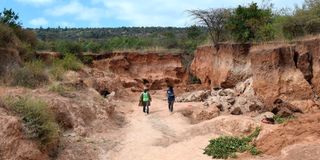
John Sila and Antony Hassan walk across the Ngonda sand quarry in Machakos County on August 21, 2026, a day after the mine collapsed, burying two sand miners alive.

What you need to know:
- Postmortem reports point to the same cause of death: trauma. Those who survive often suffer broken limbs and spinal injuries.
Barely a week after a sand mine buried Amos Nzyoka and Hassan Idi alive on the outskirts of Muthwani Township in Machakos County, operations resumed at the deadly quarry. The two were among five residents mining sand when the disaster struck. When Healthy Nation visited, three survivors of the recent collapse were already back at work, toiling at the quarry overlooking Ngando Hills.
For Joseph Mwanthi, it was the second time he had survived a similar accident. "We are devastated. But we have to return to sand mining because we have no other source of livelihood. Sand is our cash crop," he told Healthy Nation.
And on Thursday, a sand miner died in a quarry at Kwamboo, Masinga Sub-county, in the latest sand mining accident. Kithambioni Assistant Chief Onesmus Musyoka confirmed the incident, saying the quarry, locally known as nguu, collapsed and buried the youthful miner alive.
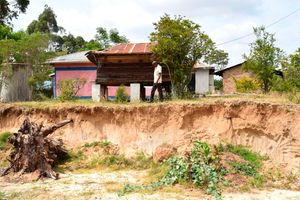
The tragedies are the latest in a county that banks heavily on sand trade to boost its own-source revenue. Much of the sand mining here involves desperate young men who dig up farmlands and rangelands for a special type of sand, later blended with riparian sand to enhance its market value. After excavating vertically, the miners burrow horizontally under thick layers of earth, exposing themselves to immense danger. Their struggle to dig themselves out of poverty often ends in death or injury when a mine collapses under the weight of the soil above, along with lasting environmental degradation.
Also read: 60 mine accident deaths recorded
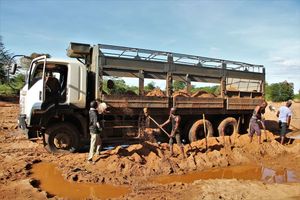
Survivors of sand-mining accidents recount harrowing tales. Mwanthi believes the Muthwani collapse could have been far worse. "No one saw the quarry collapsing. There was no distress call. It took a split second; a deafening rumble from the collapsing quarry, and a cloud of dust hung in the air for a long time. The mine collapsed barely five minutes after a sand truck drove out," he said.
When the dust settled, Wambua Nzyoka had lost his younger brother, Amos. He himself was lucky to be alive. He had stepped out of the quarry just moments before the disaster struck.
According to Muthwani Assistant Chief Boniface Matheka, the deaths of Amos and Hassan brought to six the number of residents killed in sand-mining accidents since January. A spot check by Healthy Nation revealed that at least 16 Machakos residents have died in similar incidents over the past year. Among them were three miners buried alive when a sand mine collapsed at Isyukoni Village, near Ekalakala Township in Masinga Constituency, in April.
"We have buried so many sand miners. The only way out of this crisis is job creation. They go to the quarries because they have no other means of making a living," said Lukenya Assistant County Commissioner Daniel Saningo, whose region has been hit hard.
Postmortem reports point to the same cause of death: trauma. Those who survive often suffer broken limbs and spinal injuries. An interview with Hassan's mother, Praxedes Mumbua Idi, revealed that her son had cheated death twice before. The 48-year-old first injured his back when a mine collapsed on him some time ago. More recently, he broke a leg in another collapse. He was not so lucky the third time. "He died an honourable death; making an honest living rather than stealing," she told Healthy Nation on the day she buried her firstborn son.
She has since joined the campaign against unregulated sand mining in the county, echoing Saningo's call for the government and private investors to act swiftly and create job opportunities for Machakos youth, to avert further deaths and injuries.
Zipporah Nzyoka, mother of Amos and Wambua, believes her family's loss could have been avoided if authorities had acted sooner to stop unregulated mining. Over the years, the peasant farmer had been a prominent voice among parents discouraging their sons from working in the sand mines, warned both of the dangers and the meagre returns. Multiple interviews reveal that a sand miner takes home about Sh500 for loading a truck, while the mine owner pockets at least Sh1,000 per truck. Sand merchants, meanwhile, earn far more.
Nzyoka strongly believes that sand mining is not a meaningful source of livelihood. Beyond the mines being death traps, she says, miners take home peanuts. "Our concerted calls on authorities to ban reckless sand mining have fallen on deaf ears. Every time we push them to act, they promise swift action, ut it never happens. The only thing that does happen is more deaths at the quarries," she said.
Beyond deaths and injuries, reckless mining damages houses, roads and water pipelines, and even leaves graves exposed. Environmentalist Jeremiah Mutavi Simba blames reckless sand harvesting for the drying up of seasonal rivers. The director of Semi-Arid Regions Environmental Solutions, an NGO promoting environmental conservation, notes that sand makes drylands habitable by extending the utility of seasonal rivers beyond the rainy season. "Water locked in a sandy riverbed raises the water table and recharges nearby wells, making water easily accessible to animals, humans and vegetation along rivers.”
The Athi Kapiti Wildlife Conservancies Association, which brings together conservancies in Mavoko Constituency, has linked unregulated sand mining to a decline in zebra and other wildlife populations. The association has raised alarm over wild animals accidentally drowning in water-filled quarries abandoned by miners.
Outcry over reckless sand mining has intensified in recent years as demand for the commodity has skyrocketed. A new report links this surge to President William Ruto's affordable housing programme. Although sand is an essential ingredient in concrete, the study, conducted by Professor Kennedy Mkutu (USIU), Dr Michael Owiso (Maseno University), Dr Jan Bachmann (University of Gothenburg), and Dr Bernard Musembi Kilaka (Gothenburg and Maseno), argues that it is often overlooked, stressing the urgent need for proper regulation.
The unending sand-mining accidents have thrown Machakos County's lacklustre approach to sand management into sharp focus. Although the devolved unit enacted the Machakos County Harvesting Act in 2014 to regulate mining and trade, enforcement is largely limited to licensing transport trucks.
Governor Wavinya Ndeti rarely speaks the same language as ward representatives on this issue. Kalama MCA Boniface Maeke squarely blames her for the sand-mining menace. "What Machakos needs is political goodwill, starting with the governor. That is what is missing.” He cited Mwala Constituency as the exception, the only constituency where reckless sand harvesting has become a thing of the past, thanks to concerted efforts by MP Vincent Musyoka.
Musyoka effectively led residents in banning commercial sand harvesting at the height of the craze in 2016. He even threatened to arm residents with bows and arrows to deter merchants he accused of working with administrators and police to impoverish residents through wanton sand mining. The strategy worked: it ended wanton harvesting, restored depleted rivers, and spawned multiple irrigation schemes along rivers cutting across the constituency.
A decade later, Ndeti has moved to streamline the sector by revising the 2014 law. "The Machakos Sand Act, 2014, is not implementable in its current state because it does not heavily involve the riparian community. We have come up with the Machakos Sustainable Sand Harvesting Bill, which proposes sustainable sand harvesting," Environment Executive Onesmus Kuyu said.
He added that the bill empowers and involves riparian communities in decisions around sand harvesting and ring-fences money at the community level for environmental protection. "The bill is currently before the cabinet," Kuyu said.
However, Healthy Nation has since established that the proposed law is designed to cover only riparian sand mining, raising fresh concerns over the other type of mining that continues to claim lives.