Cancer overtakes heart disease as Kenya’s second leading killer
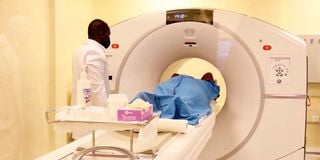
A patient undergoes cancer screening at the Integrated Molecular Imaging Center located at the Kenyatta University Teaching Referral and Research Hospital on January 10, 2022.

What you need to know:
- The country now records more than 44,000 new cancer diagnoses annually, with over 29,000 Kenyans succumbing to the disease each year; figures that underscore the urgent need for comprehensive cancer control strategies.
In a disturbing health shift, cancer has overtaken cardiovascular disease as Kenya’s second leading cause of death, new data from the National Cancer Institute of Kenya (NCIK) reveals, while infectious diseases remain the nation’s top killer.
Dr Elias Melly, CEO of NCIK, revealed these alarming statistics ahead of the second national cancer summit scheduled for later this month, painting a stark picture of Kenya's evolving health landscape.
The country now records more than 44,000 new cancer diagnoses annually, with over 29,000 Kenyans succumbing to the disease each year; figures that underscore the urgent need for comprehensive cancer control strategies.
"We cannot treat cancer entirely unless our healthcare system is fixed. We cannot treat cancer unless we fully address malaria and other ailments," Dr Melly told delegates during a media breakfast meeting last week, highlighting the interconnected nature of Kenya's health challenges.
Dr Melly identified chemical exposure as a significant contributing factor to Kenya's rising cancer burden, pointing to agricultural practices that continue using banned carcinogenic substances.
"Chemical exposure is one of the causes of cancer in the country, which is why all chemicals with carcinogens should be banned from being used on our farms," the CEO emphasised.
He revealed a troubling reality: chemicals prohibited in other countries due to their cancer-causing properties are somehow finding their way into Kenyan markets, creating a public health crisis through the food chain.
"In other countries, they have been banned, but somehow they find their way to our markets. This is why we need to work with the Ministry of Agriculture to prevent these chemicals from getting into the market because the food we are eating is now posing as a risk factor for cancer," Dr Melly explained.
According to Dr Melly, radiation through mines is another major risk factor for cancer in the country.
Gold mines, for example, harbour a significant amount of radon gas, a classified human carcinogen.
Radon exposure is a significant public health threat, potentially leading to increased risk of lung cancer, leukemia, and chronic obstructive pulmonary disease.
Data
“The Ministry of Health cannot address matters cancer unless we work together through a multisectoral approach. If data is collected, it will inform our planning and cancer research because as you may know, epigenetics (how your behavioUrs and environment can cause changes that affect the way your genes work) influences our genetic makeup,” the CEO observed.
While agreeing with Dr Melly, Dr Timothy Olweny, the chair NCIK board of trustees, highlighted the country’s strategic vision for cancer control.
“We have to engage our patients, I am passionate about ‘end of life care’ because a lot of people spend most of their finances, more than 90 per cent, in the last two weeks of their lives. As healthcare professionals we end up making decisions that do not even make sense for the patients and sometimes in the process do more harm than good,” he told delegates.
“Patient-driven information falls within our mandate and my vision is that one day we are going to get to point where we ensure patients easily find details about specialists, licensed cancer centers, local treatment options and where they can get information about financing as well as the support they require,” he said, adding that Kenyan cancer patients who seek treatment abroad should not be forgotten.
He acknowledged the persistent challenge of Kenyans seeking cancer treatment abroad and called for a deeper understanding of the underlying reasons
“Foreign treatment is something that has been a thorn in our flesh as the health sector for a while. One of the things we have to do first is to understand why Kenyans opt for foreign treatment.”
He cited the lack of trust in local healthcare facilities.
The official added that from a funding perspective, Kenya needs to ensure that patients who have conditions that can be treated in the country are treated within our borders.
“And especially if the funding is coming from the public sector. If it’s an individual who opts to go out of the country, that is their prerogative because the funding is individual. However, there are cases we have to admit that they can get better healthcare services outside the country. Those are the ones we need to fund.”
However, he warned that when the government funds foreign cancer treatment with amounts that can't even cover airfare, it creates a system where only the wealthy survive – “ it means only those who are well to do will be able to top up to get foreign treatment”.
Dr Olweny said they are working with the Social Health Authority (SHA) to iron out all these issues in terms of being able to prioritise which patients go outside the country.
He acknowledged that though the SHA oncology package is at Sh500, 000, it is not enough.
“There’s a benefits package and tariffs advisory panel that was set up by Health CS Aden Duale. It is supposed to review the benefits and one of the things they are exploring is that we make sure when patients leave Kenya, they go to institutions that are recognised by the country.”
He added that they are working to ensure patients who return from abroad get continuity of follow-up care.
“We need to have these discussions so that we can have policies set and funds deployed for the purpose of prioritising patients,” Dr Olweny urged.
Mercy Osoro, a lymphoma cancer survivor who battled the disease for 20 years, said: “I was diagnosed as a child. I took herbal medicine and it severely affected my spleen. I went for chemotherapy and the big mass on my neck went away after three cycles.
But after six months, the mass showed up again on both sides, this time aggressively.
“This meant that I had to start chemotherapy afresh and as a result; my heart was affected to a point that I got a heart failure. However, I am still standing here as a survivor with scars just to tell other cancer patients that there is hope. We also need to prioritise childhood cancers. We can start by reminding every parent to keenly observe them.”