COP 30: What's in your pants? Definition of gender stalls Belem climate talks
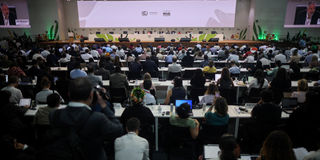
Negotiators attend a plenary session during the UN Climate Change Conference (COP30), in Belem, Brazil, November 21, 2025.

In Belém, Brazil
A diplomatic row over what the word “gender” really means is threatening to complicate the closing stretch of COP30 climate negotiations in Belem, Brazil after six governments insisted on inserting their own definitions as formal footnotes to a key text on gender and climate action.
The issue, usually settled at technical level, has become so fractious that the Brazilian COP30 presidency has escalated it to ministers in hopes of brokering a truce before the final text is released on Thursday.
Delegations familiar with the discussions say the sticking point is whether “gender” within the UN climate process should continue to reflect the broad, inclusive understanding used across the UN system, or whether countries should be allowed to narrow the term to biological sex, effectively excluding trans and non-binary people from gender-responsive climate policy.
What has emerged is a patchwork of footnotes, at least six so far, attached by individual governments seeking to reinterpret the word “gender” according to their domestic laws and political priorities.
The result, negotiators warn, is a legalistic tangle that could undermine years of progress on gender and climate justice.
Paraguay’s footnote states that, for all references to gender across UNFCCC documents the term gender is framed exclusively within the provision of Article 48 of its national Constitution and interprets it as referring to the female and male sexes”.
Article 48 of Paraguay’s constitution recognises equality between men and women without reference to gender identity.
By invoking it, Paraguay effectively restricts gender to a binary, excluding any broader understanding common in international human rights frameworks.
Argentina’s footnote takes a different tack, asserting that references to gender are understood “as defined in Article 7.3 of the Rome Statute of the International Criminal Court”.
Also Read: What next for Africa after COP30?
This is significant because the Rome Statute defines gender as “the two sexes, male and female, within the context of society”. It adds that the term does not imply any meaning different from the above. While this definition nods to social context, it also explicitly limits gender to male and female.
Iran’s footnote mirrors Paraguay’s, stating that gender under the UNFCCC should be understood solely according to its “Law on Family and Youth Support”, again restricting gender to biological male and female categories.
The Holy See’s footnote is the longest and most detailed. It recalls its 2022 interpretative declaration made upon joining the UNFCCC, and argues that “any reference to ‘gender’ and related terms… is to be understood as grounded on the biological sexual identity that is male and female”.
It adds that the Holy See promotes a “holistic” approach centred on human dignity, using a language that is familiar in Vatican positions on gender debates.
Several other countries, including Malaysia and Indonesia, have supported similar framings, though not all have submitted written footnotes.
The Nation understands that the row over what the term ‘gender’ really means is now delaying work on the mandate of the UNFCCC’s gender programmes, including the Gender Action Plan, which aims to ensure women, girls and gender-diverse groups can shape and benefit from climate action.
A narrow, biological definition of gender as suggested by the countries could shrink the scope of that work dramatically by curtailing the recognition of trans, non-binary and gender-diverse people in climate vulnerability assessments.
Speaking to the Nation from Belem, Ms Ndivile Mokoena from GenderCC South Africa lamented that “politicising the gender language and definition and rejecting the language on intersectionality by parties is a big shame”.
“This is a violation of the Paris Agreement, which states explicitly that the principles on gender equality are to be included in decisions and actions related to climate change mitigation, adaptation and support as well as transparency framework for climate change impacts.”
“World leaders behave as if they live in a bubble and not in communities where intersectionality exists,” protested Ms Mokoena.
“They treat intersectionality as an individual or family concern yet it is a global imperative as these groups are not treated with fairness, justice, and inclusiveness, but with disdain.”
Ms Elizabeth Wanja, coordinator of the Kenya Climate Working Group, said “the strength of the new gender adaptation plan lies in its inclusive design”, noting that “every priority area, objective and activity already recognises the realities of gender-diverse people”, and that “there is no need for exclusionary definitions when the work itself is built on the universality and human rights”.
“The negotiations at COP 30 clearly show that parties are ready to move from symbolic commitments to real gender-responsive action. What we need is political courage to protect the integrity of the gender action plan and prevent a language that weakens its inclusivity and ambition,” said Ms Wanja.
Observers say the effort to dilute gender language is not new, but this is the first time countries have attempted to formalise it through multiple footnotes attached directly to COP outcome text.
Some of the governments pushing for restrictive definitions have recently enacted conservative domestic laws limiting the recognition of gender identity. Others are responding to political pressure from religious institutions, nationalist movements or coalition partners back home.
Gender advocates are also cautioning that, once inserted into one text, these footnotes could set a precedent for all future climate negotiations, emboldening other states to add their own definitions, not just for gender but potentially for human rights, Indigenous rights or other sensitive terms.
The gender fight in Belem is unfolding alongside another clash over human rights references in the same text.
Several states are resisting explicit mentions of human rights, sexual and reproductive health and rights, and the rights and protection of women environmental defenders.
Women environmental defenders from Latin America, Africa and Southeast Asia face intimidation, criminalisation and even killings linked to mining, land grabs and fossil fuel projects, and activists here are warning that removing explicit protections from the text would leave them even more vulnerable.
For Brazil, hosting its first COP in three decades, the row is unwelcome. The presidency has so far attempted to keep the gender text balanced, but the footnotes have turned what should be a consensus-building exercise into a political landmine.
The Presidency has now elevated the matter to ministers, hoping political authority can succeed where technical negotiators hit a wall. But with just hours to the end of the summit, time is short and both sides appear firmly rooted.