COP30 final week: Finance crisis threatens climate action as Africa seeks wildlife commitment
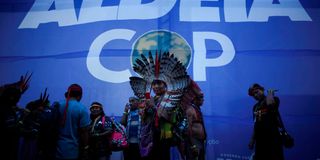
Indigenous people gather in the COP30 Village (Aldeia COP30) during the UN Climate Change Conference (COP30) in Belem, Brazil, November 12, 2025.

As COP30 enters its final days, African non-state actors have sounded an alarm about what they describe as a crisis undermining the entire summit, the absence of adequate climate finance commitments to implement the Global Goal on Adaptation (GGA).
GGA is a framework designed to help countries prepare for and respond to climate change impacts.
In a statement released this week, African civil society groups warned that discussions about adaptation indicators are meaningless without corresponding financial support.
"Without means of implementation, indicators are useless," they declared, calling on African negotiators to "resist anything short of a decision that reflects the scale and urgency of adaptation in Africa."
The core complaint centres on what they characterise as developed nations attempting to shift climate finance responsibilities to the continent least responsible for the crisis.
"What we see are machinations by developed country parties to rewrite the Paris Agreement by shifting obligations for the implementation of the adaptation agenda to those least responsible for the climate crisis, and those with the least capability to finance adaptation," the statement by the Pan African Climate Justice Alliance reads.
"The Paris Agreement principle on Common but Differentiated Responsibilities based on Respective Capabilities is being thrown to the dogs."
The non-state actors are particularly concerned about proposed indicators that would effectively transfer the burden of climate finance to developing nations already struggling with debt.
"Indicators such as proportion of government budget allocated to climate adaptation and resilience and annual adaptation finance expenditure effectively transfer the burden of financing adaptation to developing countries, which are already debt-stricken," the statement warns.
International climate justice organisations report that adaptation financing needs reach up to $300 billion annually, yet current funding barely covers these requirements. CARE International, in its own COP30 statement, emphasised that "climate finance remains the fault line of global action: many rich countries inflate figures, offer loans instead of grants, and cut aid when support is most needed."
CARE International has outlined comprehensive demands for COP30, including tripling adaptation finance by 2030, adopting a well-funded Gender Action Plan to support women-led climate action, and providing predictable grant-based finance for loss and damage. The organisation emphasises that "ten years after the Paris Agreement, the promise to keep global warming below 1.5°C is slipping away," with the world having just experienced its hottest year on record.
"Climate finance is the fault line of global climate action," according to CARE's senior advisor on climate change. "Ten years after Paris, developed countries are cutting aid, cooking the climate finance books, and labelling large projects with little or no adaptation component as 'climate finance'. Much of this so-called support comes as loans, not grants, and repayments often flow quietly back to donors. COP30 must deliver fair, public finance, not more bills for those already paying the highest price."
African negotiators have called for the horse to lead the cart at COP30.
"At the onset, we insist that financing adaptation cannot be optional; it is not charity, and therefore, it is mere rhetoric to discuss indicators of GGA, without the requisite means of implementation," they stated.
Yet even amid this financial crisis, African leaders have moved to advance a more hopeful agenda. On 15 November, at an official side event hosted by the World Federation for Animals, Zimbabwe's Permanent Secretary for the Environment announced that African leaders have agreed to launch a Global Wildlife for Climate Action Declaration at COP31 next year.
The endorsement emerged from the inaugural African Union Biodiversity summit held in Botswana in early November, where heads of state adopted the African Leaders' Gaborone Declaration on Biodiversity.
In this declaration, leaders committed "to endorse the Wildlife for Climate Action Agenda and Declaration and call upon the rest of the world to support Africa and Africa's wildlife resources on this cause."
Follow our WhatsApp channel for breaking news updates and more stories like this.