Countries asked to withdraw law that criminalises traditional seed savers
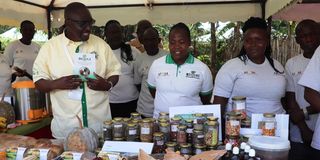
An organisation of seed savers displaying seeds for different indigenous crops during the launch of Vihiga County Agroecology Policy.

What you need to know:
- Penalties include up to two years in jail or a Sh1 million fine.
When traditional seed savers gather at Luanda Market in Vihiga County every Monday and Thursday to sell different varieties of seeds, especially indigenous vegetables, most of them are not aware that they are committing a criminal offence that can land them in jail.
They unknowingly violate Kenya’s Seed and Plant Variety Act, which mandates that all seeds must be certified by the government.
The Act prohibits smallholder farmers from selling or sharing indigenous seeds as well as saving their seeds for the next harvest. Penalties include up to two years in jail or a Sh1 million fine.
Under the Act, all seeds sold or shared must be certified by a government agency, and certified seeds are “those that have undergone laboratory tests and have been determined to be of high quality, true to identity, high in purity and germination capacity, uniformity, can adapt in adverse weather conditions and are free from pests and diseases”.
This law applies to all countries that are signatory to the International Convention for the Protection of New Varieties of Plants (UPOV), also known as UPOV 1991 Act, which, food system activists are now asking African countries to withdraw, and those that have not signed to keep off.
Kenya is a signatory to UPOV 1991 Act.
“The UPOV Convention was conceived and designed by European states for industrial breeders without consultation with farmers who produce over 70 per cent of Africa’s food through propagation of farmer-saved seeds,” Dr Million Belay, general coordinator at the Alliance for Food Sovereignty in Africa said.
He was speaking during a consultative meeting to come up with agroecology policy for the East African Community, convened by the East African Legislative Council.
“The convention demands that protected varieties be distinct, uniform, and stable - terms that sound scientific but are fundamentally incompatible with the rich genetic diversity that African farming depends on,” he said.
Kenya deposited its instrument of accession to the 1991 Act of the UPOV Convention when Parliament amended the Seeds and Plant Variety Act (CAP 326) in April 2016 following a motion that was moved by the then Majority Leader Aden Duale.
Evans Ochuto, a young seed saver who grew up in a seed-saving family, believes that if the Seed and Plant Variety Act is fully implemented in Africa, then there is a risk of losing hundreds, if not thousands of indigenous species and varieties that cannot be found in agrovets or the government-approved seed list.
“Most of our agrovets store seeds for vegetables such as spinach, kales, onions, tomatoes, carrots among others,” said Mr Ochuto, who is in charge of Vihiga Seed Bank located in Luanda. “Seeds for indigenous vegetables such as esirietselo (Erythrococca bogensis), vine spinach (Basella alba), linyolonyolo (Commelina bhenqalensis) and Shikhubayeka (Vigna membranacea) can only be purchased from indigenous seed savers, and not licensed agrovets.”
Local knowledge
According to the law, the penalty charged to seed merchants and seed sellers who are not licensed by the Kenya Plant Health Inspectorate Service is a fine of up to Sh1 million and a jail term of up to two years.
The law - Seed and Plant Variety Act - remains in place even after Kenya launched the National Agroecology Strategy for Food Systems Transformation 2024 - 2033, which, among other things seeks to strengthen the economic viability of rural areas based on short marketing chains, and safe food production.
The National Agroecology Strategy, which contradicts the Seed and Plant Variety Act, supports diverse forms of smallholder food production, food sovereignty, local knowledge, social justice, local identity and culture, and indigenous rights for seeds and breeds.
The strategy further calls for restoration and preservation of indigenous knowledge and genetic resources, while underscoring a fact that overdependence on external inputs limits space for local indigenous knowledge and innovation.
Proponents of UPOV 91 argue that it provides and promotes an effective system of plant variety protection with the aim of encouraging the development of new varieties of plants for the benefit of society.
But opponents say it infringes on the rights of indigenous farmers because it deals with breeder’s rights (individual) and criminalises farmer’s rights (collective/communal).
Ferdinand Wafula, an indigenous seed saver and the founder for Bio Gardening Initiative in Vihiga County argues that new seed varieties by individual breeders are always developed (hybridised) using farmer-saved varieties that have been passed from generations to generations over thousands of years.
“It therefore becomes unfair to develop regulations that protect breeders without considering and directly involving seed savers and indigenous knowledge bearers, who have protected those genetic resources for generations,” he said.
So far, Murang’a and Vihiga counties have enacted their agroecology policies with strong bearing on use and protection of indigenous technical knowledge, which includes traditional seed saving and seed banking.
The Vihiga County policy, for example, seeks to address the declining usage of traditional practices (which are threatened by the UPOV legal regulations), and inter-generational knowledge transfer concerning seed saving, wild harvests, utilisation of edible insects and mushrooms.
According to Dr Belay, the continuous push for countries to adopt UPOV 1991-style laws is coming not from within, but from external pressures: trade deals, donor requirements, and regional harmonisation led by organisations like the African Intellectual Property Organisation and the African Regional Intellectual Property Organsation.
“These laws are being fast-tracked through national assemblies, many times without the knowledge and consent of the very farmers they will affect,” he said.