Death in darkness: The rising snakebite crisis haunting Baringo families
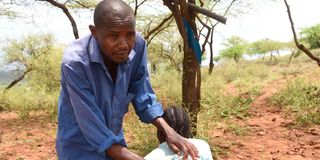
David Kigen of Koisarat Village, Koibatek in Baringo County shows the scar on his wife Mercy’s back at their home on February 25. In 2023, a snake bit Mercy and their four-year-old son while they slept. The child died three days later while undergoing treatment

What you need to know:
- In the rocky hills of this region, venomous snakes are turning homes into death traps. Nearly every homestead has a victim: someone nursing injuries, living with permanent disabilities, or mourning a loved one.
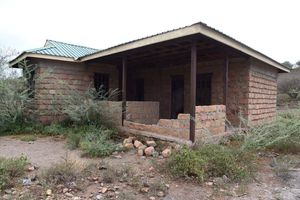
A small grave lies barely visible among thorny shrubs, just 10 metres from a humble one-roomed house in Koiserat village, Mogotio. It is the resting place of four-year-old Enock Kipteroi, who lost his life to a venomous snake bite while asleep.
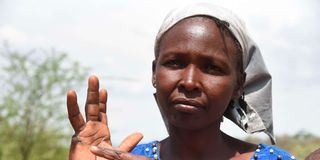
Anne Kiptai during the interview in Lopoper Village, Koibatek. She shows where a snake bit her in 2021, resulting in the amputation of her finger.
For families in Mogotio, Baringo County, such tragedies are far from rare. Snake bites are a constant and deadly threat. In the rocky hills of this region, venomous snakes are turning homes into death traps. Nearly every homestead has a victim: someone nursing injuries, living with permanent disabilities, or mourning a loved one.
The rocky hills that surround the area provide perfect hiding places for snakes, which often slither into homes after dusk, drawn by warmth, shelter, and water. The ordeal of the Kigen family in September 2023 illustrates the deadly toll these silent predators exact.
Mercy Kigen, Enock’s mother, sits outside the family’s modest structure, cradling her one-year-old child. A faint but visible scar on her back tells of the venomous bite she survived the same night her son was fatally bitten.
Around 4am., Enock cried out in pain, describing the sensation as an iron sheet cutting his finger. His father, David Kigen, awoke to find the boy’s finger bleeding. Moments later, Mercy felt a sharp, piercing pain in her back and began vomiting.
Realising the danger, David frantically searched the home and found a cobra coiled just metres from the bed. He killed the snake and raised the alarm, mobilising neighbours to help take his wife and son to Majimoto Health Centre.
With no anti-snake venom available at the facility, the family had to travel more than 25 kilometres to Marigat Sub-County Hospital. By the time the drugs arrived, Enock had succumbed to the bite. He died the following morning at 6am.
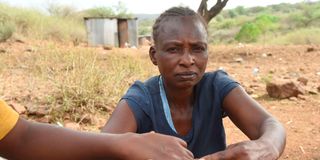
Pauline Talai at her home in Majimoto Village, Koibatek. In 2014, a snake bit her daughter on the hand at night while the family was asleep.
“It was so sad because I lost my firstborn son under such circumstances,” David says. “If the anti-venom had been available locally, he could be alive today. I spent over Sh40,000 on medication and transport.”
Weeks later, Enock was laid to rest. Poor access roads forced locals to clear a path for a proper burial. The family sought compensation from the Kenya Wildlife Service (KWS) but were initially told snake bites were no longer covered. They were eventually allowed to fill a compensation form, but have received no response.
“The government should compensate us for the loss. This is a rocky area; snakes keep roaming our houses, especially at night. We live in constant fear. Even now, I cannot sleep, fearing the reptiles will creep into our house again,” says David.
A post-mortem report conducted at Baringo County Referral Hospital on September 29, 2023, confirmed that Enock had an abnormally swollen head, neck, and right upper limb, with fang marks on his middle finger. The report concluded he died of complications from a snake bite.
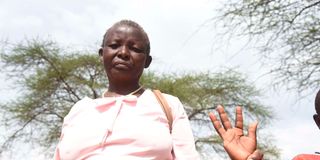
Dinah Cherutich of Siewa Village, Koibatek, shows where a snake bit her grandson in 2019, leading to the amputation of his finger.
In neighbouring Kapkole village, Richard Kimaru lost his two-year-old son in 2013. He recounted arriving home around 5.30pm after a long day’s work, only to find the child weak and crying faintly. His siblings, who had been caring for him, were unaware of what had happened.
“When I carried the child, I noticed blood oozing from his tongue. Minutes later, he breathed his last in my arms,” says Richard. A cobra had hidden inside a clothes basket, biting the child. Richard killed the snake and reported the case to the area chief and KWS, eventually receiving Sh200,000 in compensation.
Anne Kiptai of Koiserat village survived a snake bite in 2021 but lost a finger.
“I felt a sharp prick on my finger at around 1am and thought it was a cat. When I woke up, a snake was beside me and my finger was bleeding. I fainted and was rushed to Marigat Sub-County Hospital, then later to Baringo County Referral Hospital.” The treatment lasted over a month, leaving her with a permanent disability and limited ability to carry heavy objects.
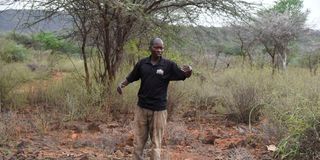
Richard Kimaru at his home in Kapkole Village, Koibatek Sub‑County. In 2013, a large snake bit his two‑year‑old child while they were asleep; the child later died. He was fortunate to receive Sh200,000 in compensation. He now places water containers around his compound for snakes to drink and return to the forest, just in case they come by.
Valentine Kiptoo, 18, was bitten in 2014 while sleeping with siblings. The bite deformed her finger, limiting her capacity to carry out daily chores.
Sylvia Korir, 21, was bitten as a one-year-old while sleeping with her twin sister. Her twin died, and she survived but with a deformed thumb that still hinders her ability to write or carry out household tasks.
These stories illustrate a frightening reality: in Mogotio, snake bites are not rare, and nearly every household has a victim. Locals report weekly incidents, especially during dry spells when snakes leave rocky hideouts in search of water.
Poor infrastructure and limited medical supplies compound the problem. Majimoto Health Centre lacks anti-venom, forcing victims to travel dozens of kilometres to Marigat, Kabarnet, or Nakuru. Locals rely on boda bodas, which are expensive and slow, especially during the rainy season.
Residents have resorted to unorthodox treatments, including the use of black stones believed to draw out venom.
Majimoto Sub-Location Senior Assistant Chief Kibet Kobetbet confirms the crisis. “Several deaths and permanent disabilities are linked to a lack of anti-venom and poor road access. Every homestead has at least one victim. Children are the most vulnerable.”
He identifies the worst-hit villages as Majimoto, Kopeper, Koiserat, Kaparpaya, Kapingo, Sesoche, Kapkole, and Shewa. Snakes sometimes prey on livestock, adding to residents’ fears.
The cost of treatment is high. The Kigens spent over Sh40,000 on medical care and transport. Valentine Kiptoo’s family spent Sh50,000, partially funded through local fundraisers. Many families cannot afford transport or anti-venom, worsening outcomes and increasing fatalities.
“The lack of local anti-venom, poor roads, and high transport costs leave families helpless. Children are often the victims, and some families lose everything in medical costs,” a resident says.
Baringo County Health Executive Committee Member Solomon Sirma says most facilities are now equipped with anti-venom. He highlights a partnership with the Kenya Primate
Research Institute to develop locally produced anti-venom from snakes captured in Baringo.
“This will be effective against the species most common in our lowland areas,” he says. The programme includes informed consent for using snakes and biological resources to create effective antidotes.
The World Health Organization estimates that 5.4 million people are bitten by snakes annually, with 2.7 million by venomous species. This results in over 100,000 deaths and life-long disability for 400,000 more.
For families in Mogotio, these statistics are a grim reality. Residents call for proper stocking of anti-venom in local health centres, better access roads for emergencies, and timely government compensation for snake bite victims.