Defiant love: A mother's journey through stage four breast cancer and pregnancy
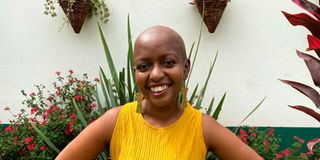
Mwende Mutiso, 32, who was diagnosed with stage four breast cancer in 2018 but got pregnant and delivered safely.

What you need to know:
- Mwende's journey with cancer began almost a decade ago. In December 2015, she felt a lump in her right breast.
- Over the next year, multiple doctors dismissed it as a "hormonal imbalance." It wasn't until July 2016 that a lumpectomy revealed pre-cancer.
In the soft afternoon light of her Nairobi home, Mwende Mutiso, 32, settles on the sofa with her baby. The scene is one of serene motherhood; nothing betrays the fact that Mwende is living with stage four breast cancer, or that she carried and delivered this healthy child against overwhelming medical advice.
The baby coos, lifting a hand in a gesture her mother interprets as a wave. "For now, it means come, hi, or bye," Mwende says with a smile. As the baby begins to teethe on her finger, Mwende gently replaces it with a silicone teether. "No, mama, use this." Soon after, her sister takes the infant for a nap, and Mwende begins her extraordinary story.
"In February last year, I started feeling lethargic and nauseous. Certain smells made me sick," she recalls. "It felt like I was going through chemotherapy all over again."
In her mind, she was just coming down with something; and the possibility of pregnancy didn't cross her mind.
Besides, after her stage four breast cancer diagnosis, her doctors had been clear: her chances of ever conceiving were slim to none. They had also warned that a pregnancy would be dangerous as her specific cancer—triple-positive breast cancer—is fueled by hormones. If she were to become pregnant, the rising estrogen levels would likely cause her cancer to grow as aggressively as her baby.
When her mother suggested a pregnancy test, Mwende dismissed the idea but took one anyway. "I saw two dark lines. I thought, 'these strips have expired!"
She bought tests from five different pharmacies. All were positive. "I just started laughing from the shock. I told my mum, and she also started laughing,” she adds.
Even with the positive tests, Mwende was in disbelief, convinced there must be some mistake. To be certain, she went to the hospital for an ultrasound.
The ultrasound confirmed the unbelievable: a seven-week-old "cashew nut" with a heartbeat. "Immediately I saw the scan and heard the heartbeat, I totally fell in love. I knew regardless of what the oncologist would say, I wanted that baby."
With the ultrasound results in hand, she returned to her oncologist. Mwende asked if she had ever treated another stage 4 patient who had become pregnant. The doctor's response was stark: she had one. That patient had passed away.
"The typical case," the doctor explained, "is a patient who is already pregnant and then receives the diagnosis. This situation is usually the other way around."
Mwende, who supports other cancer patients, remembered another woman diagnosed at six months pregnant. She called to check on her, only to learn she had passed on the previous month.
Mwende turned to her cancer support networks, asking relentlessly if anyone had known a stage 4 patient who had gone through a pregnancy. "The answer was always 'no,'" she says. "Those who had survived similar situations told me they were advised to terminate the pregnancy because the risks were simply too high."
Her doctor also recommended termination as she was still in her first trimester. The alternative was to begin chemotherapy after the first trimester. "I remembered how brutal chemotherapy is," Mwende explains. "I was already feeling lethargic, so the thought of navigating both pregnancy and chemo was overwhelming—how would I possibly manage?"
At the same time, she was tormented by doubt. "Was I making the right decision?" she wondered. "What if I can't take care of my baby? What if I die and leave them right after giving birth? All these questions and different scenarios were racing through my mind.”
Her doctor told her she had up to the end of first trimester to make a decision. She prayed for a clear sign. Then, she received one. A visible lump on her chest, which had been growing since a September 2023 scan began to resolve on its own before her first trimester ended. "I thought, I think this is that sign." Further, a chance encounter with a shop attendant who "prophesied" she would soon be making presentations with her five-year-old daughter sealed her resolve.
She informed her doctor she was keeping the baby.
A miraculous pregnancy
Her medical team, though concerned, supported her. An oncologist and gynaecologist worked together, monitoring her and the baby with tests and ultrasounds every three months.
Contrary to all expectations, Mwende thrived. "I've never felt healthier. The rest of my pregnancy was so smooth, with no complications." She refused chemotherapy, fearing it would affect the baby, and her doctors agreed to hold off unless her scans or blood work showed "red flags."
Defying predictions that her health would deteriorate, necessitating delivery at 32-34 weeks, Mwende carried the baby to term. Her blood work was better than before she was pregnant. On November 27, she went into labour. "It didn't take two hours," she remembers. "I delivered her naturally." Though a tear required surgery, her healthy daughter was born at 4:25am. She breastfed her for seven months, another personal victory.
A decade-long cancer battle
Mwende's journey with cancer began almost a decade ago. In December 2015, she felt a lump in her right breast. Over the next year, multiple doctors dismissed it as a
"hormonal imbalance." It wasn't until July 2016 that I had a minor surgery to remove the lump, a procedure called lumpectomy. The test results revealed that I had ductal carcinoma in situ (DCIS), an early form of breast cancer where the cancer cells were confined to the milk ducts and had not spread. I remember the news wasn't broken in the best way. The doctor told me blankly that I had breast cancer and that my breast would need to be removed, and then I would undergo radiotherapy."
Her family advised her to seek other opinions, and they all confirmed DCIS.
In September the same year, she underwent a mastectomy - a surgical operation to remove a breast. She started physiotherapy and did check-ups every three months.
The emotional toll was heavy. "In 2017, the reality of the surgery dawned on me, and I slipped into depression. "I was really in a dark place, and in 2018, I sought professional help and was put on antidepressants."
In December 2018, her worst fears were realised. A lump under her scar was initially dismissed, but a biopsy nine months later confirmed the cancer had returned, spreading to her lymph nodes and a lung—an automatic stage four diagnosis. The prognosis was a year. She endured oral chemotherapy and targeted therapy until her finances were depleted.
She halted her treatment but continued to be monitored with scans, tumour marker tests, and blood work every three months, and a full PET scan after nine months.
By mid-2021, a PET scan revealed a remarkable outcome: there was no evidence of cancer in her body.
However, in March 2022, she noticed swollen lymph nodes in her neck, prompting another PET scan. "The results showed a small, inactive nodule in my lung, and confirmed the lymph nodes were not cancerous," she shares. "So officially, there was no recurrence. But when I compared the new scan to my previous one, the images were different, which was unsettling."
In September 2023, the follow-up PET scan revealed a recurrence: several nodules had appeared along her airway, upper chest, and collarbone. Despite the findings, she was not experiencing any physical symptoms.
"The recurrence plunged me into depression," she recalls. "I started drinking heavily, was hardly eating, and my health deteriorated rapidly. My life was engulfed in darkness for many months."
In March this year, she noticed a small, barely visible bump on one side of her forehead. Despite its size, it was extremely painful. The pain came and went, and over time, the bump grew into a visible lump.
By June, the situation had escalated. She began experiencing debilitating headaches that forced her to stay in bed. "I paid for a PET scan, and the results were devastating," she shares. "The cancer had spread to underneath my skull, the surrounding tissues, my ovary, diaphragm, and lymph nodes."
Due to the frequent and severe migraines, she immediately began a course of full brain radiotherapy—a gruelling 10-day treatment, administered every day except weekends.
About two and a half weeks later, she began chemotherapy. After that, she will continue with targeted therapy. "The standard protocol is a treatment every three weeks," she explains. "However, research has shown that continuing chemotherapy for a year and a half leads to better outcomes. That's the plan we're working with, as I am still fundraising to cover the costs."
The side effects have been severe. She has lost her hair, a process that began during radiotherapy, and she battles constant fatigue. She also endures nausea, mild headaches, diarrhoea, dizziness, and itchy skin. Throughout this ordeal, her family has been a vital support system. "My family has been incredibly supportive, helping to raise my daughter as I continue to fundraise for my treatment," she says.
For Mwende, the path ahead remains difficult. Yet, as she watches her daughter play, the joy of her defiant choice is a powerful medicine in itself.
Doctor's perspective on Stage 4 cancer and pregnancy
Dr Joseph Abuodha, a consultant medical oncologist at Aga Khan University Hospital, explains why doctors strongly discourage pregnancy for stage four cancer patients.
"Stage four is a chronic disease requiring continuous treatment," he says. The primary risks are the effect of pregnancy on the cancer and vice versa. Cancer can cause pregnancy loss, and treatments can lead to foetal abnormalities, especially in the first trimester, when therapy is avoided.
While certain chemotherapies can be safely given in the late second and third trimesters, others like radiotherapy are avoided. Dr Abuodha emphasises that decision-making is shared with the patient.
Dr Abuodha explains that the decision to terminate or continue a pregnancy depends on the cancer's characteristics. If the cancer is aggressive or already progressive, the priority is often to continue chemotherapy or other essential treatments.
"However, for some patients diagnosed in their second or third trimester, certain types of chemotherapy can be safely administered without requiring a termination," he adds.
Whether the pregnancy can be carried to term ultimately depends on the mother's health not being severely compromised. "If a patient has reached the maximum safe dosage of chemotherapy before delivery, or is intolerant to it, and the baby is mature enough to survive outside the womb, we advocate for an early delivery," Dr Abuodha says. "This allows us to proceed with more aggressive treatment options for the mother."
Regarding delivery, the process can often proceed normally unless a specific medical indication necessitates a cesarean section. This is typically the case when cancer affects the reproductive system or adjacent areas—such as cervical, uterine, or vulval cancer, or a colon tumour in close proximity to the baby.
On the matter of breastfeeding, Dr Abuodha advises that mothers undergoing chemotherapy should not breastfeed as the drugs can be transmitted through breast milk.
"Some cancers can be indolent; they do not grow rapidly," he notes, allowing some women to defer treatment. However, he adds, "We usually advocate for an early delivery to shorten the time without treatment."
He concludes: "People can still have healthy children when they are pregnant with stage four cancer." But it requires intense, frequent monitoring—sometimes as often as every two weeks.