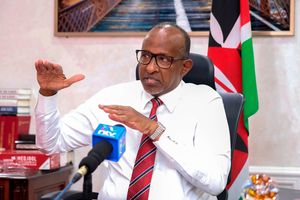
Doctors billing SHA for drugs they never gave patients, Duale says
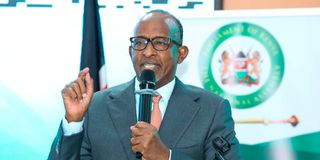
Health CS Aden Duale makes his remarks when he appeared before MPs during day-two of the 2026 Legislative Retreat for Members of the National Assembly, at Lake Naivasha Resort in Naivasha, Nakuru County, on January 28, 2026.


The Social Health Authority (SHA) has introduced an SMS verification system to protect patients and prevent fraud within the healthcare sector. The new system has identified cases where doctors have billed SHA for drugs that were never dispensed.
Speaking exclusively to Nation.Africa, Health Cabinet Secretary Aden Duale revealed that under the new system, every Kenyan will receive an SMS immediately after visiting a facility, asking them to confirm the services they received and whether they paid for them.
"Kenyans will be asked whether they received all the services they were entitled to. If they say no, the hospital will not be reimbursed. This will make Kenyans aware of their entitlements, and if they did not receive the services, they have the right to return and ask why, or even complain to the authorities," Health Cabinet Secretary Aden Duale told the Daily Nation in an exclusive interview on Monday.
"Thousands of Kenyans visit facilities but end up paying for services that should be free, while others are sent to buy medicine that should be dispensed by the facility at no cost," he added.
Doctors billing for undispensed drugs
Mr Duale said the system had identified cases where doctors treated patients, sent them out to buy drugs, and then billed SHA for medicines that were never dispensed.
"At the Afya Yangu portal, the system asks doctors whether they are dispensing medicine. If the response is positive, the patient should receive medicine. However, in most cases, patients leave without drugs, yet SHA is still billed for them," he said.
"We have the names, telephone numbers, constituencies, and counties of these patients. We can track them and confirm whether they received the services claimed by the respective hospitals."
The CS cited Kakamega County General Teaching and Referral Hospital, where records showed that about 52,000 patients were seen last month, but only 9,000 received medicine. In Bomet, he said, about 34,000 patients passed through public hospitals last month, yet only 4,600 received medicine.
"This is why the chemist business around hospitals is booming. Either the drugs are being stolen or there is collusion between hospital staff and pharmacy owners. Most patients are being told to buy drugs outside, forcing families to bear additional out-of-pocket costs despite their SHA contributions," Mr Duale said.
"We will not reimburse hospitals that do not give Kenyans medicine. They will only be paid if they dispense the drugs."
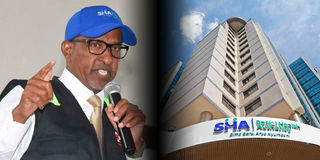
Health Cabinet Secretary Aden Duale (left) and the SHA Headquarters in Upper Hill, Nairobi. The authority lost Sh11 billion in six months.
Free services charter
For primary health care, which is fully funded by the government, the ministry is placing green charters in all facilities with bold text reading "Walk in — walk out", indicating that services are free.
"Should a patient be asked to pay, they will be required to report the facility to SHA. We have been remitting money to hospitals on time, and there is no reason they should not provide services to patients as required," the CS said.
Level 2 and Level 3 hospitals had earlier complained that they had not received payment for primary health care from SHA, forcing many facilities to suspend essential services. The delays, coupled with widespread rejection of previously submitted claims, pushed many private health care providers to the brink of collapse, with several grappling with severe cash flow crises.
However, Mr Duale insisted that legitimate claims are paid on time.
"Every 14th day of each month, we pay claims. Those that have not been paid either have a missing document or something was not done correctly, and the system flags it. Hospitals should stop claiming they do not know why their claims have not been paid. The system automatically informs them," he said.
Sh19 billion request
To clear pending bills and improve provision of primary health care, Mr Duale has asked the National Assembly to approve at least Sh19 billion for health.
Speaking during the fourth National Assembly retreat in Naivasha yesterday, the CS said the ministry urgently requires Sh5.9 billion for the Primary Health Care Fund. To cover the projected deficit in primary health care services running up to June 2025, he urged lawmakers to approve Sh11.9 billion in the Supplementary Budget.
Mr Duale also requested Sh2 billion for the maternity package, which he said is aimed at safeguarding the lives of mothers and new-borns.
"We require the support of this House to provide quality care to Kenyans, and I want to assure you that no taxpayer's money will be lost under my watch," he told lawmakers.
"The state of our health care is transforming. We have moved from a deficit-ridden NHIF to a surplus-generating SHA. We have moved from paper files to a digital superhighway."
29 million registered
As of January 26, 2026, 29 million Kenyans have been registered with SHA, and Sh130.4 billion has been collected, the CS told lawmakers.
Mr Duale admitted that initial weaknesses in the SHA system led to the loss of Sh11 billion in the first six months.
Responding to a question from Kitui Rural MP David Mboni, who asked whether taxpayers had indeed lost Sh11 billion through fake claims as reported by the Daily Nation, the CS said: "This Sh11 billion was stolen when the system was still young. People exploited it, not knowing it would be audited later. At that time, claims stood at Sh10 billion while collections were Sh5 billion. As of last night, claims were below Sh5 billion."
The CS assured lawmakers that the current SHA digital system tracks every shilling from the moment a contribution is made to its utilisation.
"Let me be clear: Kenyan money will not be stolen. The digital system we have built is a fortress. It allows us to track every shilling from the moment it is contributed to the moment it pays for a pill or a procedure. If you attempt to steal from the sick, the system will catch you, and the government will prosecute you," Mr Duale said.
Follow our WhatsApp channel for breaking news updates and more stories like this.