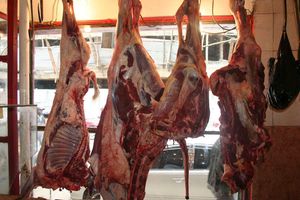
Donkeys rescued and rehomed amid thriving theft and illegal slaughter
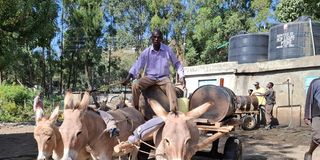
Michael Muriuki guides his donkeys in Bahati sub-county, Nakuru, in January 2026. A former mathematics teacher, Muriuki is among thousands of Kenyans whose livelihoods rely on donkeys; animals increasingly targeted by criminals for the illegal bushmeat and hide trade.

What you need to know:
- Kajiado remains the most notorious hotspot, with trafficking routes running from Namanga to Shampole along the Tanzanian border.
- Other affected counties include Kiambu and Nyandarua, while cases in Narok and Nakuru are declining as intervention measures take effect.
At 9am on a Saturday, Michael Muriuki has already lost count of the number of trips he has made to the community water point. Around him, villagers bustle through their morning chores, but he is focused on the orders ahead: delivering water to households across five villages.
His two donkeys wait patiently, harnessed to a cart carrying two 210-litre steel drums and two 20-litre jerrycans.
Each trip earns him around Sh2,100.
Muriuki, 46, is a former Mathematics and Social Studies teacher at a private school. He grew up around donkeys; the main mode of transport in his home area of Maili Saba, Nakuru County, and while still teaching, he began supplying water on the side. The business grew steadily. In 2010, he left formal employment for good.
“I saw that working with donkeys was better than teaching. After two years of observing, I was convinced. I also loved the freedom it gave me compared to a white-collar job.”
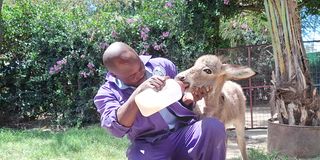
KSPCA field officer Josphat Machingi bottle-feeds a two-week-old foal in Naivasha, December 2025. The foal was rescued after its parents were killed for the illegal meat trade. Over the years, the center has become a sanctuary for stolen donkeys intercepted by police, providing rehabilitation before they are rehomed.
At the time, his monthly teaching salary was Sh10,000; money he says he could now make in under a week.
By 2023, he had built his herd to four donkeys. But in April of that year, he lost three of them to criminals who stole, slaughtered, and sold the meat and hides in the local market.
The loss was devastating. Without his donkeys, Muriuki returned to menial jobs and short-term teaching gigs to survive.
“I struggled to care for my wife, who had just given birth. My savings were gone. I had no money to buy another donkey,” he says.
In 2025, with the help of Farming Systems Kenya (FSK), he received two donkeys and later bought two more from savings, with one costing about Sh15,000.
“I restarted my water business, and I can now provide for my family. I am using the proceeds to finish building our house.”
Before connecting with FSK, he had not seriously considered animal cruelty. The organisation taught him that tethering donkeys by the roadside, failing to provide water and pasture, and overworking them was harmful.
“Now, I set them free from 1pm to roam. In the evenings, I feed them maize germ to restore energy, and they sleep in a shelter I built.”
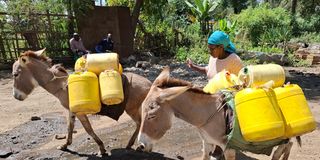
Mary Nashipae leads her donkeys through Bahati. After fleeing the 2007/08 post-election violence in Kericho, the mother of five bought her first donkey to help resettle her family. Today, she is a veteran water vendor of over a decade, using the trade to support her children and ailing husband.
Each month, he arranges for veterinary officers to visit and check on the animals. Other donkey owners in the area have since adopted the practice.
Kenya is home to one of East Africa’s largest donkey populations. The animals are widely used for water provision, agriculture, and transporting people and goods.
Mary Leposo, a water vendor in Nakuru, has relied on them for over a decade. She started with one donkey and acquired two more in 2025. For the mother of five, the business has been a lifeline, especially after fleeing Kericho during the 2007/2008 post-election violence.
“I am now the sole breadwinner, caring for my ailing husband,” she says. “The money covers his medical needs, my children’s education, food, and even building our home.”
Business peaks during drought, she notes, and in December, she earns extra by transporting harvested crops for farmers. Her day begins at 6 am, making three to four trips delivering water. She charges Sh20 per 20-litre jerrycan.
Luckily, she has never lost a donkey to theft. “I built their shed next to my house. No one can enter the compound without us noticing,” she says.
With support from stakeholders, she has upgraded the shelter, secured veterinary care, and improved how she feeds her animals.
James Kamau has worked with donkeys for three years, using them to transport water and goods.
“Donkeys raised my children to adulthood. I would not trade this business for any other job. They have been a blessing.”
Borehole water
Each trip takes him two to three kilometres to villages that rely on borehole water. With an average of eight trips a day at Sh300 per trip, he can earn up to Sh2,400 on a good day.
However, he faced a major setback in 2024 when thieves stole four of his donkeys, leaving him with only three and cutting his daily earnings in half.
“I struggled to make up for the lost income. But we are back to normal now. I have rebuilt my herd to six donkeys.”
The trio is part of the 20-member Kagoto Donkey Owners Self-Help Group, which received 38 donkeys and successfully re-homed them with support from FSK.
Paul Muiruri, the group’s chairperson, says donkey theft for illegal slaughter is a major challenge the government must address.
“FSK, working with government agencies, has recovered some of the animals, rehabilitated them, and found them new homes. Most stolen donkeys are slaughtered in the bush, with the meat and hides sold in local markets,” he explains.
Last year, 50 donkeys were recovered in Narok Central after suspects fled when police approached. More recently, police seized seven donkeys headed for slaughter in Narok North. In both cases, the animals were taken to KSPCA in Naivasha for rehabilitation before being rehomed.
At the centre, KSPCA field officer Josphat Machingi bottle-feeds a two-week-old foal whose parents were slaughtered for bush meat. Their hides, he says, were sold to dealers.
The foal is one of only six donkeys currently at the facility — the remnants of a larger group, with the rest successfully rehomed to families who depend on them.
Machingi says rescue operations happen day or night. Police often intercept stolen animals and call KSPCA to take them into custody.
Upon arrival at the centre, the donkeys go through a structured process. First, they are unloaded into the yard and given water, essential after the stress of transit, followed by food.
They are then sorted by condition. Most arrive in poor health due to mistreatment by previous owners.
“The most exhausted are placed in stables, the healthier ones remain in the yard, and the sick are moved to an isolated bay,” says Machingi. “Depending on the time of rescue, veterinary officers are called in to assess and treat them.”
As part of anti-theft measures, each donkey is fitted with a microchip carrying a unique identification number to help track ownership.
KSPCA has been rescuing donkeys for years, including those abandoned, overloaded, or bearing multiple wounds.
Rescued donkeys remain at the facility while FSK and KSPCA scout for new owners through a rehoming process. But the animals are not given out randomly.
“We assess whether the person is capable of caring for them and how they will be used. Even with a large herd, we don’t hand them over without thorough vetting. They are rehomed in groups,” Machingi explains.
The crisis peaked in 2019, when Brooke East Africa declared donkey slaughter an emergency after research warned that Kenya’s donkey population could be wiped out within years if no action was taken. At the time, up to 1,000 donkeys were being slaughtered daily.
Then, Kenya was among countries in East Africa with the largest donkey population at approximately 1.8 million. However, new data by the Kenya National Bureau of Statistics shows that the number has dropped to less than 500,000 as of 2024.
Difficulties in breeding have worsened the depletion of local herds. Serious welfare, health, and safety violations are also linked to the trade, transport, and slaughter of donkeys for meat and skins.
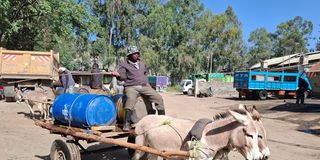
James Kamau guides his donkeys through Bahati sub-county, Nakuru, in January 2026. After losing half his herd to thieves in 2024, Kamau has since rebuilt his livestock, stabilizing the water-vending business that supports his family.
There are growing concerns that the loss of donkeys may disproportionately affect some of the poorest communities, especially those in rural areas.
A 2019 report by the Kenya Agricultural and Livestock Research Organization in collaboration with Brooke East Africa, quantified the economic toll on communities that depend on donkeys.
The study, a cross-sectional survey across seven counties: Turkana, Nakuru, Machakos, Baringo, Narok, Kajiado, and Kirinyaga, found that donkeys were a vital source of livelihoods, generating a mean monthly income of Sh11,390 per household.
However, families whose donkeys were stolen and slaughtered lost that income entirely, pushing them into economic hardship.
The report calculated that if 25 per cent of the slaughtered donkeys, equivalent to 75,494 animals, had been working animals, they would have generated a mean monthly income of Sh11,390 each. The total income foregone during the reference period (April 2016 to December 2019) was therefore valued at Sh28.3 billion.
In contrast, the gross revenue from exporting donkey meat and skins during the same period totalled just Sh1.82 billion; meaning the income lost by donkey owners was 15 times greater than the earnings from the export trade.
In February 2020, the government banned donkey slaughter in Kenya. Three slaughterhouses, licensed since April 2016 and processing around 400 donkeys a day, were shut down for fuelling theft.
But the ban has not stopped the theft, illegal slaughter, or trade in donkeys and their products.
FSK Executive Director Kenneth Wamuga notes that four years after the ban, the organisation and law enforcement had intercepted 722 donkeys. By mid-2025, 101 animals had been recovered and 623 successfully rehabilitated and rehomed; an 86 per cent decline, attributed to increased community vigilance and multi-agency efforts.
In addition, 110 donkey carcasses, hides, and skins were intercepted while being transported to Nairobi and Limuru in Kiambu County.
Wamuga notes that Kajiado remains the most notorious hotspot, with trafficking routes running from Namanga to Shampole along the Tanzanian border. Other affected counties include Kiambu and Nyandarua, while cases in Narok and Nakuru are declining as intervention measures take effect.
Despite progress, several challenges persist: collusion and corruption among compromised law enforcement officers, insufficient intelligence, and evasive tactics by culprits. Outdated laws, Wamuga adds, continue to fail in deterring the criminals involved.