Duale: None of Sh1.9bn US Ebola support passed through Health ministry

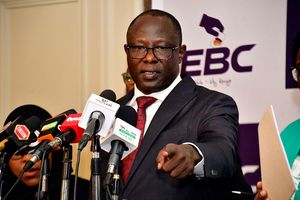
Health CS Aden Duale at a past event. He has disclosed that the US Ebola preparedness funds were allocated directly to partners for surveillance, clinical preparedness, emergency operations and logistics, not through the Ministry of Health.

What you need to know:
- According to Duale, US$3.77 million (Sh488 million) of the funding has gone toward surveillance and response, while US$6.5 million (Sh841.7 million) has been allocated to clinical preparedness, including infection prevention and control and personal protective equipment.
- A further US$2.65 million (Sh343.33 million) has gone to emergency operations, and US$2 million (Sh258.9 million) to supply chains and logistics.
Health Cabinet Secretary Aden Duale has said none of the US$14.52 million (about Sh1.9 billion) in Ebola preparedness support extended to Kenya by the United States government has been transferred to, received by, or administered by the Ministry of Health or the Kenya National Public Health Institute (KNPHI).
CS Duale said the funds have instead been allocated directly to implementing partners supporting surveillance and response, clinical preparedness, emergency operations, and supply-chain and logistics interventions. He said the ministry and KNPHI retain policy direction, technical leadership and coordination roles to ensure partner-led interventions align with the country’s national preparedness priorities.
“The United States Government has extended Ebola support to Kenya amounting to US$14.52 million. These funds have been allocated directly to identified implementing partners to support surveillance and response, clinical preparedness, emergency operations, and supply-chain and logistics interventions. None of these funds has been transferred to, received by, or administered by the Ministry of Health or the Kenya National Public Health Institute,” CS Duale told the Nation.
“The Ministry and KNPHI provide the necessary policy direction, technical leadership, and coordination to ensure that partner-supported interventions are aligned with Kenya’s national preparedness and response priorities,” he added.
According to Duale, US$3.77 million (Sh488 million) of the funding has gone toward surveillance and response, while US$6.5 million (Sh841.7 million) has been allocated to clinical preparedness, including infection prevention and control and personal protective equipment. A further US$2.65 million (Sh343.33 million) has gone to emergency operations, and US$2 million (Sh258.9 million) to supply chains and logistics.
Separately, the World Bank has approved Sh3,326,272 for the Ebola response through its Health Emergencies Preparedness, Response and Resilience project, which the National Treasury has yet to release, Duale said. That component is being implemented through KNPHI and coordinated by the State Department for Medical Services.
The disclosure comes as Kenya moves to secure broader emergency financing from the World Bank. The country is expected to receive about Sh51.8 billion (roughly US$400 million) through the lender’s Rapid Response Option within six weeks, according to a source cited by Reuters. The funds are intended to address risks from El Niño, the regional Ebola outbreak and high energy prices.
A World Bank spokesperson said the lender is supporting Kenya to finalise a framework allowing it to access rapid financing when an eligible crisis occurs, including risks tied to the conflict in the Middle East and El Niño. Kenya applied for the financing after the Iran war, which began in February, pushed crude oil prices sharply higher; the source said the risks the country faces have since broadened beyond energy costs alone.
Kenya’s World Bank project portfolio exceeds US$7 billion (Sh905.8 billion), with about US$3 billion (Sh388.35 billion) already disbursed or committed. Under the emergency financing framework, countries can typically access up to 10 percent of their undisbursed lending portfolio, which would give Kenya access to roughly Sh51.8 billion, though the final figure depends on the undisbursed balance once the framework is complete. Kenya and the World Bank are finalising a Contingency Emergency Response Project to set out the financing terms; the World Bank Board has already cleared the underlying projects.
In July, the US Embassy in Nairobi separately announced $14.5 million (about Sh1.9 billion) in support for Kenya’s Ebola preparedness across 22 high-risk counties. The funding is supporting training for laboratory professionals, deployment of disease detectives, rapid response team training, operation of Kemri Ebola-testing laboratories, mobile diagnostic laboratories, and the activation of county and national emergency operations centres.
“As a major transportation, trade and travel hub linking East and Central Africa, Kenya plays an important role in regional infectious disease preparedness and control,” the embassy said, adding that strengthened preparedness would protect the health and economic wellbeing of Kenyans and reduce the risk of cross-border spread.
Kenya has yet to record a confirmed Ebola case despite ongoing outbreaks of the Bundibugyo strain in the Democratic Republic of Congo and Uganda. Surveillance has been heightened at points of entry, with four laboratories designated for testing: the National Public Health Laboratory, Kemri Nairobi, Kemri Kisumu, and a mobile laboratory serving Busia and Bungoma.
As of the latest situation report from the Ministry of Health and the Kenya National Public Health Institute, a total of 132 samples have been tested for Ebola across the country, with three samples undergoing testing in the past 24 hours, all returning negative results. Since surveillance efforts intensified, more than 228,533 travellers have been screened at various points of entry, with over 5,000 travellers screened in just the past day.
The Kenyan authorities describe their current measures as precautionary, a routine preparedness strategy rather than a direct response to any immediate threat. The proactive approach aims to enhance the country’s defences against potential incursions of the virus.
On the health frontline, as part of the preparedness strategy, 3,161 healthcare workers have been educated and trained to recognise the signs of Ebola, as well as methods for infection prevention and control. Meanwhile, the national health system has identified 414 beds as surge capacity, with 62 beds specifically designated for Ebola management.
To facilitate rapid response, five laboratories equipped for testing and confirmation of the virus are strategically positioned throughout the country.
Unlike the more commonly encountered Zaire strain of Ebola, which has caused significant outbreaks across West and Central Africa, the Bundibugyo strain does not currently have a licensed vaccine or approved treatment options. The existing Ervebo vaccine and monoclonal antibody therapies, Inmazeb and Ebanga, were specifically developed for the Zaire strain, rendering them ineffective against Bundibugyo. This lack of preventive measures places additional emphasis on early detection and isolation as vital components of Kenya’s defence strategy.
The absence of a licensed therapeutic intervention means that case management is limited to supportive care, focusing on rehydration, pain and nausea management, and maintaining electrolyte balance. Healthcare providers are continually exploring alternative treatment options, including investigational drugs such as remdesivir, which is manufactured in Egypt. The KNPHI is actively seeking emergency access to these treatments through the Africa Centres for Disease Control and Prevention.
A recent laboratory preparedness assessment, conducted by the KNPHI in September 2025, revealed disparities in readiness levels across 13 counties identified as being at very high or high risk for viral haemorrhagic fevers. While some areas are better prepared than others, the assessment highlighted critical gaps such as insufficient stockpiles of personal protective equipment and uneven workforce training. Laboratories reported challenges in specimen referral mapping and limited participation in external quality assurance programmes.
According to the World Health Organization (WHO), the ongoing Ebola outbreak in the Democratic Republic of the Congo has escalated into the second-largest Ebola epidemic on record. Driven by the rare Bundibugyo virus strain, the crisis prompted the WHO Director-General to declare it a Public Health Emergency of International Concern on May 17, 2026. By September 2026, the WHO documented 6,757 confirmed cases and 3,267 deaths, reflecting a severe crude case fatality ratio of 48.3 per cent.
The virus has aggressively spread across 61 health zones spanning six provinces: Bas-Uélé, Haut-Uélé, Ituri, North Kivu, South Kivu and Tshopo, with Ituri remaining the heavily impacted epicentre. While local authorities report that infection peaks may finally be levelling off in specific hotspots, the WHO continues to warn that delayed or hidden case detection within households and local communities poses a persistent risk to containment efforts.