Ebola epidemic disease: What the tough new rules mean for Kenyans
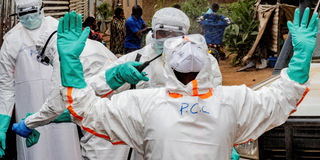
Members of the Civil Protection, a local community-based team that works to help mitigate the spread of the Ebola virus and ensure burials happen safely and quickly, wearing personal protective equipment (PPE), disinfect after handling the body of an unidentified man, who according to his family, died of Ebola after retrieving it from his house, as aid agencies intensify efforts to contain a new Ebola outbreak involving the Bundibugyo strain, in Bunia, Ituri province, Democratic Republic of Congo, July 10, 2026.

Hide a suspected Ebola case, lie on a health form or help someone leave quarantine, and you could now be fined up to Sh50,000 or jailed for up to six months.
The penalty is part of new rules that give the government clear legal powers to screen travellers, isolate patients and control burials as it tries to stop Ebola spreading in Kenya.
Health Cabinet Secretary Aden Duale signed two legal notices on October 12, 2026. They were published in a special issue of the Kenya Gazette, Legislative Supplement No. 132. They follow Kenya's first imported Ebola case, in a Kenyan who had been living in the Democratic Republic of Congo.
Legal Notice No. 203 declares Ebola (Bundibugyo virus) a "formidable epidemic disease" under section 35 of the Public Health Act.
Legal Notice No. 204, the Public Health (Ebola Disease) Rules, 2026, is made under section 36 of the same Act. It spells out what officials can and must do. It has five parts, covering points of entry, notification and disease control, burial, and general provisions.
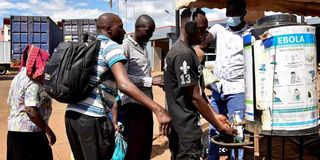
Travellers sanitize their hands before entering at the Kenya immigration services to access port health services at the Busia One Stop Border Post October 8, 2026.
The rules say their aims include preventing and controlling spread through surveillance and contact tracing, detecting and reporting cases quickly, and providing safe care. They also promise safe and dignified handling of the dead.
Measures, they say, must be proportionate to the risk and respect human dignity and fundamental rights and freedoms.
The rules define Ebola disease as an illness caused by any virus in the genus Orthoebolavirus. That includes Ebola virus, Sudan virus, Bundibugyo virus and Taï Forest virus. So they cover more than the strain named in the declaration.
The Cabinet Secretary is responsible for communication on policy. The Director-General for Health gives technical guidance.
The Kenya National Public Health Institute (KNPHI) becomes the lead national technical body. It coordinates surveillance, early warning, laboratory diagnosis, case investigation, contact tracing, infection control, risk communication and surveillance at points of entry.
It works with other ministries, county governments and development partners, and can activate a national Incident Management System.
From the guidelines,everyone entering or leaving Kenya must be screened and fill in a health declaration. It asks for contact details, travel history and any symptoms or possible exposure. Answers must be true and accurate.
“A traveller who refuses can be referred to an immigration officer. Where there is a public health risk, the port health officer can instead arrange separation, medical assessment, and isolation or quarantine. A Kenyan citizen cannot be refused entry.” Duale notice said.
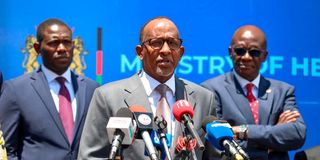
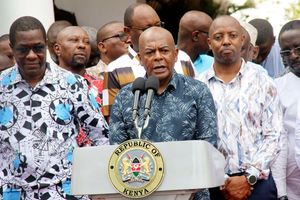
Cabinet Secretary for Health Aden Duale, accompanied by other government officials, addresses journalists during a press briefing at Afya House in Nairobi on October 6, 2026, after Kenya confirmed its first case of the Ebola virus.
If screening raises reasonable suspicion of Ebola, the officer must arrange separation, assessment and any testing. Suspected cases waiting for referral must be kept apart from other travellers and contacts.
A contact found at a border post is quarantined at a designated facility and monitored for 21 days from the last relevant exposure. Someone who tests negative twice under the protocols may be released early. If the contact was in transit, the officer must tell the medical officer of health at their destination.
Officers cannot impose quarantine or travel limits simply because someone arrived from an Ebola-affected country. They must first assess the person's exposure.
It also states thatoperators of international conveyances must tell a port health officer about a suspected case or possible Ebola death on board, and keep passenger and crew records for contact tracing.
“Officers can inspect a conveyance, order decontamination, or restrict its use by written direction, which must end once the grounds no longer exist.”
Anyone who knows of, or reasonably suspects, an Ebola case or death must report it at once. The report goes to a medical officer of health, the nearest health facility or a national government administrative officer. It can be oral, electronic or written.
According to the notice, the person reporting does not have to take the patient anywhere. Heads of schools, workplaces and residential institutions must report suspected illness or death among people in their care, and health workers must notify the medical officer of health immediately.
“Only the national reference laboratory and laboratories designated by the Cabinet Secretary may test for Ebola. Any other laboratory that receives a sample from a suspected case must send it on. Every result goes to the KNPHI Director-General.
On who traces contacts, the notices give the authority to any medical officer of health to investigate each notification and trace contacts. Trained community health personnel can help, but they have no power to order compulsory examination, isolation or quarantine.
“The medical officer can order isolation of a suspected or confirmed case, and quarantine or movement limits for a contact after assessing the exposure. Every order must state the grounds, requirements, place, duration and arrangements for review. An urgent oral order must be confirmed in writing as soon as practicable,” It states.
Contacts are quarantined for 21 days and checked daily. Anyone who develops symptoms is moved to isolation and treated as a suspected case. Cases and contacts must be kept apart.
People held under compulsion must get appropriate care, food, water and essential help. The order must be reviewed, and ended when its grounds change.
The government pays if the facility is a government one. If it is private, the person pays, unless a medical officer of health directed the placement in writing.
The Cabinet Secretary must designate facilities by Gazette notice, with county governments. “Designating a private facility does not by itself entitle it to government payment.”
The rules set strict steps for those who die of suspected or confirmed Ebola. Only trained people in protective equipment may handle the body.
“It must go into a sealed, leak-resistant body bag marked with an identification reference. It must not be washed or embalmed, or undressed and redressed for a funeral. Burial must happen without undue delay, at a suitable and lawful site. The medical officer must consult the next of kin and allow family participation and religious or cultural observances that fit infection control.” It states.

Gravesite of Kenya’s first Ebola patient, who travelled from the Democratic Republic of Congo through Uganda before arriving at Jomo Kenyatta International Airport in Nairobi.
The grave must be identifiable, and its location told to the family.
Duale stated that a body of someone who has died of Ebola cannot be taken or repatriated outside Kenya.
“A medical officer of health can ask the police to help enforce an isolation or quarantine order. Anyone who leaves against a lawful order can be returned, but only under lawful authority and with medical supervision.”
It states that: “It is an offence, without reasonable excuse, to fail to comply with a lawful requirement for screening, notification, investigation, contact follow-up, isolation, quarantine, decontamination or safe burial. It is also an offence to knowingly give false or misleading information, or to knowingly help someone leave or try to leave isolation or quarantine.
The penalty is a fine of up to Sh50,000, up to six months in prison, or both.
The Cabinet Secretary must review the rules, and any restrictions under them, at least every three months. He must vary or withdraw any restriction that the assessed risk no longer justifies. The rules lapse 12 months after they start, unless revoked earlier.
The move follows declarations earlier this year by the World Health Organization and Africa CDC. In May, the WHO declared the Bundibugyo outbreak a Public Health Emergency of International Concern. Dr Tedros Adhanom Ghebreyesus said it met the criteria for that status but not for a pandemic emergency.
Africa CDC then declared it a Public Health Emergency of Continental Security. The WHO and Africa CDC launched a joint continental plan to raise US$518 million (about Sh67 billion) for surveillance, diagnostics, infection control, safe burials, community engagement and clinical care.
Follow our WhatsApp channel for breaking news updates and more stories like this.