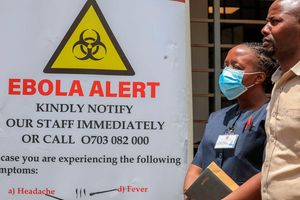
Ebola facts and myths: Can airport biometric scanners spread the virus?
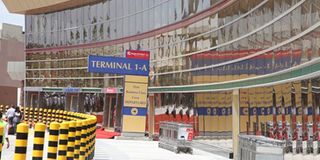
Terminal 1A at Jomo Kenyatta International Airport (JKIA).

Every day, thousands of international travellers press their fingers on unsterilised biometric scanners at airport immigration desks and leave pathogens behind.
While border teams screen for fevers, touch-based scanners remain a dangerous and overlooked way of spreading infection from one traveller to the next.
Ebola spreads through direct contact with infected bodily fluids. If a passenger wipes sweat or coughs into their hand and then presses the glass plate, every traveller who follows could be at immediate risk.
Failing to sanitise these high-touch devices works against public health efforts. It turns border checkpoints into infection risk hubs.
Nation spoke to three travellers who recently returned through the Jomo Kenyatta International Airport (JKIA). They had to sterilise the machines and their hands before placing their fingers on the scanner glass.
Marcus Vance, 42, who flew in from John F Kennedy International Airport, said: "When you land after an eleven-hour flight, everyone is exhausted, wiped out, and wiping their faces. You get shoved into an endless queue where hundreds of people are funnelling toward the machines."
Mr Vance watched the process closely while standing in line. Traveller after traveller walked up to the immigration control gate, pressed four fingers firmly onto the illuminated glass, waited for the green light and moved through. Not once did an agent wipe down the screen. Not once was an automated UV steriliser used.
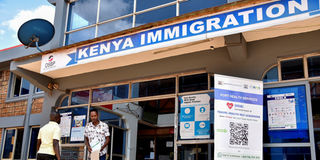
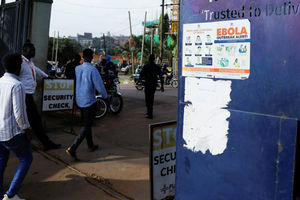
Travellers walk at the Kenya immigration services to access port health services at the Busia One Stop Border Post, a crossing point between Kenya and Uganda. A man who had been living in the Democratic Republic of Congo travelled and died of a new Ebola outbreak involving the Bundibugyo species at the Nairobi Hospital on October 8, 2026.
"I watched a man two spots ahead of me visibly sweating, coughing repeatedly into his palm, and then slamming his hand down on the reader," Mr Vance recalls.
"When it was my turn, the glass looked smudged with oily residue. I pulled out an alcohol wipe from my carry-on and thoroughly scrubbed the scanner window before placing my hand down."
The response from border staff was immediate and sceptical.
"The officer looked at me like I was causing a scene or delaying the line," he explains. "He actually told me, 'Sir, you're slowing down the line, just place your fingers.' But I told him straight: until there's a protocol to sanitise these between passengers, I'm cleaning it myself. It takes five seconds to wipe glass, but weeks to clear an outbreak. It makes zero sense that we take off our shoes for security, but cannot wipe the machines."
Another traveller, Nicholas Okumu, questioned the way border control screens for illness.
"Border control spends millions on thermal cameras and health questionnaires, yet thermal cameras only catch symptomatic individuals who already have a fever. What about asymptomatic carriers, or individuals in the early incubation phase who are sweating or showing mild discomfort? They walk right past the thermal camera and press their fingers onto the reader."
He added: "You could literally see layered fingerprints, skin oils, and moisture build-up on the surface. That is a textbook fomite, an inanimate object capable of carrying infectious organisms from one host to another."
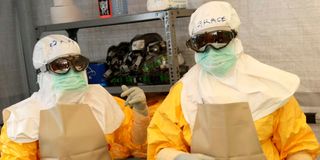
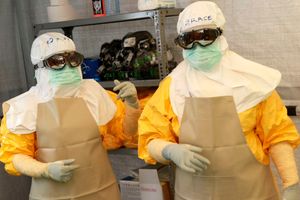
Health workers at an Ebola isolation facility.
Mr Okumu did not have a sanitiser, so he placed his hands on the scanner and went straight to the washroom to wash them.
For Elena Rostova, an independent documentary journalist, the decision to sanitise immigration scanners came after she witnessed a health scare on a previous assignment covering humanitarian logistics.
"People assume airports are hyper-sterile environments because they look clean and modern," she told Nation. "In reality, thousands of people from dozens of continents touch the same six square centimetres of glass every single hour."
During her recent clearance, Ms Rostova watched the queue move fast. Border guards rushed passengers forward, prompting them to scan their passports and place their right hand on the biometric pad.
"When I stepped up, I reached into my bag for my travel sanitising spray and a tissue," she recalled. "The agent paused and said, 'You don't need to do that, miss.' I told him that I'd rather take ten seconds to clean the glass than risk picking up whatever the last 50 people left behind."
She added: "We have seen how fast international travel can spread a pathogen around the world. We have contactless payment, touchless doors, and automated passport readers. Why are we still forcing millions of people to press their bare skin onto contaminated glass plates without a mandatory wipe-down protocol in place? It's an unnecessary vulnerability in our global health defence."
Prof Shem Otoi, an infectious disease modelling expert, said: "As global passenger volumes continue to recover and expand, the reliance on physical contact biometrics poses a persistent risk. Until border agencies implement mandatory automated UV disinfection, provide touchless biometric alternatives, or integrate routine sanitisation protocols between passengers, the responsibility for breaking the chain of transmission will continue to fall on individual travellers armed with alcohol wipes at the immigration desk."
Ebola is not transmissible through the air or water, but a person with symptoms can pass on the virus through fluids such as sweat. This could pose a slight infection risk at ports of entry, where hundreds of visitors are required to place their hands on the machines.
According to the World Health Organisation (WHO), Ebola passes between people through close, direct contact with infected bodily fluids. Blood, faeces and vomit are the most infectious.
It can also pass indirectly through previously contaminated surfaces and objects. The WHO adds that the risk from contaminated objects is low and can be reduced further by cleaning and disinfection.
Follow ourWhatsApp channel for breaking news updates and more stories like this.