Ebola next door: No screening at Busia border despite State order
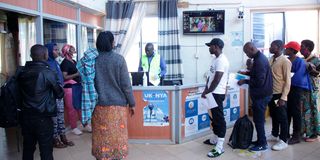
Passengers arriving in Kenya from Uganda at the Busia Border on September 21, 2022.

At the Busia border crossing, one of the busiest entry points between Kenya and Uganda, people are moving in and out, as they do every day. On foot, on boda bodas, carrying goods. The traffic is constant and familiar. No screening ongoing.
This is despite an advisory issued four days ago for counties to begin immediate screening of individuals entering and exiting the country.
A spot check at the border on Monday revealed that screening has not yet begun for pedestrians crossing from Uganda into Kenya. People on foot pass through without being stopped, questioned or checked for symptoms of a disease that has now killed 88 people in the Democratic Republic of Congo and reached Uganda's capital, Kampala, where two laboratory-confirmed cases have been recorded in the past week.
Officials at the border office said that passengers arriving by bus would undergo screening at the public health office before proceeding with their journeys. For everyone else crossing on foot, that process has not yet started.
It is a gap that sits uncomfortably against the urgency of the government's own directive.
On May 16, the Ministry of Health issued a national advisory commanding all 47 county governments to immediately intensify screening and surveillance at all points of entry, specifically listing airports, airstrips, seaports, land border crossings and transit points. Busia is a land border crossing. The directive was issued four days ago.
As of May 18, the DRC has reported 336 suspected cases, 88 deaths and 10 laboratory-confirmed cases, concentrated in Eastern DRC's Ituri Province, a region that the World Health Organisation describes as characterised by significant cross-border movement through neighbouring countries including Uganda and South Sudan, with onward travel connections across East Africa, including Kenya.
The demographic profile of those affected adds another layer of concern. WHO reports that most suspected cases are between 20 and 39 years old, with women accounting for more than 60 per cent of cases, a pattern that suggests significant transmission through household contact and caregiving, exactly the kind of close-contact transmission that does not stop at borders.
In Uganda, the Ministry of Health confirmed two laboratory-verified cases of the Bundibugyo strain of Ebola in Kampala. The first was an elderly man who had travelled from Ituri Province in the DRC. He was admitted to a private Kampala medical facility on May 11 with severe symptoms and died on May 14. A second, epidemiologically unlinked case emerged in the capital within 24 hours of the first confirmation.
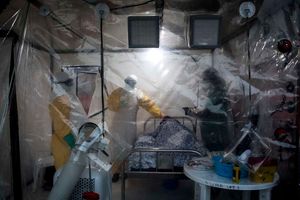
Three medical workers check on an Ebola patient in a Biosecure Emergency Care Unite on August 15, 2018 in Beni, DR Congo.
Both patients were managed under strict intensive care protocols. Uganda has quarantined dozens of identified high-risk contacts, activated emergency border screening measures, deployed rapid response teams along major transit routes and western points of entry, and postponed the annual Uganda Martyrs' Day celebrations scheduled for June 3 to reduce the risk of spread.
The World Health Organisation on May 18, formally declared the Ebola situation in the DRC and Uganda a Public Health Emergency of International Concern, the organisation's highest level of alert, a formal acknowledgement that the outbreak has crossed borders and requires a coordinated international response.
The Bundibugyo strain driving this outbreak has no licensed vaccines or approved therapeutics. That distinction matters. The more familiar Sudan and Zaire strains of Ebola have candidate vaccines and experimental treatments that have been deployed in previous outbreaks. This one does not.
Follow our WhatsApp channel for breaking news updates and more stories like this.