End of drought in sight, but coming rains will be insignificant for arid regions
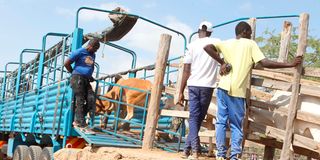
Traders load livestock into a truck at the Garissa livestock market on January 28, 2026. Prices have plummeted due to the ongoing drought, with cattle now fetching between Sh30,000 and Sh50,000, while some goats are being sold for as little as Sh2,000.

What you need to know:
- Despite the biting impact of the drought, Environment, Climate Change and Forestry CS Deborah Mulongo stated yesterday that the situation has not yet reached the threshold to be declared a state of emergency.
The ongoing drought in Kenya is expected to end this month, with forecasts indicating the start of the long rains in March. However, meteorologists warn that drought-stricken regions will experience average to low rainfall.
According to the National Outlook Forum for the March-April-May season, the highlands west and east of the Rift Valley and the North Western region will experience average to above-average rainfall.
In contrast, the Arid and Semi-Arid Lands (ASALs) of North Eastern and Eastern regions will see only average to below-average precipitation.
The outlook shows that coastal areas are likely to experience depressed rainfall.
Despite the biting impact of the drought, Environment, Climate Change and Forestry CS Deborah Mulongo stated yesterday that the situation has not yet reached the threshold to be declared a state of emergency.
The CS expressed concern that despite the forecast of rainfall beginning next month, its impact may be limited, particularly due to the below-average short rains in the last quarter of 2025.
"We are hoping for the best, and also anticipating anything,” Mulongo said.
She also indicated that her ministry has mapped areas anticipated to experience negative impacts from the coming rains such as mudslides and floods so that the people living in those areas can be informed in good time.
Edward Muriuki, the acting director of the Kenya Meteorological Department, said that while ASAL regions are forecast to receive average rainfall, this will likely be insufficient to counter the existing severe deficit.
“The previous seasons did not perform well. These areas require much more than average rainfall. A significant period for such areas is the October-November-December rainfall, which already failed,” he said.
Muriuki explained that the failure of the October-November-December (OND) rains is often determined by large-scale climate patterns elsewhere in the world, which ultimately affect local conditions.
“In Kenya, the failure was driven by La Niña, which is associated with drought in eastern Africa,” he said. “We expected to receive moisture-laden winds, but that did not happen.”
However, he added that the food basket regions in the country look promising despite there being average to above average rainfall.
He said that the Kenya Meteorological Department is also coming up with an application and a USSD option for people with no internet access to help in the dissemination of climate and weather information.
Safia Verjee, executive director at the Kenya Red Cross, said the heightened drought stress in some parts of the country has resulted in nutrition deterioration in most counties. She highlighted counties that are currently in the critical phase, including Turkana, Mandera, Samburu, Garissa, Isiolo, Marsabit (North Horr, Laisamis) and Baringo (Tiaty).
She said a recent assessment shows that about 65 per cent of water sources in some parts of Kenya have dried up and borehole water yields have dropped drastically, forcing ASAL communities to trek between 5.6 and 9.6 kilometres to fetch water.
“The most extreme conditions were reported in Mandera and Wajir, where households trek up to 10.8km. In Mandera, livestock trekking distances reach 14.4 km,” she said.
Safia added that counties such as Mandera, Marsabit, Wajir, Garissa, Isiolo, Baringo, Kajiado, Kitui, Kilifi, Kwale, Tana River, and parts of Turkana are facing worsening food insecurity, with limited pasture regeneration and reduced crop production.
So far, about 2.12 million people are affected by drought-related stress, including; rising acute malnutrition, especially children under five and pregnant and lactating women.
Apart from longer walks in search of water, the Red Cross team has also reported rapid depletion of pasture and water sources for pastoral and agro-pastoral communities, declining livestock body conditions and milk production, undermining nutrition and household incomes as well as rising staple food prices, especially in ASAL counties.
They also report a surge in inter-community tensions over scarce water and pasture as well as other emerging risks of displacement, school dropouts, and heightened protection concerns for women and girls
“Let us ensure that early warnings consistently lead to early and effective action, leaving no community behind,” said Safia.