Ruto rejects international pressure for domestic climate spending
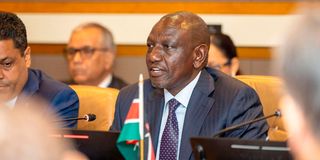
President William Ruto delivers his speech during a High-level Meeting on Haiti at the United Nations Headquarters in New York, on the sidelines of the 80th Session of the United Nations General Assembly (Unga) in New York, USA.

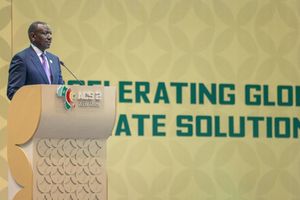
President William Ruto pushed back against international pressure for Kenya to fund most of its climate action domestically, telling world leaders that such expectations are unjust for countries that contributed little to global warming.
Speaking at the UN General Assembly's climate finance dialogue, Ruto's comments came as his administration faces mounting criticism at home over increased taxes and the high cost of living that sparked nationwide protests in the last few months.
"We are told that 60 percent of climate finance should come from domestic resources. This is manifestly unfair because much of the burden is being placed on countries that have contributed the least to the climate crisis."
The President's remarks reflect the difficult balancing act his government faces. While international donors increasingly expect Kenya to mobilise domestic resources for climate projects, citizens are already struggling with higher fuel taxes, a controversial housing levy, and increased VAT on essential goods, measures his UDA administration introduced to boost government revenue.
Just last year, widespread protests erupted across Kenya as young people, hit hardest by unemployment and rising living costs, demanded the withdrawal of tax increases. The demonstrations forced Ruto to abandon several proposed tax measures, creating a revenue gap that complicated government spending, including commitments related to climate financing.
"We must not ignore the risks of overtaxing small, vulnerable economies already battling high costs of living and climate shocks. For many of our citizens, the social contract does not allow this to be the ultimate solution," he said in his speech.
Kenya's climate challenges are already visible. Last year alone, the country experienced severe flooding that killed over 300 people and displaced hundreds of thousands, followed by drought conditions in northern regions where pastoralist communities lost livestock. These climate extremes cost billions of shillings in emergency response and reconstruction – money the government struggles to find.
Despite these constraints, Ruto attempted to position Africa as a solution to global climate challenges rather than just a victim. He pointed to initiatives such as the Africa Green Industrialisation Initiative, though critics note that many such continental projects have struggled with implementation and funding gaps.
"Africa has the potential to become a global hub for green industry, processing minerals, adding value to agricultural produce, and producing alternative fuels," he added.
However, Kenya's own green industrialisation remains limited. The country's manufacturing sector contributes less than 10 percent of GDP, and most raw materials are still exported without value addition. Recent efforts to develop green hydrogen projects and expand geothermal energy face significant financing hurdles.
The President also highlighted a persistent challenge that undermines development financing across Africa. "Africa loses nearly $90 billion every year through leakages that rob us of the very resources we need for climate action."
This figure on illicit financial flows resonates particularly in Kenya, where corruption scandals regularly dominate headlines. Recently, the government was forced to investigate massive irregularities in the procurement of medical equipment, while ongoing probes into misuse of Covid-19 funds continue to drag on through the courts, years later.
Ruto's call for a fairer global tax system through the proposed UN Tax Convention reflects growing frustration among African leaders about multinational companies shifting profits to avoid taxes. In Kenya, disputes with international firms over tax obligations remain common, as the government often lacks the resources to pursue complex tax cases.
The President acknowledged that private investment is crucial for climate action but argued that international perceptions of risk in Africa are overblown.
"Too often, perceptions of risk overshadow reality. But Africa offers some of the most exciting opportunities for green growth in the world," he said.
Yet, Kenya's own experience tells a more complex story. While the country has attracted some renewable energy investment, particularly in geothermal and solar projects, many international investors remain cautious due to concerns about corruption risks, policy inconsistencies, and currency volatility.
Ruto concluded with a call for action, but his message revealed the gap between international expectations and domestic realities.
"Time is not on our side. Climate change is a global existential threat. What we do, or fail to do, in this moment will shape the destiny of humanity," he said.