Farmers turn to organic indigenous vegetables to improve food and nutrition security
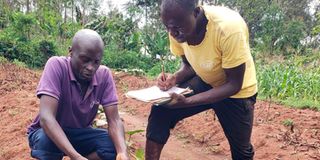
Joseck Mukuna and Philip Ochami measure the breadth of a pumpkin leaf as part of the farmers' training on growing traditional vegetables in Essunza, Vihiga County.

What you need to know:
- Vihiga farmers are revitalising traditional vegetable farming through specialised organic training.
- They document plant growth, extract seeds, and have revived nearly extinct nutritious varieties.
Vibrant bunches of leafy greens catch the eye as you walk through the Traditional Vegetable Fair in Emaloba, Vihiga County. These aren't just ordinary vegetables – they're living treasures of Kenya's culinary heritage, now being rediscovered for their exceptional nutritional value and resilience in a changing climate.
Known scientifically as African Nightshade, Jute Mallow, Amaranth, Cowpea, Spider Plant, Crotolaria and Ethiopian Kale, these vegetables are more familiar to locals as Kunde, Managu, Sageti, Terere, Nderema, Kanzira and Mrenda. They have long been staples in western Kenya's households, cherished for their distinctive flavours and health benefits.
The Traditional Vegetables Fair represents more than just a marketplace – it's a knowledge hub where farmers are learning to understand how these indigenous crops respond to different growing conditions.
Joseph Mukuna stands proudly among more than 60 farmers participating in this collaborative initiative by the Alliance for Bioversity and Seed Savers Network Kenya. He and his colleagues from across Vihiga County have undergone comprehensive training on growing these leafy vegetables organically, meeting a rising demand driven by evolving dietary preferences and nutritional awareness.
"These vegetables are cultivated without synthetic pesticides or fertilisers, making them a truly natural and sustainable food source," explains Mukuna, who doubles as a community health promoter in Esunza.
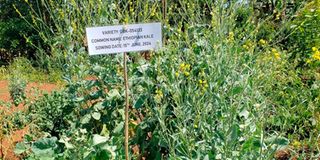
A batch of Ethiopian Kale locally known as Kanzira flourishes in one of the demo plots in Esunza , Vihiga County.
Through intensive training, the farmers have mastered sustainable cultivation techniques while documenting the adaptability of these vegetables to various climatic conditions. Their approach is remarkably scientific.
"We record every change in the plant, when it starts fruiting, pod formation and how long it takes to harvest," Mukuna says, gesturing toward his carefully tended plots.
The farmers meticulously observe and document the shape, size, and colour of leaves; the breadth and height of each plant; the number of pods produced; and the seed count within each pod. They even note flower colours, using rulers and strings for precise measurements.
"Before, I didn't see the economic value in these traditional vegetables. Now, I understand their behaviour in different climates and how to maximise yields," Mukuna adds, his eyes reflecting newfound enthusiasm.
Twice weekly, the farmers gather at demonstration plots to characterise their crops, helping them identify and manage pests and diseases while assessing resilience. These observations yield valuable insights.
"Some varieties like the giant Managu have red pods, and we've noted that it can withstand dry weather," he says, pointing to robust plants thriving despite challenging conditions.
As the first point of contact between locals and the nearest health facility, Mukuna oversees 102 households. His knowledge of traditional vegetables enhances his ability to advice on proper nutrition.
"I'm very passionate about the health of pregnant mothers and children under five. These vegetables are nutritious and important in meeting their nutritional needs," he explains.
Beyond cultivation techniques, the program teaches seed extraction, liberating farmers from dependence on expensive commercial seeds.
Loise Isaac, another participant, has gained valuable knowledge distinguishing varieties of Jute Mallow (Mrenda) and African Nightshade (Managu), understanding how each performs under different climatic conditions.
"I've learnt how to extract seeds from these traditional vegetables, which is beneficial because I cannot afford to buy them," she says, displaying carefully harvested seeds in her palm.
Terryanne Wamucii, assistant programs coordinator at Seed Savers Network Kenya, explains that their engagement with Vihiga farmers began in June last year. "The aim of this characterisation is for farmers to identify which crop varieties flourish locally while learning which pests and diseases affect different varieties," she says.
The initiative has yielded unexpected benefits. Lillian Aluso, project coordinator at Alliance for Bioversity, notes that working with Vihiga farmers has revived some nearly extinct traditional vegetables.
"Varieties like Rinyororo and Nderema, which our forefathers used, were excellent for food security, especially during dry spells," she explains. "Farmers now recognise which species fetch better market prices, with amaranth alone having 16 distinct varieties."
Nutritionists confirm the exceptional health benefits of these indigenous greens.
"Traditional vegetables are high in vitamins C and iron compared to other staple vegetables," says Christine Kihara, nutrition coordinator at the Nakuru County Department of Health. "They provide the body with fibre that aids digestion and supports healthy metabolism. Dark green leafy vegetables are rich sources of iron, crucial for energy production and other bodily functions."
However, Kihara cautions against common cooking mistakes that diminish these benefits. "When dark leafy vegetables are boiled, they lose vitamin C, which is heat-sensitive. Adding milk to reduce bitterness causes a negative interaction between iron and calcium, reducing absorption of both nutrients."
For Mukuna and his fellow farmers, organic cultivation of traditional vegetables represents both a return to their roots and a path to a healthier future. He has established a demonstration plot where he teaches community members about these indigenous treasures and supplies local schools with fresh, nutritious produce.
"I'm a better farmer now," he says with a smile that reflects well-earned pride, "and this is just the beginning."