Fenced rangelands and hay bales replace roaming herds
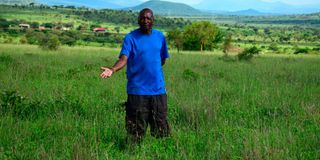
Kimirei ole Kanyiko shows a section of his rangeland in the Ewason region, Kajiado County, on March 25, 2026. Many herders in the region have turned to growing pasture to cope with frequent droughts.

What you need to know:
- Pasture farming emerges as lifeline for herders battling against drought and shrinking communal grazing lands.
- Shift from traditional pastoralism reflects changing land ownership, climate pressures, and need for resilience.
A drive on the Mombasa-Nairobi highway across Kajiado shows a silent agrarian revolution taking root in the county. What used to be a swathe of rangeland extending to as far as the eyes could see has become a patchwork of green fields teeming with lush grass as herders turn to pasture management to protect their animals and livelihoods from the vagaries of drought.
“We make hay when the sun shines to keep our animals alive throughout the year,” says Kimirei ole Kanyiko, a pastor who champions pasture farming.
Kimirei grows bush ryegrass and the African foxtail grass in a fenced section of his 112-acre rangeland in the Ewason region. “An acre of land produces up to 400 bales of hay per season. This translates into 800 bales of hay per year. We produce more than enough pasture. We have allowed some of our neighbours to graze in our rangeland,” he tells Healthy Nation.
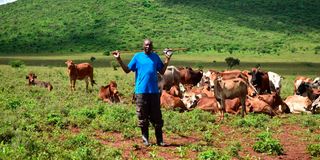
Kimirei ole Kanyiko looks after his herds at his rangeland in the Ewason region, Kajiado County, on March 25, 2026.
Kiboko assistant chief Bernard Nabelo says the agrarian revolution started with a change in land tenure in the region. Many of what used to be group ranches managed communally in the region have since become private lands. “Times have changed. With reduced size of land following the subdivision of Kiboko Group Ranch, for instance, individual herders are forced to significantly reduce the number of livestock and fence off their parcels,” he says.
A prolonged drought sent herders panicking in 2022 and further tested the traditional pastoralism model in Kajiado County. Kimirei is among herders who lost many herds of cattle to the drought. The Baptist Church pastor has yet to recover from the economic shock that rocked him after he lost half of his animals. Many herders had to relocate their animals to other counties.
“When the drought ended, we had learned a lesson. A five-acre parcel in Kitui County where I relocated my animals was able to sustain my animals, something that my 112-acre rangeland was unable to do in our hour of need. Growing pasture and fencing off our rangelands can protect our animals and livelihoods from drought,” he says.
A non-governmental organisation that promotes sustainable development in Kajiado East through a pasture campaign. Dedicated Children Agency has set up a demonstration farm opposite Oldonyolenkai Primary School in Kimirei’s neighbourhood where it showcases grass varieties suited for the region.
“When drought strikes herders, the impact is devastating. Their children tend to drop out of school to escort their animals as they search for water and pasture. To enhance the resilience of herders, we encourage herders to put a section of their rangeland on pasture. They do not have to graze their animals. They should harvest grass and bale hay to maximise production,” says Simon Kiseli, a food security and livelihood specialist at the organisation.
A growing pressure from wild animals has fuelled the push by herders to fence off their rangelands. “Zebras, which roam around, tend to deplete our pasture when we do not fence off the rangelands. They strike at night. This exposes our livestock to drought,” Kimirei says.
Kenya Agricultural and Livestock Research Organisation (Kalro) scientists, who champion pasture production to bridge a widening animal feed gap nationally, are banking on early adopters such Kimirei and Bernard to promote a mindset change among pastoralists. They bet big on climate-smart pasture in restoring rangelands degraded by deforestation and overgrazing, as they build climate-resilient livelihoods.
“As Kalro Kiboko, we have identified African Foxtail, Bush rye and Masai love grass, which are drought-tolerant, as some of the most suitable grass varieties in arid and semi-arid regions. These grasses are rich in crude protein,” says Bernard Korir, the head of Kalro arid and rangelands research station at Kiboko in Makueni.
“A farmer should set up terraces to prevent soil and water loss before planting grass. It allows percolation of rainwater. The right time to harvest pasture grass is just as it starts flowering. This guarantees quality for maximum production. Harvesting pasture grass when it starts flowering allows it to regrow, granting farmers an opportunity for a second harvest.”
Kenya Forest Research Institute (Kefri), which promotes agroforestry, is among government agencies promoting the growing of fodder grass. “A key benefit of grass farming, which many people often overlook, is landscape restoration and the prevention of soil erosion,” says Dr Michael Okeyo, head of Kefri arid lands research station in Kibwezi Township, Makueni.
“This is achieved through slowing down the impact and flow of rainwater and holding soil particles together. We encourage farmers to grow pasture grass in between their trees to boost their livelihoods as the trees mature.”