Fire, loss and seven surgeries: Inside the overwhelmed KNH burns unit caring for a nation

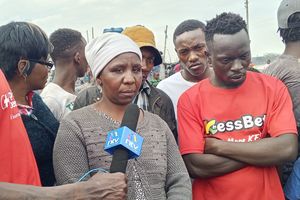
Faith Njambi, a burns survivor who underwent seven grafting surgeries to repair damages on her face and hands as a result of burns she sustained in a car explosion.

What you need to know:
- Unsafe gas cylinders, illegal electricity connections, and poor regulation drive 70 per cent of admissions, placing the sole critical care facility under constant strain.
For Faith Njambi, September 19, 2014, is a day forever etched in her memory, when joy turned to horror.
What began as a celebration for her mother's dowry in Gatundu North, Kiambu County, culminated in a terrifying inferno on the road, leaving the 53-year-old with severe burns and an unimaginable loss.
Faith vividly recalls the sequence of events that unfolded that Saturday night, which led to a six-month hospital stay for her, her sister-in-law, her niece, and her sister-in-law’s mother.
"From the moment we boarded, we could smell petrol," she recalls. "Along the way, the driver pulled over to check the car. As soon as he got out, it exploded. Flames engulfed the walls and roof while smoke filled the entire vehicle, suffocating us.”
Sitting in the backseat with her daughter, who was asleep, Faith escaped the initial inferno and rushed to pull her child out through a window. "That’s how
I got the burns," she says.
While a Good Samaritan rushed them to Kenyatta National Hospital (KNH) and she successfully saved her daughter, Faith sustained severe burns to her face and hands. Doctors later categorised her injuries as covering 41 per cent of her body.
Faith’s condition was critical. She lost consciousness shortly after arrival and woke up in the specialised Burns Unit four days later. Covered head-to-toe in bandages with her face too swollen to see, she was completely disoriented.
"My head was so swollen I couldn’t even open my eyes. For the first week and a half, I could only recognise people by their voices," she says. "When I finally regained awareness, I asked my mother about my daughter. Her silence was the first sign something was wrong.”
A doctor later confirmed the crushing news: her eight-year-old daughter had succumbed to carbon monoxide poisoning sustained during the fire. Faith remembered her daughter being talkative and responsive in the KNH casualty ward before falling unconscious, telling her, "Mum, you are so burnt. Mum, your face is so dark.”
Unable to attend the funeral due to her injuries, KNH staff arranged for her to view the body at the Kenyatta Memorial Funeral Home via a hospital ambulance. She later watched her daughter’s burial through a Skype connection from her hospital ward.
Njambi’s physical recovery at KNH lasted four months, from September 2014 to her discharge in February 2015. Her treatment involved an intensive series of seven grafting surgeries. Surgeons harvested skin from her head to graft onto her face, and from her thighs to repair the severe damage on her hands.
"The grafting was done one month after my admission. The surgeries were done gradually due to the pain. The doctors performed daily wound dressings for over a month to prevent infection."
After her discharge, Faith’s final hurdle was psychological. After seeing her scarred face for the first time, she was terrified to leave her house. "My worry was, what would my neighbours say when they see me?" she confesses.
Sick leave
She remained on sick leave for nearly five months, returning to work in July 2015—almost a year after the accident. She found the courage to re-enter society out of necessity, to support her two older children, and through an internal strength born of acceptance.
"I saw the best way to do it was to accept what God had done," she explains, noting that strong encouragement from her family, co-workers, and the KNH team prevented her from falling into depression. Today, she still wears gloves to protect her grafted hands from the sun, but her life continues; a powerful story of survival against overwhelming odds.
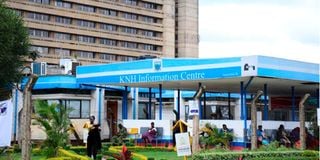
Kenyatta National Hospital in Nairobi.
The KNH Burns Unit, the sole dedicated critical care facility for severe burns in Kenya, is struggling to cope with a relentless surge in admissions, primarily driven by unsafe gas practices and regulatory failures in housing.
Dr Benjamin Wabwire, consultant plastic and reconstructive surgeon and head of Specialised Surgery at KNH, reveals that the hospital’s burn caseload exceeds the combined total for the entire United Kingdom. He cites capacity shortages, and the prohibitive cost of treating these often-preventable injuries.
Dr Wabwire confirms that burn injuries are rising, placing KNH under constant strain to manage the national patient load.
“The Burns Unit for critical care, meant for stabilising the most recent and critical cases, has a capacity of 16 beds. The general burns ward is designed for 74 patients but currently holds around 82 to 83," he says.
He explains that admission rates are higher now than five years ago due to the increased use of LPG gas for cooking and the unsafe use of electricity.
“Initially, most adult burns were from kerosene stoves, but that is steadily decreasing as people transition to gas. The 6kg cylinder causes almost 70 per cent of the burns we see," Dr Wabwire says.
"Most people buy them from local vendors who distribute gas at cheaper prices. There are regulations about where to buy gas and safety precautions, but they are not followed. Sometimes, the people who do refilling fail to add the required chemical to make it smell, so if there is a gas leak, people won't detect it. The other contributing factor is that we keep these cylinders inside the house instead of outside, which is the regulation—it should be outside with a connecting pipe to the house.”
He adds that unsafe use of electricity through illegal connections or houses built very close to power lines is a major problem. “We've had instances where we amputate all of a patient's forelimbs because a house girl went to hang clothes on a live wire. This is very common, particularly in Eastlands and other densely populated areas of Nairobi.”
Other common cases, he says, involve children from informal settlements who cause fire accidents while cooking for themselves when their parents are away.
Dr Wabwire also points to prevalent safety gaps in workplaces. Frequent electrical injuries are seen among workers on roofs or balconies whose metal equipment touches power lines; a sign of weak enforcement of the Occupational Safety and Health Act regulations, which stipulate rules employers must follow to provide a safe and healthy working environment to protect employees from job-related hazards.
Factories often fail to provide staff with essential fire-resistant clothing, increasing the risk of severe burns from metal flares or chemical spills. The continued use of highly flammable gels and spirits for food warming in the catering industry also poses a persistent burn risk.
Dr Wabwire notes that the average stay for a burn patient is one month, but this depends on the extent of the burns and the required procedures. The cost is equally dependent on the length of stay and the procedures performed.
Despite its best efforts, KNH faces significant capacity challenges in both physical space and human resources, leading to being overwhelmed during disasters.
“Any time we have a disaster, we struggle to handle the numbers," he admits. "If we have more than 10 people coming in, we are forced to either use other critical care spaces or open an emergency ward like we did during the Mradi Embakasi explosion. The cost of critical care is also high. We need ICU equipment, ventilators, pumps, and monitors, which can be in short supply because other patients with different problems use the same things.”
He further highlights that the other bigger issue is nutrition. "Burn patients need a lot of a special kind of feeding, which is out of reach for most public hospitals. They need a lot of protein. For instance, an adult burn patient needs a minimum of a quarter kilogramme of meat every day. If it is eggs, they need a minimum of eight to 10 every day. If you have 70 patients, each needing eight eggs a day, the total would be over 500. The hospital cannot afford that, yet without it, patients lose weight, which reduces their resistance to infections and impairs healing.
He also explains that the unit lacks peer support groups for discharged patients, making it difficult for survivors who have suffered disfigurement or loss of function to cope with psychological trauma and reintegrate into society.
Dr Wabwire stresses that the key to managing the burn crisis is prevention, which requires a multi-sectoral approach backed by political commitment.
"The best strategy to deal with burn injuries is to prevent them, because most are preventable. If we reduce that burden, then those resources can be allocated to other areas in healthcare.”