For Kilifi women, family planning requires a husband’s permission

Kazungu Katana, a father of 13, with his wife Zawadi and their last born daughter during the interview at their Mwarandinda home in Kilifi County on December 9, 2025.

What you need to know:
- While mothers struggle to feed their children, the requirement for a man’s consent remains the final hurdle in accessing contraceptives.
Gladys Kadzo was working on her cassava farm when she heard the announcement of a community health outreach programme. The mother of eight dropped her tools and made her way to Mwarandinda Primary School, hopeful to find free family planning services in this hard-to-reach part of Kilifi County.
“My children follow each other so closely, making it hard to provide basics like school fees, food, and clothes. Having more would mean they all go without the basic needs,” Gladys tells Healthy Nation.
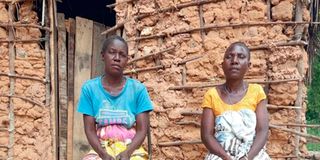
From left: Bendera Mwarua, a mother of 10, and Katama Deri, a mother of 11, during the interview at Vitengeni village in Kilifi County on December 10, 2025.
In the Mwarandinda community, a woman cannot decide alone to use contraception. She needs her husband’s approval, a cultural norm that made Gladys’ journey a brave one.
A decade ago, health practitioners visited her home offering family planning, but her husband, present at the time, refused.
“If he hadn’t been home that day, I would have chosen my preferred family planning method,” Gladys recalls. “He said no, and the doctors left.”
Denied the ability to choose family planning, Gladys had child after child until five years ago, when she had her eighth.
“I told my husband that we already had enough children and should stop having more so we could properly care for them,” she says. “Before, I relied on him entirely—for food, clothes, even taking the children to hospital when they were sick. But this time he agreed, and I went to the hospital to receive a three-year family planning injection.”
A month later, she experienced side effects such as bleeding. “My husband encouraged me to return to the hospital so the doctors could check on me,” Gladys adds, noting how supportive he has been throughout her family planning journey.
A few kilometres away, we meet Kazungu Katana, a father of 13. His wife, Ruth Zawadi, 40, did not dare attend the nearby outreach at Mwarandinda Primary School. For years, Kazungu, 55, wanted more sons. “We kept trying, and my wife kept having girls,” he says. “On the eighth pregnancy, we had twins—a boy and a girl. God answered my prayers. We now have two sons and 11 daughters.”
His firm stance against his wife using any form of family planning has come at a personal cost, requiring him to work longer hours at local construction sites to support his large and still growing family.
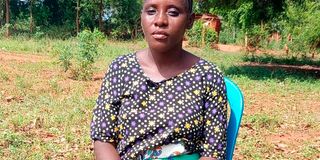
“I do casual labour at construction sites to feed my family. We eat what we get— porridge for breakfast, then ugali or whatever food we have for lunch and dinner, even if it’s only in small portions ,” he explains.
He lists the school grades of his children, the oldest soon joining Form 4.
“I have children in school. One will be joining Form 4, two are in Grade 9, one in Grade 8, two in Grade 5, one in Grade 3, and another is starting Grade 1 this January. They all attend local schools here.”
Kazungu acknowledges being aware of various scientific family planning methods for both women and men, including vasectomy and condoms. Still, he has not introduced the idea to his wife.
Zawadi acknowledges the strain. “My husband doesn’t want to hear about family planning. Once, I secretly got a three-month injection. When he found out, he was angry. I stopped, and I became pregnant again.”
Her life revolves around pregnancy and breastfeeding. “It’s very hard. We all depend on my husband, and the crops fail without rain.”
Painful memories
Zawadi’s life echoes her husband’s decades of struggle to provide for their family’s basic needs. Raising her children in poverty brings back painful memories of her own childhood. Her mother was the sixth wife in a polygamous marriage, and when Zawadi’s father died, her mother could no longer support her education. She dropped out in Class
Two and turned to marriage nearly 30 years ago, seeing it as her only option. For other women like Kadzo Deri, now 51, family planning was simply unheard of for most of her life. She had her first eight children at home, relying on myths and neighbours’ advice in her Vitengeni village. Poverty deepened as her family grew.
“Back then, we didn’t pay much attention to hospitals. I would deliver my children at home and only take them for routine vaccinations when they turned a month old,” Kadzo tells Healthy Nation.
But as her family grew, so did the struggles to feed them. She grew distressed watching her children go hungry while having nothing to give them. Her maize and other crops repeatedly failed to reach harvest, doomed by the area’s harsh, prolonged drought.
As they say, desperate times call for desperate measures. Kadzo recalls walking from one neighbour’s farm to another begging for food to feed her children and herself.
“Pawpaws were plentiful; I boiled them for meals. My children’s health suffered,” she says.
Amidst these struggles, her family continued to grow, deepening her vulnerability as she alternated between pregnancy and breastfeeding; often without any certainty of the next meal.
When she finally delivered her ninth child at a hospital, encouraged by campaigns to reduce maternal mortality, a doctor advised her to consider family planning. Kadzo asked for time. She returned pregnant with her tenth child, and again with her eleventh, her husband unwilling to consent. “I never considered using any family planning method until after I had given birth to all 11 of my children. I cannot decide without my husband’s agreement,” says Kadzo.
With her youngest aged six, she feels her childbearing years are over. “I wouldn’t advise anyone to have children the way I did, but I also won’t tell them to use family planning. Every woman has the right to choose.”
While challenges to accepting scientific family planning persist— as seen in the cases of Kadzo in Vitengeni and Kazungu in Mwarandinda — the Kenya Demographic and Health Survey data reveal that fertility rates in Kilifi and other counties across the Coastal region began to decline in 2003 following the introduction of contraceptives and family planning initiatives.
According to the 2023 Kenya Demographic and Health Survey, Kilifi’s average is 3.4 children per woman, compared to 4.6 in Lamu. Nationally, women in the poorest households have an average of five children, while those in the richest have three.
“Our entry point is empowering healthcare providers at the local level, those who reach the last mile,” says Dr Edison Omollo, programmes director at Reproductive Health Network Kenya.
“Beyond that, we equip Community Health Promoters (CHPs) who visit households, enabling them to share accurate information and support the national government in implementing and aligning existing policies and programs. This coordinated approach ensures we can deliver sexual and reproductive health services effectively; especially to women and girls in hard-to-reach and marginalised rural areas.”
Gideon Nyinge, 61, a retired teacher and CHP, is one such champion. He and his late wife used contraception to space their six children. “With many children, you struggle to provide quality education, healthcare, and diet,” he says. He now educates households in Mwarandinda and Jibidishe villages, combating myths and high illiteracy.
“My wife used four types of family planning methods,” the 61-year-old father of six tells Healthy Nation. “She started with the coil after the age gap between our first and second children turned out to be only eight months; meaning she became pregnant just four months after giving birth to our firstborn.”
According to Gideon, many of the households he works with still cling to myths and misconceptions about family planning, which keep them from using contraceptives. He connects this reluctance to high levels of illiteracy. As a teacher who understands science—just as his late wife did—he explains that they made their family planning decisions together, aiming to provide a better life for their children.
His efforts have borne fruit in women like Gladys, who left her farm for a Hormonal Intrauterine Device (HIUD) at the outreach. “This place is closer than the hospital, which is a three-hour walk,” she says. The method allows her to do casual jobs and contribute at home. “My husband and I agree: we support each other to raise our eight children.”
Kephine Atieno, a nurse working with the Access HIUD project in Kilifi County, explains that Hormonal Intrauterine Device is a long-term family planning method that lasts five years.
“It releases hormones that prevent pregnancy and is both government-approved and clinically proven to be effective. It has become a preferred option for many of our clients. We explain to mothers that this method provides protection for five years, and once they decide they are ready to conceive, the HIUD can be removed and fertility returns.”
She adds that through continued awareness campaigns, especially in hard-to-reach areas like Mwarandinda and Vitengeni villages, the myths and misconceptions creating fears around family planning uptake will become a thing of the past, though it will require joint efforts.
“Every family planning method can have side effects, but we have ways to manage them,” the nurse explains. “A mother who uses family planning consistently generally appears healthier and stronger than one who gives birth year after year.”