From Cairo crisis room to climate kingmaker: Africa's 40-year rise—and its implementation problem
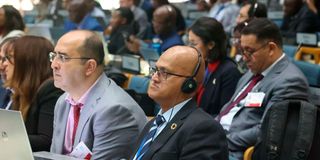
Delegates attending the African Ministerial Conference on the Environment at UN offices in Nairobi on July 14, 2025.


What you need to know:
- The most recent, and the 20th ordinary session, was held at the United Nations Office in Nairobi (UNON) in mid-July, marking four decades since the African Ministerial Conference on Environment (AMCEN) was founded.
- When AMCEN speaks, it represents over one billion people—nearly one in eight humans on Earth
- But Kenya's success highlights an uncomfortable reality: while some AMCEN member states have thrived, others have struggled to translate continental unity into national action.
The year was 1985. Madonna dominated the airwaves, the Berlin Wall still divided East and West, and in a sweltering conference room in Cairo, a group of frustrated African environment ministers were about to make history.
They had watched, powerless, as prolonged droughts ravaged the Sahel. Ancient forests were disappearing before their eyes. Desertification was devouring farmland and destroying livelihoods. While the world debated whether climate change was real, Africa was already drowning in its consequences.
These ministers faced a brutal reality: individually, their voices were whispers in the cacophony of global politics. Together, they could become a roar.
That December day in Cairo, they made a decision that would reshape environmental politics forever. They would speak as one continent, one voice, one unstoppable force.
Forty years later, that room has become the most powerful environmental negotiating bloc on Earth.
The most recent, and the 20th ordinary session, was held at the United Nations Office in Nairobi (UNON) in mid-July, marking four decades since the African Ministerial Conference on Environment (AMCEN) was founded.
A gathering of environment ministers might seem routine—just another policy meeting. But beneath the formalities and communiqués, these sessions shape the continent’s climate priorities, financing demands, and negotiating positions on the global stage. The decisions made in rooms like these often ripple out into national policies and international climate talks.
"I think one of the most important achievements of AMCEN in 40 years is the establishment by the ministers of African groups of negotiators," explains Rose Mwebaza, director of UNEP's Regional Office for Africa. "Because with 54 countries, even as large a continent as Africa is, negotiating individually in a UN body of 193 member states doesn't carry the same weight. But when Africa negotiates as one, it has made it the most powerful, most influential negotiating bloc in climate negotiations."
When AMCEN speaks, it represents over one billion people—nearly one in eight humans on Earth. It speaks for the continent that holds 60% of the world's best solar resources, 30% of global mineral reserves, and 17% of the world's forests. Most crucially, it speaks for communities on the frontlines of climate change who did the least to cause it.
The art of environmental war - with mixed results
To understand AMCEN's power, picture the gladiatorial arena of international climate negotiations. Countries arrive with armies of lawyers, scientists, and diplomats. Alliances shift like desert sands. Talks stretch through the night as billions of dollars and millions of lives hang in the balance.
Into this chaos walks Africa—unified, prepared, unshakeable.
Take COP27 in Egypt, 2022. For decades, vulnerable countries had demanded a "Loss and Damage Fund"—money to help communities devastated by climate impacts they couldn't adapt to or prevent. For decades, rich countries had said no.
But AMCEN had done its homework. Through months of coordination, African negotiators arrived with unwavering unity and the moral authority of representing the world's most climate-vulnerable continent. They didn't just ask for the funds—they demanded it, backed by scientific evidence, legal precedent, and the combined weight of 54 nations. They got it.
But two years later, the fund remains largely on paper. Operationalisation has been slow, funding contributions modest, and many of the institutional coordination problems that AMCEN promised to solve remain unresolved.
"The Loss and Damage Fund wasn't charity," says Dr Richard Muyungi, a Tanzanian economist who chairs the African Group of Negotiators. "It was justice."
The billion-dollar green revolution, sort of
AMCEN's defenders point to concrete achievements when ministers return home and turn promises into reality. But the track record is decidedly mixed.
Drive through Kenya's Rift Valley today, and you'll see steam rising from the earth like breath from a sleeping giant. This is Olkaria, where Kenya has harnessed volcanic fury to generate over 700 megawatts of clean electricity—a genuine success story that began with AMCEN knowledge-sharing.
"In Kenya, we have developed a very robust and sustainable model for financing locally led initiatives that target the most vulnerable communities," Kenya's environment minister, Dr. Deborah Barasa, told delegates at AMCEN-20. "To date, FLLoCA has disbursed over USD70 million to sub-national governments to enhance the resilience of communities."
But Kenya's success highlights an uncomfortable reality: while some AMCEN member states have thrived, others have struggled to translate continental unity into national action.
Six hundred million Africans still lack access to electricity. The continent accounts for only 1.57% of global renewable energy capacity despite possessing 60% of the world's best solar resources. Deforestation continues across the Congo Basin. Desertification advances in the Sahel despite decades of initiatives.
Perhaps the most telling case study is the Great Green Wall—AMCEN's flagship project and perhaps its most audacious promise. The vision: a living barrier 8,000 kilometres long, stretching from Senegal's Atlantic shores to Djibouti's Red Sea coast.
The reality is more complex. Ethiopia has indeed planted 5.5 billion seedlings, and Senegal has established 11 million acacia trees that now produce gum arabic for international markets. But by 2020, only 4% of the Great Green Wall was complete, far behind schedule. Some experts question the survival rates of planted trees and the long-term sustainability of the approach.
"Progress has been patchy," admits one official who didn't wish to be named. "Some countries have made remarkable strides, others have struggled with basic implementation. That's the challenge of continental coordination—you're only as strong as your weakest link."
The $1.3 trillion question
Last week, as ministers met in Nairobi under the theme "Four Decades of Environmental Action in Africa: Reflecting on the Past and Imagining the Future," the stakes were high.
Africa needs $1.3 trillion annually by 2035 for climate action—a number so large it makes heads spin and calculators smoke. But Dr. Muyungi, who has spent time crunching these numbers, isn't intimidated.
"Our understanding was that, and still is, that the funds must be provided by developed countries to developing countries," he explains, referring to the climate finance commitment made at COP29. "However, the decision and the agreement in terms of the 300 billion is to mobilise. Now, mobilisation has got a lot of challenges."
The problem? "Mobilisation" often means loans, not grants. And Africa's debt burden is already crushing. "When you talk about banks, you talk about loans, and the African loan burden has been increasing because of the so-called mobilisation," Muyungi notes. "Africa wants grants. Justice, not charity. Climate finance as reparations, not business opportunities."
Even AMCEN's supporters acknowledge institutional challenges. The Conference meets only every two years, limiting its ability to respond to fast-moving crises. Funding for the AMCEN secretariat remains inadequate—a persistent complaint that surfaces at every session.
More fundamentally, AMCEN operates by consensus among 54 countries with vastly different priorities, capabilities, and political systems. Oil-rich Nigeria has different interests from landlocked Chad. South Africa's industrial concerns don't always align with Madagascar's conservation priorities.
"Aligning priorities is where the tricky part is. Because at the end of the day, we must all come up with a common agenda," says Dr Muyungi. "Sometimes it is a tussle, but eventually we agree."
At the end of the week, ministers adopted a High-Level Political Statement that reads like a declaration of environmental independence.
"Africa stands at a critical juncture in our efforts to protect its natural capital," they declared, "ranging from the diverse ecosystems, landscapes, air, rich biodiversity to its vast mineral wealth, freshwater, and marine resources."
The ministers committed to "play a leading role in safeguarding the continent's natural capital, prioritising sustainable management practices that balance economic development with environmental conservation." They pledged to embrace "whole-of-government" and "whole-of-society" approaches, to "employ digital technologies, including artificial intelligence," and to promote "green growth pathways that harness environmental action as a driver of decent jobs."
Most importantly, they committed to "build on the achievements and lessons of the past four decades and to chart a bold and transformative path forward for environmental sustainability in Africa."
Most tellingly, ministers pledged to "employ digital technologies, including artificial intelligence" for environmental monitoring—a tacit admission that current monitoring and evaluation systems are inadequate.
But the lack of binding enforcement mechanisms means AMCEN commitments often remain aspirational. Countries can sign onto ambitious targets knowing there are limited consequences for non-compliance.
The future is African green
The next AMCEN meeting is in 2027. By then, COP30 in Brazil will have come and gone, the Great Green Wall will have grown longer and stronger, and Africa's renewable energy revolution will have accelerated even further.
The ministers who gathered in Cairo 40 years ago couldn't have imagined their continent would become the world's environmental conscience. Today, it's impossible to imagine global environmental leadership without Africa at its centre.
[email protected]