From Linda Mama to Linda Jamii: ‘I walked out free’ vs ‘I was detained over bills’
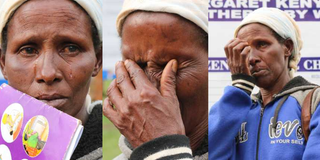
Anna Cheptonui, 50, weeps outside the Margaret Kenyatta Mother Baby wing in Nakuru County Referral and Teaching Hospital on October 2, 2024, after her 18 year-old daughter who had given birth at the facility under the Linda Mama programme was detained until she pays Sh7,500.

What you need to know:
- The Linda Mama programme was launched by former President Uhuru Kenyatta in June 2013 as a free maternal healthcare service in public facilities.
When Gladys Midecha discovered she was pregnant a decade ago, she sought guidance at the nearest City Council Clinic. Asked whether she had registered for the now defunct National Hospital Insurance Fund (NHIF), she paid Sh20, received her clinic book and was registered for the Linda Mama programme.
Thanks to Linda Mama, all her subsequent clinic visits were free. Unemployed at the time, the City Council Clinic made the most sense. The check-ups were comprehensive—she received all three tetanus injections free, and her HIV tests at no cost.
"For mothers who tested positive for HIV, the clinic provided counselling and free medication," she explains. "The doctors and nurses were very involved. At every clinic visit, they would hold sessions to tell us what to expect, and conduct normal checks such as weight and height. They even advised me on my diet, letting me know if I was overeating or undereating and what I should do about my weight."
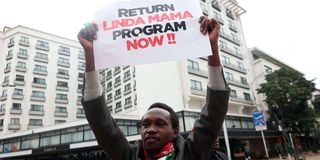
A protester on July 16, 2024 carries a placard urging President William Ruto to return the Linda Mama Programme.
"The one service the clinic did not provide was a scan or ultrasound. So, at seven months pregnant, I paid privately to get a scan done, to check on the baby's weight and to see if the baby had turned," she recalls.
In October, she walked to Kenyatta National Hospital in the afternoon to deliver. At the triage, she was examined, asked for her Linda Mama book and admitted to the maternity ward.
"The delivery went smoothly, and I walked out the very next morning. The clinic book was the key—it was all I needed. I did not pay a single shilling for the entire delivery process. It was completely free," she says.
Ten years later, Melvin Nyaoga has had a totally different maternity experience. Her ordeal began about a month ago when she started experiencing labour signs, though her due date had not arrived. She first went to a local dispensary, which directed her to Moi Teaching and Referral Hospital (MTRH) because her water had broken.
Arriving at MTRH at 11am, she was immediately told she needed to pay Sh520 to book a bed. She did not have the money, resulting in significant delay. She was forced to wait until 5pm before being finally admitted, spending six hours at the hospital with her water continuously dripping.
Financial issues
The following morning, the 22-year-old was taken for an emergency caesarean section and successfully delivered her baby. However, financial issues escalated rapidly, with her baby admitted to the new-born unit for special care.
"When it came time for billing, I was unexpectedly asked to pay for a whole year of SHA coverage within 24 hours of delivery to clear the hospital bill. I had been previously informed that I could pay for only four months in advance. Now, I was told a one-year payment was required, and since I was late, my late entry would not be accepted. My hospital bill for just two days had already reached Sh72,000," she narrates.
"My baby stayed at the new-born unit for 11 days, accruing an additional bill of Sh18,000. As the hospital hostel was full, we stayed in the ward during this time. I was ultimately discharged two weeks ago after resorting to protesting at the hospital due to being detained over the unpaid bill," she says.
The two experiences paint a stark difference in care for expectant Kenyan mothers who cannot afford medical care.
The Linda Mama programme was launched by former President Uhuru Kenyatta in June 2013 as a free maternal healthcare service in public facilities. The government later transitioned responsibility to the National Health Insurance Fund (NHIF) to improve efficiency and timely processing and payment of claims, expanding the programme's coverage in 2016.
The main objective was to ensure all pregnant women and their infants had access to quality and affordable maternal and child health services without financial barriers. It was part of the country's strategy to achieve Universal Health Coverage (UHC), reduce maternal and new-born deaths, and increase births assisted by skilled providers.
All pregnant women, so long as they were Kenyan citizens, were eligible to benefit from the services. They would register using only a national identity card and antenatal care records. Services were accessed based on need, not ability to pay.
The programme offered a comprehensive service package for expectant women and their new-borns for one year from activation. This included antenatal care, skilled delivery care covering both normal and Caesarean section births, postnatal care, basic and specialised obstetric emergency care including referral for complications, care for the new-born baby including outpatient and inpatient management, and outpatient and inpatient management for conditions and complications during pregnancy, delivery and postnatal.
By 2023, more than 5.2 million mothers had been registered under the programme, with an average of 1.2 million mothers benefiting annually between 2019 and 2023, according to statistics from NHIF. At least 5,635 public health facilities, 437 private health facilities and 164 faith-based health facilities had been signed up to provide free maternity services.
Now, the Linda Jamii programme has been fronted by President William Ruto as an upgrade to Linda Mama. Introduced by his administration in June 2025, it is under the Social Health Authority Insurance Programme.
According to the President, Linda Jamii is the expanded government scheme that evolved from lessons learnt during implementation of the older, maternal-focused Linda Mama programme. Its primary goal is to provide broader health insurance coverage for the entire family rather than solely focusing on mother and new-born.
The programme, being implemented under the new Social Health Authority (SHA), is a household-based scheme, allowing mothers to register their spouses and children, covering the entire family.
The programme covers antenatal care and postnatal care, new-born health services, outpatient and inpatient care, and emergency services. A key life-saving inclusion not fully covered under Linda Mama is the Anti-D serum treatment, a vital intervention for Rhesus-negative mothers.
According to Dr Abdi Mohamed, the chairperson of SHA, the core challenge with Linda Mama was its structure as a single event-based payment rather than comprehensive insurance cover. He explains that Linda Mama failed to eliminate the issue of mothers being stranded in hospitals due to unpaid bills.
"The initial design merely aimed to pay for the service delivery event, primarily for antenatal care and one postnatal care, which was insufficient compared to full family cover. There were also inadequate and discrepant reimbursement rates. Public Level 2 and 3 facilities received Sh2,500 for normal delivery and Sh5,000 for C-section, whilst private/Faith-Based Organisation (FBO) facilities received Sh5,000 and Sh17,000, respectively.
This was significantly less than the NHIF Super Cover's reimbursement of Sh10,000 for normal delivery and Sh30,000 for C-section, creating an untenable system of different prices for the same benefit," said Dr Abdi.
"The low reimbursement and lack of a formal NHIF card requirement led to reports of misuse, such as multiple deliveries within a year, and double billing—claiming from both Linda Mama and a super cover," he added.
Dr Abdi asserts that the new Social Health Authority/SHIF (Linda Jamii) system is decidedly superior because it fundamentally shifts to a comprehensive, premium-based family cover. Addressing the persistent issue of mothers still being detained in hospitals post-delivery, he attributes it to failure of registration/enrolment.
"The mothers were not registered for any cover, did not secure the indigent cover, or failed to enrol as underage mothers during their ANC visits. When registration is not done before the event, the hospital faces a challenging situation post-delivery regarding bill management. The proposed solution is to ensure non-affording mothers are actively recruited and registered for cover at Level 2 and 3 facilities during their ANC appointments, rather than waiting until they are stranded after delivery," he said.