From plastic crisis to economic lifeline: How businessman built a recycling empire in Garissa
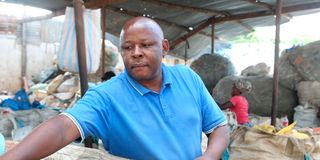
Allan Olingo, the Taka ni Mali founder.

What you need to know:
- Recognising the dual potential for environmental impact and livelihood creation, Allan relocated his business in 2016.
- Today, the company employs 70 people and processes up to 40 tonnes of plastic monthly.
What began as a casual conversation on the streets of Nakuru in 2016 transformed into an environmental success story that now employs tens of people in one of Kenya's most challenging climates. Allan Olingo's journey to Garissa town started when a friend mentioned the plastic waste crisis plaguing the northeastern town — a problem that would become Olingo's opportunity.
Garissa’s scorching climate, with temperatures soaring to 38°C, drives relentless consumption of bottled water and beverages, leaving behind mountains of plastic waste. "I was looking for plastics and I found them in plenty here in Garissa. In a week, I collected 10 tonnes of plastics for my business—unlike in Nakuru, where I struggled to gather even one tonne.”
Recognising the dual potential for environmental impact and livelihood creation, he relocated his business and started a recycling venture, Taka ni Mali ("Waste is Wealth") to Garissa in 2016. Today, the company employs 70 people and processes up to 40 tonnes of plastic monthly. “I started Taka ni Mali company with the purpose of conserving the environment. Plastics cause a lot of harm, including threatening human health, burdening economic activities and exacerbating climate change," Olingo says.
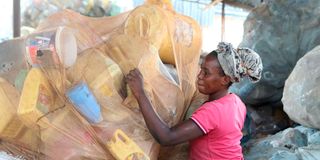
Grace Muthui, a staff at Taka ni Mali.
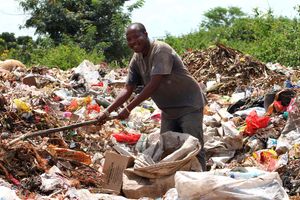
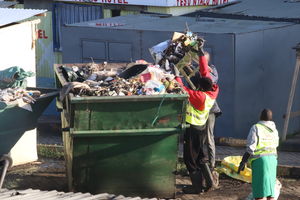
The operation runs on a simple but effective model. Plastic pickers scour Garissa town daily, collecting discarded bottles and containers. At the collection site, workers sort plastics by colour, remove stickers, and crush the material before shipping it to manufacturers in Nairobi who produce plastic utensils. In a productive month, the company processes up to 40 tonnes of plastic waste from Garissa alone.
The economic impact extends far beyond Olingo's business. At Sh25 per kilogramme, plastic collection has become a viable livelihood for dozens of residents. Each picker’s collection is weighed daily, with payments providing immediate income in a region where formal employment opportunities remain scarce.
For waste picker Kasembi Paul, plastic collection has meant educational opportunities she never thought possible. Since joining the venture in 2018, she has earned enough to pay school fees for her children, including sending her youngest to North Eastern Polytechnic.
"I have been able to pay fees for my children through this enterprise. My last born is at North Eastern Polytechnic courtesy of plastics," Kasembi says. On productive days, she takes home at least Sh2,000 from delivering plastics to Taka ni Mali, though the work requires covering long distances under Garissa's scorching sun.
The social benefits extend beyond economics. Paul Muoti, who has collected plastics for five years, credits the work with keeping him away from crime and providing purpose in a town where youth unemployment runs high.
"Engaging myself in environmental conservation has helped me avoid clashing with law enforcers in this town. I am a very busy man throughout the day collecting plastics to earn a living," Muoti explains, calling on other young people in Garissa to join environmental conservation activities.
Despite the success of enterprises like Taka ni Mali, significant obstacles persist. Olingo faces bureaucratic hurdles including undefined cess fees that vary unpredictably during product transportation, while his workers endure harassment from authorities who mistake them for thieves or assume they are mentally challenged.
The challenges reflect broader policy gaps in Kenya's waste management system. According to Isaac Mitei, coordinator for the National Environment Management Authority (Nema) in Garissa County, the region faces unique complications, including porous borders that allow illegal plastic imports from Somalia and Ethiopia.
"We are challenged with the porous border that is allowing illegal inflow of plastics from Somalia and Ethiopia, but we are engaging law enforcers on how to deal with the issue," Mitei explains.
Garissa County has yet to implement material recovery facilities as required under the Sustainable Waste Management Act of 2024, while the Extended Producer Responsibility framework that would hold manufacturers accountable for plastic waste remains poorly enforced.
The broader crisis
Garissa's plastic problem reflects a national crisis of staggering proportions. According to the Kenya Plastics Pact, the country generates an estimated 22,000 tonnes of waste daily, about 20 per cent of which is plastic. Kenya's daily plastic consumption is estimated at 0.03kg per person, with the full amount of plastic becoming waste ranging from 0.5 to 1.3 million tonnes annually.
The statistics paint a stark picture: Kenya generates 966,000 tonnes of plastic waste annually, yet only 27 per cent is collected, and a mere 8-10 per cent gets recycled, according to United Nations Trade and Development data.
Recent estimates suggest Kenya imported more than 575,000 tonnes of raw plastic in 2021 alone, valued at around Sh98.2 billion, with plastic packaging consumption reaching 259,252 tonnes yearly - 71 per cent of which is imported.
Economic impact reaches billions. The Kenya Plastics Pact reports that the country’s projected plastic waste could reach five million tonnes by 2030, while the global plastic recycling industry is projected to grow from $34 billion in 2019 to $60 billion by 2027. However, with Kenya recycling only eight per cent of its plastic waste, the country is missing substantial economic opportunities.
In Mombasa, Kenya's second-largest city with a population of two million, 3.7kg of plastic per capita leak into water bodies annually, according to UNEP data. The waste stream tells a troubling story of modern consumption patterns. According to the original UNCTAD report, plastic beverage bottles account for 13 per cent of all beach litter collected in 2019, followed by bottle caps at 11 per cent. Food wrappers, plastic lids, takeaway containers, and grocery bags complete the list of most commonly discarded items.
In Garissa County, according to the Met Department, temperatures range from 22°C to 38°C with an annual average of 28.6°C, creating what weather experts describe as "short, sweltering" summers.
This climate reality means that, according to World Bank data, Nairobi generates about 2,400 tonnes of solid waste every day, of which a fifth is plastic, while arid regions like Garissa face even more concentrated plastic waste challenges due to higher per-capita consumption of packaged beverages.
Burning plastic compounds climate problems
According to a 2024 study published in the journal Sustainability, in Kenya, 56 per cent of plastic waste is openly incinerated, compared to 17 per cent per cent in Ghana and 10 per cent in South Africa, making Kenya one of the worst performers globally for plastic incineration. This practice releases harmful greenhouse gases and toxic substances into an already heat-stressed environment.
In Garissa, indiscriminate dumping blocks drainage systems and pollutes soil and ecosystems, while the lack of an integrated waste management system compounds the environmental damage. County environment officer Dekkow Khalif acknowledges the administration is working to change behaviours around waste disposal while developing a comprehensive solid waste management policy.
"We are working hard to have people have a behavioural change on how they are disposing of their waste from their homes and everywhere," Khalif says, noting that the 2018 Garissa County Environmental Act provides a framework for conservation efforts.
Olingo's success in Garissa reveals how environmental challenges in Kenya's arid and semi-arid regions can become economic opportunities with the right approach and support. According to United Nations, global plastic waste will reach 460 million tonnes annually by 2025, while UNEP data shows that 19-23 million tonnes of plastic waste leak into aquatic ecosystems worldwide each year.
As climate change intensifies heat and water stress across the country's drylands, such innovative waste management solutions may prove essential for both environmental protection and community resilience. In recent years, Kenya has emerged as a regional leader in fighting plastic pollution, implementing groundbreaking policies, including the 2017 ban on single-use plastic bags and subsequent extensions to protected areas.
According to the United Nations Development Programme, the Western Indian Ocean covering Kenya's coastline generates more than US$22 billion annually in goods and services, with Kenya's economic share estimated at $4.4 billion annually. Proper plastic waste management could significantly enhance this blue economy potential.
For Olingo, who moved his life from Nakuru based on a friend's observation about Garissa's plastic problem, the solution remains straightforward: "I appeal for a conducive business environment in Garissa to attract investors in the arid and semi-arid classified county.