From top employee to rock bottom: One man’s 16-year battle with alcohol addiction

David Owuor during the interview on December 23,2025.


What you need to know:
- When he could no longer afford beer or whiskey, he would turn to cheap local brew, which could cost as little as Sh20.
Two decades ago, a casual sip turned into a habitual struggle that set David Owuor on a 16-year battle with alcohol addiction. He vividly recalls one weekend during the December holidays when friends invited him to watch a football match at a local pub in Homa Bay.
At the time, he had just completed high school and was preparing to join college to study accounting.
He did not drink much that night, but days later, he could not shake the persistent urge to open another bottle.
When he was admitted to the Kenya College of Accountancy, the newfound freedom and a little extra money allowed him to indulge his growing thirst for alcohol.
Despite this, he managed to complete his studies, graduate, and secure a job at an insurance company, where he would eventually be recognised as one of its top employees.
He also earned substantial commissions from his deals, yet a significant portion of his income was spent at liquor stores.
“After work, I would go out to socialise and have a drink, but it grew into compulsive drinking,” Owuor recalls. “That soon became dependency, and finally, full-blown addiction.”
For 16 years, Owuor battled alcohol addiction. When he could no longer afford beer or whiskey, he would turn to cheap local brew, which could cost as little as Sh20.
National crisis
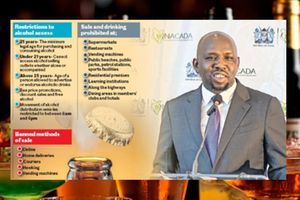
Owuor's story mirrors a national crisis in Kenya According to the National Authority for the Campaign Against Alcohol and Drug Abuse (Nacada), alcohol is the widely abused drug in the country.
According to Simon Mwangi, deputy director of Corporate Communications at Nacada, this pattern is common, with individuals often moving between alcohol and other substances such as miraa (khat), bhang, tobacco, and prescription drugs.
The national current alcohol use prevalence rate is 12.2 per cent among people aged 15–65 years.
A 2022 report indicates that men show significantly higher consumption rates than women. Disturbingly, one in every 14 youths aged 25 to 35—over 596,000 people—was addicted to alcohol at the time of the survey.
Owuor was eventually forced to stop working after his employer received numerous complaints from clients about his behaviour, which included showing up to meetings intoxicated, reporting late for work, and failing to follow up on appointments.
“After losing my job in 2017, all I did for the next five years was drink. I would spend days in bars or local beer dens,” he says.
His turning point came in June 2021 when he was enrolled at Asumbi Treatment Centre, a rehabilitation Centre in Homa Bay County. Four years of therapy helped him slowly break free from alcohol's grip.
Charity Ochieng, a psychologist and founder of Luminar Haven Wellness Hub, explains that prolonged substance abuse disrupts brain chemistry, increasing risks for mental health conditions like depression and anxiety. The consequences extend beyond the individual.
The long-term impacts, she explains, include disrupted brain chemistry, which affects mood, sleep, and cognitive function.
The expert further notes that the effects of alcohol and drug abuse extend beyond the individual, deeply impacting families and the wider community.
"Families can break up when one member is using drugs. This can lead to mental health conditions such as psychosomatic disorders, reduced functionality and impaired judgment," she says.
Elkana Mutaaru, a programmes officer at Asumbi Treatment Centre, highlights peer pressure and psychosocial factors as key drivers of substance use, particularly during festive seasons when social drinking can lead to addiction.
He warns that during festivities, many individuals, like Owuor, may be influenced to start drinking or abusing other substances, potentially leading to addiction.
“Young people need to be mindful of who they socialise with during celebrations to avoid being introduced to alcohol and other drugs,” he advises.
While Owuor is not yet fully recovered, he believes his story is worth sharing to help others still struggling with addiction. Through his community-based organisation, Tumaini Action, he reaches out to those in the grip of alcoholism.
On December 23, 2025, he hosted an inaugural annual half-marathon in Kendu Bay dubbed ‘the Sobriety Run’ to raise awareness about the dangers of alcohol abuse.
"I want to create awareness about alcoholism and give a second chance to all who are already addicted," he says, noting he chose December strategically to reach those tempted to drink for the first time during festivities.
This is even as he raised concerns over the lack of government-owned rehabilitation centres to attend to the needs of those from humble backgrounds.
“The private facility in our area is considered too expensive for many people, which has prevented numerous addicts from accessing the help they need,” he explains.
Willis Okeyo, another recovered addict, has challenged the government to allocate more resources to mental health services to combat drug abuse.
Ken Okoth, Homa Bay County's mental health focal person, confirms a surge in alcohol abuse affecting employed and unemployed individuals alike, including school-going students who often drop out. New cases frequently spike during holidays and festive seasons.
"The impacts are school dropouts among teenagers and unemployment, disease infection and family conflict among adults," Okoth says, noting that professionals with mental health issues often see plummeting productivity.
Despite available support, stigma remains a major barrier to seeking help, leaving many to suffer in silence.