From zero to 27 deaths: Makueni grapples with maternal health crisis
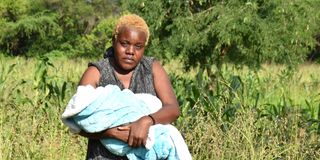
An emotional Olivia Mbaika during the interview in Utithi Village, Makueni County. She has taken on the role of breastfeeding the infant left behind by her younger sister, Caren Bahati, who died after giving birth at Kambu Sub-county Hospital.

What you need to know:
- While the 27 maternal deaths recorded in Makueni County last year are relatively low compared to other regions, they represent a sharp reversal in progress.
- In 2023, the county recorded zero maternal deaths related to postpartum hemorrhage complications.
A family in Makueni County has been thrown into disarray after a mother bled to death following the birth of twin daughters at Kambu Sub-county Hospital.
Two hours before Lillian Mwikali died, medics wheeled her back to the theatre after she complained of dizziness. She died on the same operating table where she had delivered twins through Caesarean section earlier that day. Her death was recorded as yet another statistic in the county's growing maternal mortality burden.
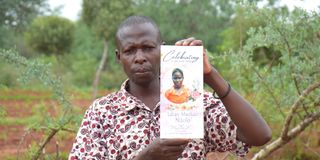
Antony Ndolo holds a funeral programme for his wife, Lillian Mwikali, at their home in Kiembeni Village, Makueni County. Lillian died after delivering twins at Kambu Sub-county Hospital.
"The late Lillian Mwikali was admitted at Kambu Sub-county Hospital on 8/12/2025 and delivered through Caesarean section the following day. She started complaining of dizziness at around 10am. The condition worsened, and she was taken back to the operating theatre, where she was promoted to glory on 9/12/2025," her eulogy reads in part.
Healthy Nation understands that Lillian died from complications related to postpartum hemorrhage (PPH): excessive bleeding after childbirth. It was this condition that medics were attempting to manage when they opened her up a second time within 24 hours.
Antony Ndolo, the widower, was inconsolable when a Healthy Nation team visited their homestead in Kiembeni Village. "Throughout our marriage, we kept praying for twins. Now, unfortunately, she cannot celebrate the answered prayer," he said.
Lillian's death is not an isolated tragedy. According to Ministry of Health data, more than 1,800 mothers died in similar circumstances last year across the country. Nairobi County leads with 313 deaths, followed by Nakuru (98) and Garissa (97).
While the 27 maternal deaths recorded in Makueni County last year are relatively low compared to other regions, they represent a sharp reversal in progress. In 2023, the county recorded zero maternal deaths related to postpartum hemorrhage complications.
The World Health Organization identifies postpartum hemorrhage, excessive bleeding after childbirth, as the leading cause of maternal deaths globally. "It is a major killer of our women. It causes a breakdown of vital organs," said Anne Kihara, president of the International Federation of Gynecology and Obstetrics.
Ndolo embodies the devastating toll of this condition. A stone mason who once worked in Nairobi, his days are now consumed with caring for the twin daughters, feeding them formula donated by well-wishers, washing clothes, and cooking for the family.
In the neighbouring Utithi Village, an extended family has been thrown into mourning after a young mother succumbed to complications related to PPH, the same problem which killed her mother 20 years ago. Caren Bahati died under unclear circumstances while receiving treatment at the Makindu Sub-county Hospital, where medics rushed her when she had developed complications after giving birth through Cesarean section at the Kambu Sub-county Hospital in the run up to Christmas. An elder sister has turned to breastfeeding the infant.
Olivia Mbaika fought tears as she took turns to breastfeed her daughter and her sister’s son. “As he latches onto the breast, he reminds me of his mother. I raised Bahati for 20 straight years. She was orphaned at birth after our mother succumbed to PPH. I cannot afford to watch her grandson suffer,” she told Healthy Nation.
The spike in maternal deaths in Makueni County has sparked intense outcry. “Our work is becoming increasingly difficult,” said Esther Nzioka, a community health promoter in Utithi Village. “Some communities now believe it is safer to deliver their babies at home. We are likely to see a return to home deliveries. This is a dangerous situation,” she added.
Former Makueni Governor Kivutha Kibwana said the maternal deaths crisis reflects a broader healthcare system failure. "Health workers are harassed, morale is broken, and exits are mounting. The greatest loss remains the deliberate destruction of a system built by and for the people," he said recently, referring to a homegrown insurance scheme that provided free healthcare to nuclear families in county hospitals for an annual fee of Sh500. His successor, Governor Mutula Kilonzo Junior, has since dismantled the scheme, dismissing it as unsustainable.
However, Health Chief Officer Harvey Mulei has pushed back against the growing perception that maternal deaths have overwhelmed the county. He insisted that medics remain committed to ending the problem. "We take maternal deaths and PPH seriously. Healthcare workers have not been negligent on this particular issue," Mr Mulei told reporters.
Prof Kihara, a lecturer in the Department of Obstetrics and Gynecology at the University of Nairobi, is among experts who once viewed Makueni County as the gold standard in preventing maternal deaths. Governor Mutula Kilonzo Junior's administration has since partnered with development partners to deploy a range of interventions aimed at reversing the trend. These include retooling medics on safe motherhood to prevent and treat PPH, introducing new medicines such as heat-stable Carbetocin, rolling out technologies to address maternal deaths, and aggressively promoting hospital deliveries.
Kilonzo Jnr has faced mounting criticism from stakeholders, who accuse his administration of dropping its guard against maternal deaths. At a recent meeting to review the latest fatalities, he criticised medics, accusing them of emotional numbness in the wake of the spike. He has since demoted and transferred Abdulaziz Ali and Emmanuel
Laiposha, the former medical superintendents at Kambu and Makindu sub-county referral hospitals, respectively, in a shake-up aimed at enhancing service delivery.
"Healthcare workers in Makueni should understand that those seeking emergency services turn to hospitals to save their lives. We are looking into this so that we do not end up losing mothers as they give birth, as well as infants," Kilonzo Jnr told reporters on the sidelines of a ceremony to commission Ngakaa Hospital, a Level 4 facility funded jointly by the county government and World Vision International. He is betting heavily on cooperation with NGOs to turn around the maternal deaths trend.