Groundbreaking treatment for sickle cell disease approved for use
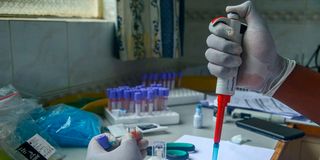
A lab technician conducts an electrophoresis test during a free sickle cell screening medical camp in Nairobi. Treatment for the disease has been approved for use in England for older children and adults with a severe form of the disease.

What you need to know:
- Sickle cell causes between six and 15 deaths out of every 100 deaths among children aged less than five years old globally.
- The Ministry of Health estimates that 14,000 children are born with the disease in Kenya annually.
Treatment for sickle cell disease, the most common inherited blood disorder in Kenya, has been approved for use in England for older children and adults with a severe form of the disease.
The treatment, in the form of a one-time gene therapy called exagamglogene autotemcel, or exa-cel, edits the faulty gene in the stem cells of a sickle cell patient.
According to the Centres for Disease Control and Prevention, sickle cell disease is a “group of inherited red blood cell disorders. Red blood cells contain hemoglobin, a protein responsible for transporting oxygen. Normally, these cells are round and move smoothly through small blood vessels to deliver oxygen throughout the body.
In individuals with sickle cell disease, the hemoglobin is abnormal, causing red blood cells to become rigid, sticky, and shaped like a sickle—a C-shaped farming tool. These misshapen cells have a shorter lifespan, leading to a persistent shortage of red blood cells. Additionally, as they pass through small blood vessels, they can become lodged, obstructing blood flow.
During the gene therapy treatment, blood stem cells are removed from a patient’s body. Using CRISPR technology, a gene in a patient’s bone marrow stem cells is edited so that the body produces functioning haemoglobin. The treated cells are then returned to the patient through an infusion.
Clinical trials have shown that the therapy can stop painful sickle cell crises, a painful episode that occurs when sickle-shaped red blood cells clump together and block blood vessels. The trials also showed that “there was a functional cure” in 96.6 per cent of patients who received it.
Before this new one-time treatment became available, managing the disease required lifelong treatment regimens that greatly affected the quality of life for sickle cell patients. Patients endured chronic pain, the constant threat of sickle cell crises, frequent hospitalisations, and reduced life expectancy.
In clinical trials, every patient who received exa-cel remained hospital-free for a year after treatment, and nearly 98% continued to avoid hospitalization up to 3.5 years later. A survey from the Sickle Cell Society found in the past two years, before the availability of exa-cel, a quarter (24 per cent) of people with sickle cell disease had spent between one and two weeks in hospital.
Even though the treatment provides hope for sicklers, it is currently being offered in the UK for Sh262 million (£1.65 million.) According to the England’s National Institute for Health and Care Excellence, the treatment will be available only to eligible patients who are aged 12 and older, and who “experience recurrent sickle cell crises and would be suitable for a stem cell transplant but where a donor is not available.”
Sickle cell causes between six and 15 deaths out of every 100 deaths among children aged less than five years old globally.
The Ministry of Health estimates that 14,000 children are born with the disease in Kenya annually.
“The sickle cell disease burden follows malaria endemic patterns in Kenya. The high burden areas include lake-region, western and coastal region of Kenya. Due to migration patterns, sickle cell is also found in the urban and commercialised areas in Kenya,” states the ministry on its policy paper on infant screening for sickle cell disease.
"The sickle cell gene developed in areas that had malaria to protect against severe forms of malaria. And so to reduce these mortalities due to malaria, nature has got its own way of responding. Now, if you have the sickle cell trait, then you are protected against malaria. My county of Bungoma is affected more. Currently, in the clinic I run for sickle cell, we are seeing more than 1,200 patients with confirmed sickle cell," says Dr Dickens Lubanga, a pediatrician based in Bungoma Referral Hospital.
He decries the high cost of the treatment, which makes the critical treatment beyond reach for most of the patients. He explains that the current preferred mode of treatment in the country is bone marrow transplant, "which even Kenya itself is unable to do." This , he says, has resulted in doctors sending most of the clients to India for transplant to ensure their quality of life improves, and to reduce the number of transfusions and crises.
The doctor also decries the lack of adequate data on sickle cell in the country, which he attributes to the Kenyan population being unable to afford the confirmatory test for sickle cell. The test is offered at the referral hospital at Sh1,500.
The doctor also laments that the government has not conducted any studies to map up the entire population in order to establish the number of people affected by sickle cell. Donors have also been elusive, he says.
"In Western region, Bungoma is the only county that has Hb electrophoresis, a device used to screen for sickle cell and give a confirmatory test," he adds.
He explains that even though awareness about the disease has been created, it is not enough, and that some people in the community still believe that the disease is brought about by witchcraft.
"We have tried to have awareness creation workshops. We have walked around the whole of Bungoma telling people that this is an inherited disease and informing them about the importance of screening," says Dr Lubanga.