Homa Bay families brace for floods as critical control project stalls
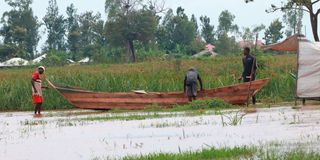
Residents of Simbi Kogembo Village in Rachuonyo North, Homa Bay County assemble a fishing boat, which they use to move around the neigbourhood during floods, on May 13, 2025.

What you need to know:
- Flooding has become a reliable campaign tool for politicians in the region, the locals say, who promise to address the challenge if elected.
- But none have ever delivered a lasting solution.
- The abandoned dyke project is just the latest in a long line of broken promises.
Rachel Ondago used to know when the rains were coming. For years, the pattern was reliable: April, then October. She could prepare, secure her belongings, and brace for the inevitable flooding that would follow. But not anymore.
"Sometimes we go to sleep but wake up the following day with our homes flooded. It is not possible to tell when a disaster would strike," Ms Ondago said.
Over the past five years, everything has changed in her village in Rachuonyo North, Homa Bay County. The predictability that once allowed families to protect themselves has vanished, replaced by a new reality where floods can strike at any time. And with the rainy season from October to December beginning, Ms Ondago and her neighbours are gripped with fear, especially because a government project that promised to end their suffering has stalled.
When climate change hits home
Her experience reflects what climate experts have been warning about. Climate change is intensifying the water cycle and reducing the land's ability to absorb water, making flooding in Rachuonyo North more frequent and unpredictable.
The water that inundates her village doesn't fall from the sky above. It begins its journey in the Mau Forest Complex and surrounding Mau Escarpment in Nakuru, Bomet and Kericho counties, where River Miriu has its tributaries. When heavy rains fall upstream, communities like her's downstream in Homa Bay bear the consequences.
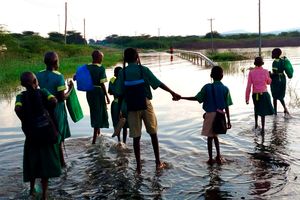
Every year, the same cycle repeats. River Miriu bursts its banks. Floodwaters sweep through villages, destroying homes and farmland. Hundreds of families, including Ms Ondago's neighbours, are forced to abandon their houses and seek shelter in schools, churches and health centres, where they wait for relief organisations like the Kenya Red
Cross to bring food and drinking water.
Mr Joel Otieno, an 80-year-old resident who has witnessed this transformation over decades, says the intensity has grown to dangerous levels. He remembers when floods were manageable. Now, they threaten lives and livelihoods.
"Flooding has negative economic effects. Farms get destroyed and food becomes scarce. Education is also suspended when families camp in schools," he said.
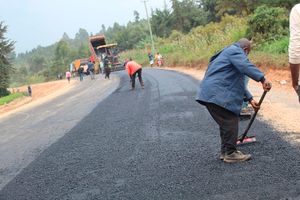
This year brought hope. The government, through the National Youth Service, began constructing dykes along River Miriu from Kobuya to Wang Chieng location. The structures were designed to channel water straight to Lake Victoria without diverting into residential areas.
The entire community celebrated when excavators arrived. Enock Agalo, a community leader in nearby Konyago village, said families felt relieved for the first time in years.
"We all felt relieved when the work started. But suddenly the project stopped. Those who made inquiries were told that the team was waiting for water levels to recede," Mr Agalo said.
The project ran out of money. Workers withdrew, leaving equipment sitting idle at the construction site. In areas where dykes were completed, floods have been brought under control. But the partially finished work has created a new danger.
"A lot of people will still be affected if the work does not continue because water will exit the river from one point and flood homes and the effect will be intense. In the past, water flowed from different points along the river," Mr Agalo said.
By concentrating the water flow without completing the full system of dykes, the suspended project could make flooding worse in unprotected areas like Ms Ondago's village.
For families like hers in Konyago, the situation is particularly dire. They regularly camp at Osodo Primary School when their homes are destroyed, where Mr Agalo says life is unbearable as people share limited space to sleep.
Two years ago, the area faced flooding from another direction. When water levels in Lake Victoria rose, backflow from the lake flooded beaches with lower shorelines, trapping communities between two sources of water.
Waiting for solutions that never come
Flooding has become a reliable campaign tool for politicians in the region, the locals say, who promise to address the challenge if elected. But none have ever delivered a
lasting solution. The abandoned dyke project is just the latest in a long line of broken promises.
Ms Ondago has had enough. The unpredictability, the recurring displacement, the destruction of farms and the constant fear have worn down her community.
"We are ready to move to a settlement scheme if floods in this region cannot be addressed. We are concerned that we will not grow as flood intensity increases every year. We need a lasting solution to this problem," Ms Ondago said.
Other residents suggest dredging River Miriu to increase its depth so it can accommodate more water flowing into the lake.
Rachuonyo North Deputy County Commissioner Aaron Koros acknowledged the crisis and said the dyke project will resume soon. He explained that funds sent to NYS for the
project, which was partly supported by the Interior Ministry, were exhausted before the work was completed.
"We are aware of what is going on. We are pushing for the work to go on and be completed before the rains. We requested the county government to help the State in supporting the project and they are ready to offer their assistance," the administrator said.
But for Ms Ondago, these assurances ring hollow. She's heard promises before. The rainy season is already beginning, and she doesn't know if she'll wake up tomorrow with water in her home. All she knows is that without intervention, the cycle will continue. Another season of fear. Another displacement.