Hospitals face closure, auction over unpaid SHA claims, lobby warns
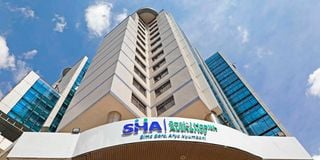
The Social Health Authority building in Nairobi.

Dozens of hospitals in the country are now running on empty coffers following a freeze of payment from the Social Health Authority (SHA) after rejection of claims with no feedback from the insurer.
They consist of mostly lower level facilities in urban estates and rural areas.
This is according to data shared by the Rural and Urban Private Hospitals Association (Rupha).
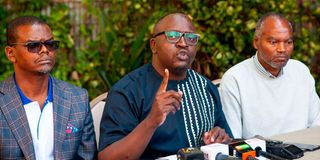
Members of the Rural and Urban Private Hospitals Association of Kenya, from left, Vice Chairman Joseph Kariuki, Chairman Dr Brian Lishenga and Simon Mbugua address journalists at the Boulevard Hotel in Nairobi on February 20, 2025.
Dr Brian Lishenga, the Rupha chairperson, told Nation that SHA has not paid facilities—which includes those under the authority, as well as faith-based and even public hospitals—approximately Sh35 billion.
“It’s like being in a bad marriage that you cannot leave,” Dr Lishenga Nation.
“There is a huge backlog, especially from inpatient medical claims, surgical claims, renal and cancer related treatment,” he adds.
Dr Lishenga says that this backlog goes all the way to six months ago and that the Health ministry says that they are reviewing those claims.
“We expect that when they review, there will be progress. So far, there is none. It has been going on for too long,” he says.
In an interview with Nation last week, Health Cabinet Secretary Aden Duale said that SHA is doing its due diligence and it is hospitals that are not doing what is required.
"Every 14th day of each month, we pay claims. Those that have not been paid either have a missing document or something was not done correctly, and the system flags it. Hospitals should stop claiming they do not know why their claims have not been paid. The system automatically informs them," Mr Duale said.
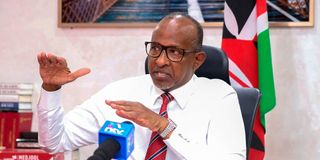
Health Cabinet Secretary Aden Duale during an interview in Nairobi on January 26, 2026.
We reached out to the CS for a comment on this specific position by the private hospitals and a specific case we highlighted, which reflects many others, but he had not respond by the time this story was going to press.
We also reached out to SHA CEO Mercy Mwangangi with the same questions, but had also not received a response.
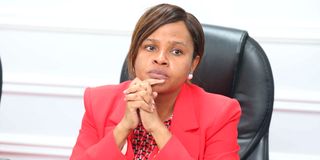
Social Health Authority CEO Dr Mercy Mwangangi.
But for individual private hospital owners, the financial hole and its consequences are real.
A private hospital owner, who asked to remain anonymous so as to freely discuss the matter without fear of victimisation, said for five months now, he has not received any payment from SHA despite adhering to all the requirements.
The authority owes him about Sh15 million.
His hospital has been running for six years, and was previously categorised as a Level 3B by the Kenya Medical Practitioners and Dentists Council (KMPDC).
In those years prior to the transition to the Social Health Authority, his hospital was not accredited by the defunct national insurer but it served patients who paid in cash and had other insurances.
When the president passed the four health bills and SHA became fully functional, he applied for accreditation and got into a contract with the Social Health Authority.
Mid last year, the government automatically altered the status of some facilities and this owner’s status changed from 3B, to 3A. KMPDC later made the announcement on the changes through a gazette notice.
“We were not consulted,” he tells Nation.
“The problem is they have used these changes to deny us funds,” he adds.
When his facility’s status changed, he bought new equipment on credit to match the status of the facility.
He bought machines for the maternity unit, theatre, the dental unit, which now has a functional dental x-ray and ultrasound machines.
"These machines are very expensive for one person to manage, so I paid part of it from my savings and took them on credit,” he explains.
It cost him about Sh8 million to buy the machines and he only managed to pay the suppliers about Sh2 million and is obligated to pay another Sh354, 000 every month to clear his debt.
“At a level 3A facility, our rebates are very small. Making such an amount every month is not something that comes easy. We have a lot of expenditure,” he says.
In the last five months, he has not been able to remit any payment from the debt that he owes the suppliers. The suppliers threatened to auction the equipment at the facility, but he negotiated with them by asking them to take one machine –the anaesthesia machine, that would help in reducing the debt.
“I gave it to them with the hope that SHA will pay. I don’t know what I will do when they come again next month. I agreed to give it away at a loss, but what do I do?” he asks.
His facility continues to receive clients every day. More than half of the Kenyans (sH29 million) have registered for SHA and when they go to a facility, they have been enlightened that services should not be rendered out-of-pocket. Facility owners, like the one we spoke to, have to offer the services hoping that one day, SHA will pay them.
“Patients are entitled. Our biggest headache is that we cannot ask them to pay in cash. I know of some facilities that tried that and some patients called SHA and that resulted in their closure. There was no investigation done,” he tells Nation.
This owner is not able to stock drugs anymore. Earlier, they could get into a contractual agreement with pharmaceutical companies and could get drugs worth at least Sh1 million.
He explains that they have done that in different pharmaceuticals and they have now been flagged and cannot take drugs unless they pay in cash.
“That is why we don’t have drugs,” he says. “We cannot tell this to patients. We agree to see them but sometimes we don't even have reagents for lab tests,” he adds.
Every month, this facility owner has running costs of more than a million shillings comprising, but not limited to, rent (Sh200, 000), equipment debt (354,000), salaries (450,000) exclusive of other bills like electricity, water and licenses.
“We don’t know why we haven’t been paid. I have duly filled the claim forms. I have followed up with SHA via email, and in person. When I get to their branch they say that they can’t see our attachments yet, on our end, all attachments are up to standard,” he says.
“For a maternity case for instance, we have even asked SHA officials to do the due diligence and call the women asking them if they delivered in our facilities. Instead, they are rejecting claims without verification or an explanation,” he adds.
When the defunct NHIF transitioned to SHA, the digital system was meant to curb fraud. The ministry has in the past accused private facilities of leading in fraud cases, one which the system was to curb before it happens. The facility owner we spoke to says that since 2024, new changes keep coming up in the portal, sometimes leaving them with no room to defend claims that they uploaded and cannot get money owed to them by SHA.
Last year, he resorted to firing some staff but since they did not have another option, they asked to stay even with reduced salaries.
“No one is listening to healthcare providers. If this continues, there will be a crisis in the system soon. We feel like the government knows what they are doing,” he says.
Follow our WhatsApp channel for breaking news updates and more stories like this.


