How bees became the unlikely guardians of Wire Forest
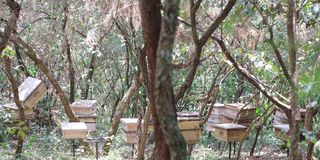
An apiary in Wire Forest, Homa Bay County on September 28,2025. Bees in the hives protect the forest from logging.

What you need to know:
- The hives are placed strategically along the forest boundary—a few metres from the edge, separating communal or private land from the gazetted forest.
For communities living on the edge of Wire Forest in Homa Bay County, the dense woodland was once a quick source of cash. Need school fees or food? Simply walk in, chop down a tree, and sell it for timber or charcoal. This practice led to one of the highest logging rates in the region, leaving swathes of the 500-hectare forest bare and endangered
Today, the forest is protected by an unexpected force: bees: bees. These insects have stings potent enough to kill humans or animals that threaten them. While the bees are simply defending their hives, their presence effectively deters illegal loggers, thereby reducing deforestation in the long run.
Also read: Rescuing Eburu Forest through beekeeping
The transformation began in 2015 when community leaders like North Kamagak Location Chief Benson Midigo recognised the self-destructive path they were on. "It became a concern to the government as the rate of tree cutting surpassed the number of tree seedlings being grown," Midigo recalls.
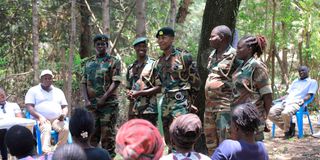
Kenya Forest Service rangers during a meeting with community members who live around Wire Forest.
The Kenya Forest Service (KFS) was struggling. Rangers patrolling the woodland would constantly encounter illegal loggers and hunters. Their efforts to stop the destruction only bred enmity. "Whenever community members saw KFS officials, they would run away," says Midigo. Residents saw the rangers not as protectors, but as enemies blocking their livelihood.
Christopher Osunga, chairperson of the Wire Forest Management Association (WIFOMA), echoes this sentiment. He explains that for anyone in need of money, the forest was the easiest source of income. They would cut down a tree to make timber or charcoal to sell. "Some people acted with impunity, cutting down trees without considering the consequences," he adds.
The solution emerged through sensitisation and engagement. Instead of being told what they couldn't do, the community was shown a better way to benefit from the forest: beekeeping.
Residents were allowed to establish apiaries within the forest's boundaries. Now, instead of destroying trees, they harvest honey. This has created a perfect symbiotic relationship where humans, the insects and trees benefit.
The hives are placed strategically along the forest boundary—a few metres from the edge, separating communal or private land from the gazetted forest. According to Osunga, their purpose is twofold: to produce honey and to provide security. This is evident to anyone walking the forest paths, where hives buzz with activity.
"The local farmers decided to place beehives in areas with the indigenous trees that were being targeted by loggers. By tying the hives to the trees, the bees naturally guard the forest as their home," says Ousunga, adding: “The bees' aggressive nature deters any would-be logger. No one can dare disturb them and engage in illegal logging.”
When it's time to harvest honey, farmers don protective bee suits and notify the KFS to minimise the risk of bee attacks. Over the past decade, WIFOMA's efforts have led to a remarkable transformation: the forest has matured, a local stream that was nearly dry has been replenished and now supplies water to residents, and annual honey production has soared from three to eighteen tons. "Beekeeping helps us conserve the environment because the bees pollinate diverse plants, enabling the forest to regenerate," says Osunga. He adds that bees help in maintaining food chain stability.
Residents also report that monkeys, which once struggled to find food and would invade homes, no longer do so because the increased fruit production from pollination now provides them with plenty to eat.
According to Osunga, who was instrumental in pushing for this change, the community is also engaged in alternative income-generating activities that do not harm the environment, including the development of kitchen gardens.
Members of WIFOMA meet every first Friday of the month to discuss conservation matters.
“Our team is engaged in environmental conservation, which they did not do in the past. They need more support from the government to further protect the forest,” says Osunga.
Currently, 1,200 hives have been installed around Wire Forest, each producing seven to nine kilogrammes of honey that sells for Sh800 per kilo. To further boost their income, farmers intend to scale up to 10,000 hives. This expansion will be supported by training in modern beekeeping practices and the production of value-added bee products beyond
honey.
The partnership
WIFOMA is partnering with the Lake Basin Development Authority to boost conservation efforts, focusing on rehabilitating over 50 acres of degraded land within Wire Forest.
LBDA Director Philip Oloo states the agency will help farmers register as a cooperative society and expand membership. He praised WIFOMA as one of the country's best community forest groups, noting that while conservation is often thwarted by individual interests elsewhere, this group has prioritised the forest's protection. “They have set aside personal interests to work together for a common cause.”
Oloo highlights that one of the world's most significant challenges is environmental degradation, which disproportionately affects farmers. Those dependent on rain-fed agriculture are particularly vulnerable, as unpredictable weather makes it impossible to know when to plant.
To address this, his agency engages in conservation and intends to improve a local spring originating from the forest by installing storage tanks. He acknowledges that a major hurdle in this work is ensuring the survival of tree seedlings, which require consistent care. "It is difficult because the seedlings need someone to take care of them
to mature," he says. However, at Wire Forest, the agency will overcome this challenge by partnering with WIFOMA members to protect the fragile seedlings.
Mr Robert Okwako, KFS deputy station manager at Wire, emphasises the critical partnership between rangers and the local community in their conservation efforts. He explains that communities living within five kilometres of the forest benefit directly from its resources such as collecting firewood and grazing livestock at its edge for a monthly permit fee of Sh116.
“We support each other whenever there is a need. This cooperation helps to reduce pressure on the forest.” However, he warns that threats from climate change pose a major risk to the forest's survival. To counter this, he calls for expanded collaboration and partnerships to address these growing environmental threats.
Plant Trees for a Better Environment is already partnering with KFS to improve tree cover and contribute to the national goal of growing 15 billion trees by 2032. The organisation's patron, Nuhu Masud reports that his team has already planted over 800,000 trees across the county since 2023.
“We are committed to continuously planting trees to improve the environment and combat the negative impacts of climate change.”
According to Homa Bay County Forest Conservator Sharon Cheluget, the current forest cover in the region is 3.1 per cent, a notable increase from previous years but still far below the national average of 10.1 per cent and the constitutional minimum of 10 per cent.
Echoing the need for sustained effort, Masud urgedsresidents to embrace tree growing as a cultural practice to ensure success in the fight against climate change.