How communal conflict led to destruction of Lambwe Forest
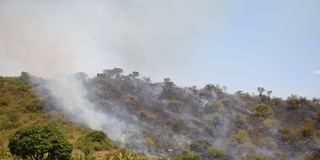
Lambwe Forest on fire.

What you need to know:
- Residents from both sides repeatedly set fire to the forest as part of territorial disputes. These perennial fire incidents killed countless trees and created large deforested areas.
Five decades ago, River Lambwe was a perennial water source, sustaining both livestock and agricultural activities in the region. Farmers in Lambwe, Homa Bay County, relied on its consistent flow to water their animals, and its banks served as a communal gathering point, fostering social interactions among locals.
However, this changed when the river dried up. Today, it is a seasonal river.
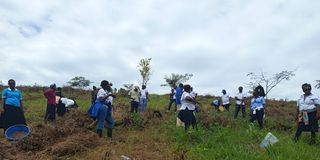
A tree planting exercise in Lambwe Forest.
Rain also comes with a lot of changes. Sometimes the river swells and bursts its banks before flooding homes. Residents blame these changes to environmental degradation, which is linked to deforestation in Lambwe Forest, a critical water catchment area for the river.
The forest, once a thriving ecosystem, has suffered decades of destruction primarily due to communal conflicts over boundaries and ownership. This environmental degradation has led to the drying up of River Lambwe, changes in local rainfall patterns, and threats to biodiversity.
According to Aba Eban, operations officer at Million Tree March - a local environment conservation organisation - the forest used to have many trees 30 years ago.
Mr Eban says the region used to receive adequate rainfall and that the forest, which is one of the largest in Nyanza, supported different living organisms and activities, including farming.
The destruction of Lambwe Forest stems from longstanding boundary disputes between communities in Ndhiwa and Mbita sub-counties:
Residents from both sides repeatedly set fire to the forest as part of territorial disputes. These perennial fire incidents killed countless trees and created large deforested areas.
"People from Ndhiwa claimed ownership of the forest. On the other hand, the Suba people insisted that the forest belonged to them. This led to many cases of arson in which unknown people used to burn the forest," he says.
Further, the shamba system exacerbated the conflicts: The colonial-era agroforestry practice (growing crops among trees) became a source of tension when some farmers grew jealous of others benefiting from forest cultivation. This jealousy led to retaliatory forest burning.
Ecological impacts
Mr Eban notes that the deforestation and environmental degradation in the forest are causing severe ecological impacts, particularly threatening water sustainability.
But all is not lost.
Recent government-led initiatives are working to restore the forest to its former glory through large-scale tree planting and community engagement programmes.
Lake Victoria South Water Works Development Agency (LVSWDA) has planted over 40,000 trees in an 18.8-hectare section of the forest.
LVSWDA senior manager in charge of Research and Strategy Siwa Miriama says: "Water comes from rivers, and rivers originate from forests. One of our missions is environmental conservation and we confine ourselves to gazetted government forests.”
The agency has partnered with Million Tree March and local community-based organisations to restore degraded forests.
LVSWWDA is working with Kenya Forest Service, which provides land allocations and expert advice on appropriate tree species.
Ms Miriama says the planted trees will enhance groundwater recharge, ensuring River Lambwe flows year-round. She adds that trees help in the formation of rainfall.
Ms Pamela Adhiambbo, a resident of Lambwe, notes that with the restored river, farmers won’t need to trek long distances to Lake Victoria for water, saving time and reducing livestock deaths.
As Lambwe Forest gradually recovers, it stands as a testament to both the destructive power of human conflict and the restorative potential of coordinated conservation efforts.