How controlled fires could save Tsavo ecosystem
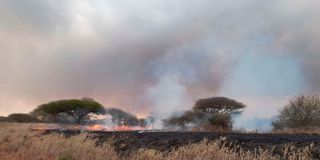
Fire at Tsavo West National Park in Mwaktau, Taita Taveta County. The ecosystem faces increasing wildfire threats linked to climate change and human activity.

What you need to know:
- Controlled fires refer to planned application of fire by a team of fire experts to land to achieve specific goals such as reducing wildfire risk, restoring health to ecosystems, or improving wildlife habitat.
- This is different from wildfires, which are unplanned and can be destructive.
Wildfires, often viewed as unmitigated disasters, have long been a thorn in the side of conservation efforts in Kenya, particularly within the Tsavo landscape, which has borne the brunt of frequent blazes in recent years. The ecosystem faces increasing wildfire threats linked to climate change and human activity.
And while the law strictly prohibits the use of fire in protected areas, a nuanced and seemingly controversial conversation method is beginning to unfold as environmentalists and researchers engage stakeholders within the Tsavo conservation area.
Leading this dialogue is Dr James Millington, a landscape ecologist at King’s College London and a member of Leverhulme Centre for Wildfire Environment and Society, alongside PhD researcher Amos Chege. The duo is advocating a paradigm shift in how Kenya approaches fire management, challenging the idea that all fires are inherently destructive, instead suggesting that a more proactive and strategic use of fire could be the key to safeguarding vital ecosystems.
"Fire is increasingly seen as a negative thing, but it is a natural part of many ecosystems, and around the world, there are many landscapes in which fire is an integral component," Dr Millington told Nation.
The perspective is a radical departure from the prevailing fire suppression policy that has dominated the country’s conservation strategies. Kenya's approach has been reactive, focusing on extinguishing fires once they ignite rather than preventing larger, more destructive wildfires. This strategy, Dr Millington argues, allows vegetation to accumulate, creating a fuel load that, when ignited, can lead to uncontrollable and devastating blazes.
"We have tried to suppress fires by putting them out when they start. That's important sometimes to protect property and lives, but it also allows vegetation to regrow without being burned. So when we have a fire with lots of vegetation, it can become challenging to control," he explained.
Instead of viewing fire solely as a threat, Dr Millington advocates for understanding its role in ecological balance and strategically deploying controlled/prescribed burns to reduce fuel loads and promote healthy ecosystem functioning. Prescribed burns, also known as prescribed fires, refer to planned application of fire by a team of fire experts to land under specific conditions to achieve specific goals such as reducing wildfire risk, restoring health to ecosystems, or improving wildlife habitat. This is different from wildfires, which are unplanned and can be destructive.
Dead trees
Controlled burns remove excess fuel build-up (dead trees, dry vegetation) that can feed a wildfire, making it less likely to spread and more manageable if it does start. They can also create or maintain habitats for certain plant and animal species, promoting biodiversity. Fire is a natural part of many ecosystems, and controlled burns can help restore or maintain these fire-adapted environments. The burns can also be used for land clearing, controlling plant diseases, and improving rangeland health.
"We want to increase the number of safe, controlled fires and reduce the number of very intense, uncontrollable fires. We need to shift our perspective and think about which fires are beneficial and which are harmful, rather than banning them outright."
Dr Millington cited examples from around the world, particularly Northern Australia, where reintegration of indigenous peoples' knowledge and practices of fire management has proven effective in preventing large, uncontrollable wildfires.
"Maybe we can learn from some of those practices and apply them in African savannahs," he said while acknowledging the need to adapt these practices to the specific contexts of Kenya.
He said that a crucial aspect of their initiative in Tsavo is the emphasis on community involvement, where locals, with their invaluable intergenerational knowledge of fire and its uses, hold a key to developing sustainable fire management frameworks.
"Engaging local communities is key. They possess invaluable knowledge about fire that has been passed down for generations," Dr Millington said.
Mr Chege, whose research delves into documenting fire patterns across Kenya’s protected and unprotected areas, noted the critical role of fire in shaping habitats, controlling vegetation, and improving soil quality.
"Fires are very important in the ecosystems and even from a social perspective. Local communities have benefited so much from fires by managing pests within areas of grazing, even clearing their farms. Without fire, we risk losing biodiversity," he said.
Mr Chege said historical community and indigenous knowledge about fire have often been overlooked or disrupted, noting that most indigenous fire management practices were disrupted by colonisation, which resulted in communities not being fully involved in fire management frameworks.
"So, we thought it would be wise to start at the local level, look at how local communities can be involved in management and also utilise the indigenous knowledge that they have to manage fires, which are now increasing in frequency," he said.
The proposal is not merely academic as it aims to accelerate community involvement in developing an integrated fire management plan for Kenya.
The plan, which is expected to be drafted by the end of the year, entails a collaborative effort involving all stakeholders, including local communities, ranch managers, county governments, and national government agencies.
"Ideally, this would be a partnership of all stakeholders who are living, governing, and working in the Tsavo wider area landscape. The plan is holistic, and it integrates both scientific research and indigenous knowledge that communities have used throughout. It can be more cost-effective and environmentally beneficial," he said.