How Covid pandemic birthed my clean fuel business
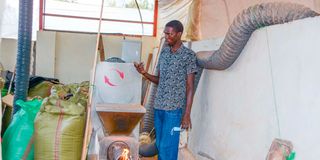
Raymong Obura at his briquettes production centre in Orongo, Kisumu County, on October 9, 2024.

What you need to know:
- Charcoal production remains a major driver of forest degradation and deforestation in the country.
While the 2020 Covid-19 pandemic had a negative impact on the lives of millions of people worldwide, it was a blessing in disguise for Raymond Obura, a resident of Kisumu, who now owns a briquettes production centre.
During the lockdown that forced people to stay in their homes, Mr Obura seized the opportunity to research on clean energy, a move that has since led to the production of non-carbonised briquettes.
The former accountant turned environmentalist successfully set up the briquettes production centre in Orongo, Kisumu County in 2023 after obtaining a certificate from the National Environment Management Authority (Nema).
He now supplies the alternative source of fuel to small scale users, who have been relying on firewood.
The move, he says, targets to increase the forest cover by reducing the number of trees felled for firewood and charcoal.
Unlike the briquettes made from charcoal dust among other components, which he says still contributes to charcoal production, Mr Obura uses dry saw dust and rice husks, which are compressed at high temperatures to produce a wood-like material.
"Every kilo or tonne of briquettes we produce prevents a number of trees from being cut down. Trees balance the ecosystem in so many ways and by conserving more, we are contributing to the government's initiative of increasing forest cover,” says Mr Obura.
His journey towards production of clean fuel began in 2020 when the accountant, then working from home, realised that while a number of sectors were threatened by Covid-19 pandemic, the food and energy seemed undisturbed. While employees lost jobs and companies closed down, the energy and food sector presented opportunities.
In the beginning, he tried to invest in green house farming, but the project failed, sending him back to the drawing board.
“While exploring the energy sector, I realised that starting a green energy business required a lot of capital,” says Mr Obura.
The 35-year-old explains that at the time, the government had imposed a ban on logging but some individuals would still acquire wood illegally to produce charcoal.
Charcoal production, he notes, remains a major driver of forest degradation and deforestation in the country.
“The impacts of charcoal production got me thinking if there was a way we could produce clean fuel in a sustainable manner while adhering to the current regulations and laws,” says Mr Obura.
While still researching, he says he came across charcoal briquette production. “However, I realised that this alternative energy source largely relied on charcoal dust and still contributed to deforestation.”
Eventually, he came across an extrusion briquette maker, a machine used to produce briquettes. He had an option of either producing carbonised or non-carbonised briquettes. Due to lack of enough funds, he settled on the non-carbonised briquettes, a fuel made from waste materials yet to undergo carbonisation.
The rod-shaped briquettes, he says, are made from compressing fine particles of dry saw dust or rice husks.
“The aim of my project is to come up with a waste management company, where I will be converting waste to wealth,” says Mr Obura.
He adds: “I was sure that my business would have ready customers since a number of households in the country still use charcoal or wood as energy sources.”
After months of researching, Mr Obura visited the Kenya Forest Service offices in Nairobi for expert opinion and directions.
He also went o Nema for an environment assessment report and received a clean Environmental Impact Assessment report.
With his savings, contributions from family and friends and a bank loan, he imported the briquette extruder from Asia in 2023 and had it moved to his parents’ home in Orongo.
When Healthy Nation team visits him on a Wednesday morning, Mr Obura is busy sun-drying rice husks and saw dust ahead of crushing.
He says the waste is often bought from either rice farmers or furniture workshops at Sh70 per 90-kilogramme bag.
After two days of drying, the raw materials are weighed while checking their moisture content. Before crushing, Mr Obura says the saw dust and rice husks moisture content should be between eight to 12 per cent.
"I have a solar dryer, where I can also place the material especially on rainy days to fasten the drying process," he says.
Once dried, he crushes the raw materials to smaller particles at three to five millimeters and later moves them to the extrusion briquette maker.
The machine compresses the raw materials at 250 degrees Celsius using either electricity or solar energy.
Once compressed, the end-products, briquettes, are ready for use.
"With this technology, we do not have to place the briquettes out to dry - they are always ready for use " he says.
Mr Obura says one of the major advantages of using the briquettes is that they have a higher energy density and produce minimal smoke.
The briquettes, unlike wood, can be utilised in smaller portions. “One needs just a few briquettes to meet their energy needs.
"Our machine has a capacity of producing 250 kilogrammes of briquettes within two hours. However, our current production remains low because we manually feed the raw material to the system," he says.
Mr Obura, who sells the briquettes at Sh35 per kilogramme, says he is targeting schools, restaurants, catering industry and individuals at home. Currently, he supplies the briquettes to small scale users.
While the material is preferred for use as an alternative 'wood’, Mr Obura says it can also be used on energy saving jikos in place of charcoal.
"There is still a need for public education to create awareness on the new product. At the moment, we have consumers who are returning customers," says Mr Obura , noting that he has been receiving positive feedback.
He says when embraced, the project will play a major role in contributing to the government's agenda of increasing tree cover by 30 per cent come 2030.
On December 21, 2023, President William Ruto launched a tree restoration programme aimed at planting 15 billion trees by 2032.
The President, who led the nation in planting 560,000 trees, also planted 56 trees to mark his 56th birthday.
According to Mr Obura, adopting clean energy sources is one way of ensuring the planted trees are protected.
Mr Obura now plans to buy a furnace, which will enable him to produce carbonised briquettes to be used as an alternative for charcoal.
[email protected]