How Kenya can turn its ports into billion-dollar green fuel hubs
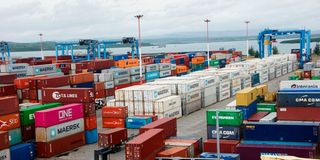
Shipping containers at the Port of Mombasa. The ports of Mombasa and Lamu serve as key gateways for Eastern Africa's trade, while the country's investments in wind, solar, and geothermal make it a strong candidate for future e-fuel production hubs.
What you need to know:
- From Kenya, where over 90 per cent of electricity is generated from renewable sources such as geothermal and wind, to Namibia and South Africa, whose wide-open spaces offer some of the best solar energy conditions in the world, Africa has the potential to become a global hub for clean fuel production.
The shipping sector holds immense potential to advance Africa's climate and economic ambitions. With much of Africa's trade flowing through its ports, the continent stands to benefit significantly from a transition to cleaner, more sustainable shipping.
Yet, Africa's participation in the International Maritime Organisation (IMO), the body that sets the rules for global shipping, remains limited and comparatively weaker than our engagement in climate negotiations under the United Nations Framework Convention on Climate Change (UNFCCC).
This October is Africa's moment to articulate its ambitions and take decisive climate action. IMO member states will vote on the Net-Zero Framework, a landmark regulatory package under the International Convention for the Prevention of Pollution from Ships that aims to make global shipping cleaner and eventually reach zero emissions by 2050.
If adopted, this regulatory package will signal to markets and investors that the age of fossil-fueled shipping is drawing to a close.
For African countries, this is more than a climate milestone. It is an economic opportunity that could reshape our relationship with global trade. Cleaner shipping could open new markets, attract investment, and create green jobs across African ports and the maritime industry. But this will only happen if African countries engage proactively, articulate their ambition clearly, and act decisively.
Africa's renewable energy advantage
As global shipping pushes toward decarbonisation, Africa stands at the cusp of a once-in-a-generation opportunity to lead in producing the clean fuels the sector will soon depend on. Across the continent, several countries are blessed with abundant wind and solar resources, natural assets that remain vastly underutilised. From Kenya, where over 90 per cent of electricity is generated from renewable sources such as geothermal and wind, to Namibia and South Africa, whose wide-open spaces offer some of the best solar energy conditions in the world, Africa has the potential to become a global hub for clean fuel production.
But there's an even stronger reason to double down on renewables: the rise of e-fuels.
E-fuels like green hydrogen, ammonia, and methanol are made using renewable electricity and are essential to powering large vessels that cannot easily operate on batteries.
As the global shipping industry races to find sustainable fuel alternatives, countries rich in renewable energy potential could become major suppliers of these next-generation fuels. For Africa, this transition could be transformative. The global push to decarbonise shipping can serve not only as a climate solution but also as a catalyst for Africa's green industrialisation.
A global market on the horizon
The global shipping industry moves almost 90 per cent of global trade and emits about three per cent of total greenhouse gas emissions, more than most countries. Cutting these emissions is no longer a choice. It is a necessity. Without decisive action, pollution from shipping will continue to drive global warming and endanger our environment and communities for generations. Climate-vulnerable nations, environmental groups, and forward-thinking industry stakeholders are all demanding firm action.
The IMO's Net-Zero Framework represents a critical step forward. It offers a blueprint for creating a predictable policy environment that can unlock investment in zero- and near-zero-emission fuels and technologies. For African economies, this could mean a surge in global demand for the very products our renewable potential can produce. Beyond exports, these fuels could also power domestic industries, reduce dependence on fossil fuel imports, and create green jobs in energy, engineering, and transport.
Timing, however, is of the essence. If the Net-Zero Framework is delayed or watered down, investors may look elsewhere. Africa's window of opportunity is open now, but it won't stay open forever.
Africa's role at the IMO: From observer to leader
Historically, African states have played a modest role in shaping international maritime policies. Yet the upcoming IMO vote presents a unique chance to change that narrative. By supporting a strong, equitable Net-Zero Framework, African countries can help steer the global transition while positioning themselves to benefit from it.
This is not just about climate responsibility. It's about economic strategy.
Standing together as a bloc, African nations can play a decisive role in shaping the future of global shipping. In multilateral negotiations, coalitions are essential. They amplify the voices of developing countries and help build influence where individual states might struggle.
For example, in climate negotiations under the UNFCCC, the African Group of Negotiators has been instrumental in developing and advancing common African positions. A similar platform may be needed for IMO negotiations to ensure that Africa's priorities such as technology transfer, capacity building, access to funding, fair representation, and a just and equitable transition are fully reflected. Early, united support would send a powerful message: Africa is not waiting to be helped. It is ready to lead.
Kenya's maritime awakening
Kenya, with its vibrant ports and growing renewable energy sector, is uniquely positioned to lead Africa's green shipping transition. The ports of Mombasa and Lamu serve as key gateways for Eastern Africa's trade, while the country's investments in wind, solar, and geothermal make it a strong candidate for future e-fuel production hubs.
Yet environmental maritime affairs have remained peripheral in Kenya's public and policy discourse. This needs to change, and quickly.
With abundant geothermal, wind, solar, and hydro resources, Kenya holds a strategic advantage in the emerging green hydrogen economy. The government's Green Hydrogen Strategy and Roadmap, launched in September 2023, sets a clear course for leveraging green hydrogen as a key driver of the energy transition, starting with pilot projects in 2025. A recent Green Hydrogen Baseline Study confirmed that Kenya has sufficient renewable energy to support large-scale hydrogen production without compromising domestic electricity supply. The study identified high potential for green hydrogen to support fertiliser production and other derivatives in the short to medium term.
In this context, it is essential that environmental maritime affairs be brought into the fold. Clean shipping fuels like green hydrogen and its derivatives are rapidly emerging as key solutions for decarbonising global shipping. Aligning Kenya's green hydrogen ambitions with the maritime sector would not only open new markets but also reinforce national goals around energy security, climate mitigation, and youth employment.
Civil society, academic institutions, and the private sector all have a role to play in elevating the maritime sector as a national priority and ensuring that it is integrated into the broader energy transition pathway. Our ports should not just be transit points for goods. They should be energy hubs, innovation centres, and catalysts for regional development.
Africa's renewable resources are not just environmental assets. They are strategic tools for economic transformation. By supporting international efforts to decarbonise shipping, African nations can drive new investment, build local industries, and assert leadership on the global stage.
As the IMO convenes this October, the question is not whether Africa has something to gain, but whether the continent is ready to claim it. For Kenya, the answer should be a resounding yes. We have the resources, the infrastructure, and the renewable energy credentials. What we need now is the political will to connect the dots between our green hydrogen ambitions and the maritime sector that could become our biggest customer.
The ships of the future will run on clean fuel. Kenya can either watch that fuel be produced elsewhere, or we can position ourselves as the supplier. The choice is ours, but the window is closing fast.
Dr Oremo is an environmental governance specialist at the Institute of Law and Environmental Governance, Nairobi