How Kenya's rural hospitals are dialling into the world's best surgeons
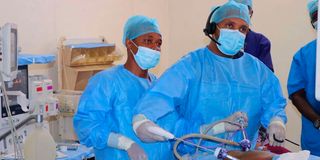
Dr Ramadhani Omari Abdalla, a surgeon at Coast General Hospital in Mombasa, leads a minimally invasive procedure using Proximie while mentoring young surgeons through the platform.

IN NEW YORK,
Last year, a woman in Murang’a County Referral Hospital was bleeding. Her abdomen was open on the table, too dangerous to close, and the surgeon in the room needed help that did not exist inside those four walls.
The patient had already been flagged earlier that day by the doctor in Murang’a County Referral Hospital, who warned the team at Kenyatta University Teaching, Referral and Research Hospital that a dangerous case was coming their way. When she deteriorated, doctors reopened her abdomen.
When the doctors were unable to stop the bleeding, she was referred to Kenyatta University Hospital with an open abdomen; her life was saved because the doctors acted fast and they had been informed about the severity of the case.
But the story exposed a gap too. The mother needed an intensive-care-level vehicle equipped with a defibrillator and a full resuscitation kit to survive the transfer to Kenyatta University Hospital. Instead, she was moved in a basic life support ambulance carrying little more than oxygen, with no defibrillator, which is required.
“Referring such a patient with an open abdomen was a risky task, and had the hospital had technology — Proximie — connection where the doctors at Kenyatta University Hospital could log in during the operation without being in the room and helping with the technical areas, more lives could be saved,” Dr Shannon Shibata-Germanos, Head of Global Health at Proximie.
She adds: “We risked, and the life was saved but how many more lives are we loosing?”
This is the story Kenya’s health leaders now tell whenever they need to explain why a piece of technology called Proximie, and a rural internet provider called Mawingu, matter more than most people could realise.
About 15 counties have since connected to Proximie where an international pool of doctors log into operation rooms in various hospitals countrywide, watch medical procedures in real time, and give guidance.
“This woman is alive,” Dr Shannon said. “We intend to make that a case story, end to end, and to actually show the impact of having this digitised process to save lives in Kenya.”
Proximie is a British digital surgery platform founded in 2016 by Dr Nadine Hachach-Haram, a plastic and reconstructive surgeon who built it for surgeons.
That single case is the backdrop to a broader push now taking shape across Kenya. Nandi County and Mawingu, the internet provider, signed a Memorandum of Understanding to connect at least 14 health centres in the region so that they can have the surgical technology platform, Proximie.
Nandi Governor Stephen Sang said the county has 35 specialists against a huge need for care.
“The gap is huge, with no resources to employ the specialists,” said Mr Sang, who signed the MoU during a side event happening alongside the United Nations General Assembly (UNGA) organised by health Innovation Exchange and Mawingu.
“Already, one of the facilities, Kapsabet County Referral Hospital in Nandi County is connected to the digital platform. Now they are able to access the huge pool of specialists across the world. Within a month, we have carried more than 25 telemedicine sessions. I am planning to extend the model to 13 more facilities,” me Sang said.
The governor said that this is not a side project. In the county budget,35 per cent is allocated to health. However, the resources are not enough to support all the programmes.
“That is why we must continuously think of innovative ways to bridge the gap,” Mr Sang said of the programme that has been anchored in the county’s Facility Improvement Fund Act and its five-year County Integrated Development Plan.
“Any successive administration would definitely work with the same programme in the future,” he said.
Dr Philomena Owende, a surgeon at Kenyatta National Hospital who also covers Murang’a County Hospital, explained why the technology is a departure from how Kenyan surgeons have always trained.
“The traditional training was that you have to be at the table and physically present during surgery,” she said. “Proximie enables teaching of many others who might not safely fit in the operation room.”
For lower-level facilities with no consultant on site, she called it “an amazing intervention,” a way to put an experienced surgeon’s guidance into a theatre that would otherwise have none.
Kenya has at least 300 surgeons for a population of more than 55 million people. The World Health Organization recommends 20 to 30 surgical physicians per 100,000 people. Those 300 surgeons are also not spread evenly. They are concentrated in Nairobi and Mombasa as well as in a handful of big towns.
But the technology cannot work without connectivity, and that is where the numbers get sobering.
“There are roughly 50 million people, 12 million homes, and only one million of those homes are connected to the internet. The number of homes that have no connectivity is daunting,” Mawingu Chief Executive Officer Farouk Ramji said.
Inside hospitals, the gap is worse than most governors realised. Of the 13 facilities in Nandi County identified for the rollout, only four had any internet connectivity at all, and even that was barely functional.
The consequences go beyond surgery. Kenya’s national health insurance claims system, Social Health Authority, depends on stable connectivity to function, and its frequent downtime has been blamed on both weak internet and the system itself.
What makes the Nandi rollout different is the partnership structure behind it. Microsoft and Starlink signed an agreement to give Mawingu 450 fully paid kits under what was described as a one-of-its-kind impact model, usable only in health facilities, schools and community institutions, never in private homes.
Where Mawingu’s own fibre network reaches, it absorbs the cost of routing and wiring entirely, charging counties only the at-cost price of internet itself, with no markup.
“There’s no margin,” Mr Ramji said, adding that all the counties have to pay is the service cost.
Governor Sang said that while enrolling the technology, a number of things have to come together in a single negotiation: connectivity, the digital platform itself and the human infrastructure inside facilities.
Nandi’s MOU alone covers 30 facilities at once. “I am sure if we can roll out some of these programmes directly, we should be able to roll out within 47 counties in a short time.” Mr Sang said.
“With this technology, a surgeon anywhere in the world can now, in theory, guide a Kenyan colleague through a complication in real time. But only if the theatre has a signal strong enough to carry it,” Dr Owende said.
Mr Sang said, standing in front of a room full of health officials and technology partners in New York: “You can only be able to log in if you have the internet. Everything else, the specialists, the expertise, the willingness to help, exists already. It is the connection that decides whether it reaches the table in time.” he said.
Dr Shannon explains the founding idea. Everything in medicine was being disrupted except for surgery so there was a need to build a solution for that, which could be available across the world.
Kenya was the first choice. “We started in Kenya because it really has a great cross-section of private and public hospitals, of rural as well as urban. So, if we could demonstrate the technology in Kenya, we knew that it was representative of the rest of the African continent, essentially,” she says. Kenya also leads in digital innovation, with the African Union currently building a digital infrastructure aimed at leapfrogging the rest of the world in digital access.
Benjamin Mwambu, Africa Deployment Specialist for Proximie, explains that the platform allows surgeons around the world to scrub in virtually.
“We are trying to take students from the operating room and let them learn virtually, using bi-directional communication so they can ask questions while the surgery is underway. This also helps reduce infections in operating rooms,” he says.
Follow our WhatsApp channel for breaking news updates and more stories like this.