How Makueni County drove postpartum-haemorrhage deaths to zero — and what still stands in the way

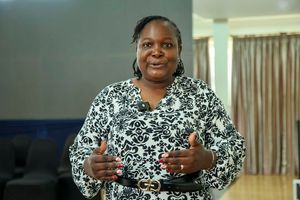
Mwikali Felister, a postpartum haemorrhage survivor, during the interview at Makueni County Referral Hospital.


What you need to know:
- While Kenya at large still struggles with a maternal mortality ratio of approximately 342 deaths per 100,000 live births, Makueni’s success has driven the cost of the life-saving ‘Kausha’ drug down. Initially, the drug cost Sh2,700, a prohibitive price for most
- . But because of the successful pilot and bulk ordering by the Kenya Medical Supplies Authority, the price has plummeted to Sh95.
For 10 years, Josephine Mbinya’s job at the Sultan Hamud Hospital maternity ward was defined by the floor.
Out of every 10 women who delivered there, eight bled so heavily that the tiles became a slipping hazard. Cleaners like Josephine stood by during deliveries, ready not with towels for the baby but with mops and buckets for the mother. The air thickened with the metallic smell of blood as it soaked through cotton wool and linen. Nurses would seat mothers on plastic basins lined with cotton before moving them to the bathroom.
When a mother died, the ward fell silent except for the sound of scrubbing. The cleaners often worked through tears, washing away what was left of a life that had just ended.

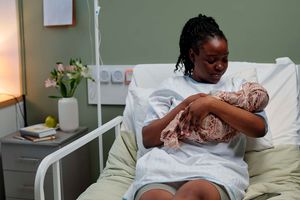
Esther Wanja, a postpartum haemorrhage survivor, during the interview at Makueni County Referral Hospital on April 23.
For the families left behind, the impact lasted far longer. Children grew up without a mother while households absorbed the loss for years.
That was Makueni a decade ago.
Felister Mwikali, from Kibwezi West, knows that ward and others like it intimately. Two of her three deliveries ended in postpartum haemorrhage (PPH) and almost killed her.
Her first child was born at home, alone. The baby arrived safely. Mwikali bled out and fainted. She was taken to the hospital unconscious. For her second child, she did everything right. She attended antenatal clinics early, took her supplements, and presented at the hospital the moment labour began. “The delivery went smoothly, and I remember feeling energised even after birth,” she says.
Her third pregnancy came with economic pressure, and she did not show up for her first antenatal visit until the seventh month. When labour started at 11pm, she stayed at home and waited until 5am to go to the hospital. There, she was told the baby was in distress, had passed stool in the womb, and needed to come out quickly.
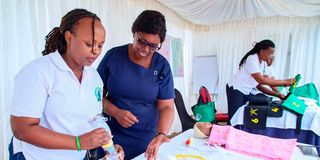
Mercy Waita (left), a nurse at Makueni County Referral Hospital, performs a neonatal resuscitation procedure on a training mannequin under the guidance of nurse-midwife mentor Christine Muteria (right) during the NXT HER Maternal Health Series at the facility on April 23, 2026.
“I was placed on a drip to hasten labour and gave birth a few hours later. The baby came out safe, but I bled heavily and lost a lot of blood; it spilt onto the floor. Every time I felt a blob of blood exiting my body, and as my strength waned, I kept crying and telling God to spare my life for the sake of my children. The doctors eventually gave me an injection that stopped the bleeding,” she says.
Esther Wanja is also a mother of three and a PPH survivor turned maternal health advocate. Her first delivery looked textbook. Everything went smoothly, and happy nurses escorted her to the ward to start breastfeeding. About ten minutes later, she began to bleed.
“Nurses were frantic, a doctor was called, and after a while, the bleeding stopped. I was sent home after three days,” she says.

Jackson Musembi, a paramedic and boda boda rider, during an interview at Makueni County Referral Hospital.
Her second pregnancy was worse. The blood would not clot. It took an emergency intervention and a transfusion of two pints to keep her alive. In 2023, against her doctor’s warning, she became pregnant again. She miscarried. The bleeding was so bad that she lost consciousness.
When she tried for a fourth child, she started supplements and antenatal visits before conception and kept them up throughout the pregnancy. At seven months, she was found to have low blood levels. The hospital told her not to worry. There was a new drug now that stopped postpartum bleeding.
“When I gave birth this time around, I was given an injection that immediately stopped the bleeding. It was one of the best experiences I’ve had in childbirth,” she says.
While Mwikali and Wanja remember the fear through personal experience, similar stories play out in hospitals across the country every day. The crisis is deeply personal for thousands of women and families, but it is also reflected in Kenya’s maternal health numbers. According to the Ministry of Health, Kenya loses 15 mothers every single day to pregnancy-related complications. Ninety-two newborns die daily, and more than 90 stillbirths are recorded over the same 24 hours.
Most of these deaths are preventable. Postpartum haemorrhage is the leading killer, accounting for nearly 40 per cent of maternal mortality in the country. The problem is worsened by a lack of refrigerated cold-chain storage for life-saving drugs in rural areas, the difficulty of measuring blood loss accurately in real time, and a severe shortage of blood for transfusion.
Globally, around 17,000 women die from PPH every year, and 90 per cent of those deaths happen in low- and middle-income countries. In many Kenyan counties, universal health coverage is still a paper promise. On the ground, there is not enough of the equipment or the blood needed to keep a haemorrhaging mother alive.

James Gideon, a boda boda rider who helped a disabled mother give birth at night, during the interview at Makueni County Referral Hospital on April 23, 2026.
Faced with these numbers, Makueni County decided it would no longer be a statistic. It partnered with UnitAid and Jhpiego to roll out the Accelerating Measurable Progress and Leveraging Investments for Postpartum Haemorrhage Impact (AMPLI-PPHI) project. The project does not rely on a single silver-bullet intervention. It rests on five innovations that, taken together, have moved Makueni’s maternity wards from death towards survival.
The first is the heat-stable carbetocin injection, known locally as ‘Kausha’. For years, the gold standard for stopping bleeding after birth was oxytocin. But oxytocin is fragile and needs constant refrigeration. In Makueni’s heat, or in facilities with unreliable power, oxytocin often lost its potency before it ever reached the patient. Heat-stable carbetocin needs no cold chain. One dose, given within a minute of birth, causes the uterus to contract powerfully and immediately, holding the line against haemorrhage.
The second is the calibrated drape. For decades, clinicians measured blood loss by sight, a method that is both subjective and dangerously inaccurate. By the time a nurse realised a mother had lost too much, it was often too late. The drape is a V-shaped plastic collection bag placed under the mother during delivery, with clear markings like a measuring cup. When the blood reaches the 300ml line, an alarm goes off, and the medical team shifts to a high-alert treatment plan.
Uterine massage
The third is the bundle of care. Instead of trying one intervention at a time while a mother bleeds, staff are trained to deliver several at once: uterine massage, intravenous fluids and the right drugs, all administered in step. The fourth is community engagement and provider training.
“We also made sure we trained healthcare providers very well, and that the community was engaged. Without awareness of danger signs, mothers would come late. But we made sure the community understands the danger signs so they can come to the facilities early and get the right care,” says Michael Muthamia, Senior Regional Programme Advisor at
Jhpiego and Project Lead for AMPLI-PPHI (Accelerating Measurable Progress and Leveraging Investments for Postpartum Haemorrhage Impact) project. The fifth is anaemia prevention. The county recognised that many women were losing the battle because they began it weak. With nearly 40 per cent of pregnant women in Makueni anaemic, the county launched a Multiple Micronutrient Supplementation (MMS) programme. Standard iron tablets were replaced with a 15-nutrient “super-pill” designed to lift a mother’s blood levels long before she reached the delivery table. An anaemic mother is seven times more likely to die from PPH; by treating the anaemia, Makueni was preventing the death.
“The Makueni story is now replicated in other counties like Kiambu and Kajiado, where their leadership decided to also buy the life-saving drugs for their women,” Muthamia adds.
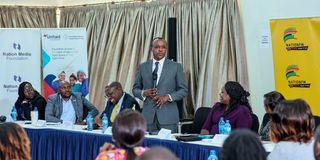
Makueni Governor Mutula Kilonzo Junior delivers remarks during the NXT HER Maternal Health Series at Kusyombunguo Hotels Limited in Makueni County on April 24, where stakeholders convened to discuss strategies for improving maternal and newborn health outcomes.
The Makueni Model did not live only in the pharmacy. Its survival depended on the people who carried it across clinics and homes. Zuena Musa, from Sultan Hamud, was one of its champions. She noticed early on that many women in her area were reluctant to deliver in hospital because they did not want to be touched or helped by male medics. Most were Muslim and preferred to be attended to by women, who were few in the wards at the time. Jhpiego officers trained Zuena and other champions to conduct civic education and to persuade women to attend antenatal clinics and give birth in hospital. The first step was pushing the county government to make female midwives available.
She conducted public barazas and spoke at funerals, chamas and meetings to convince the women to deliver babies in hospitals and attend antenatal clinics.

Makueni County Referral Community Health Promoter Susan Mutua (right) shares her experience during the NXT HER Maternal Health Series at Kusyombunguo Hotels Limited in Makueni.
“We saw women who, when they delayed, had to come back to chamas to borrow money to pay for complications that arose. We even lost a mother after a two-month hospital admission for a coma resulting from severe bleeding. She had given birth at home and bled for hours before being rushed to the hospital,” she says. The petitioning did not stop there. They started petitioning the Makueni County government for an ambulance to assist with emergency cases.
“Once we had it, we started asking for a maternity and child hospital, which took two years to be established. We also petitioned for the construction of a theatre to help in handling maternal complications and caesarean sections,” she says.
The programme also ended up depending on ordinary people who were never officially part of the health system.
James Sammy Gideon has been a boda boda rider for eight years. One night at 10pm, riding home after a long day, he came across a woman lying beside a bush, alone, in the final stages of labour.
“I rushed home, got my wife’s kanga and some lesos, and rode back to where she was. By the time I got there, she had already given birth and was bleeding and unconscious. I covered her with one, wrapped the baby in the other, and tucked the baby in my jacket. The baby’s cry attracted passers-by to the scene, and as they attended to the mother, I rode to the hospital to hand over the child for medical care,” he says.
“Another motorbike would soon after arrive and carry the mother to the same hospital. I did not leave the hospital until 3am, when the doctors assured me that both the mother and the child had been stabilised. I helped the woman out of humanity and to change the narrative of boda boda riders in society. I knew I was risking it because if something bad happened, I would have to explain myself to the police,” he adds.
At home, James got both admiration and a scolding from his wife, who worried that he had handled blood and birth fluids without any protection. The two now work as a team. When he takes pregnant women to hospital, his wife sits with them until they have delivered and are stable.
“I love seeing children and their mothers come out of the hospital healthy and alive,” he says.
Jackson Musembi has been a paramedic for eight years. He remembers a night when a river burst its banks and cut off the main route for an ambulance carrying a pregnant woman.
For 25 minutes, he stayed on the phone with the driver, guiding him through alternative bush paths from memory.
“I love saving lives,” he says.
It is this last-mile commitment, from people like Jackson and James, that ensures the Makueni Model actually reaches the women who need it.
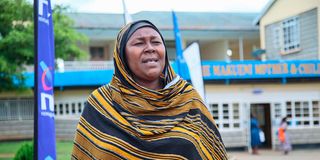
Zuena Musa, a maternal health advocate, during the interview at Makueni County Referral Hospital.
To understand why Makueni is being held up as a national blueprint, look at the numbers. In 2022, the year the project began, the county recorded 12 maternal deaths. In a county the size of Makueni, that meant 12 families shattered and dozens of children left without mothers.
In 2023 and 2024, as Kausha and the calibrated drapes were rolled out across 63 facilities, Makueni recorded zero maternal deaths from PPH in public facilities. The county recorded three deaths in 2025, but those were linked to late referrals and surgical complications rather than haemorrhage. As of May 2026, Makueni has held a clean record for the year.
While Kenya at large still struggles with a maternal mortality ratio of approximately 342 deaths per 100,000 live births, Makueni’s success has driven the cost of the life-saving ‘Kausha’ drug down. Initially, the drug cost Sh2,700, a prohibitive price for most. But because of the successful pilot and bulk ordering by the Kenya Medical Supplies
Authority, the price has plummeted to Sh95. This means the Makueni Model isn’t just saving lives in the east; it’s making survival affordable for the entire country.
But the progress has not solved every problem. The transition to the Social Health Authority (SHA) has created unexpected problems. In some of the most remote parts of the county, dispensaries that were once the front line of maternal care have not yet been empanelled by SHA.
Without proper accreditation or equipment, these facilities are no longer allowed to conduct deliveries. The result has been a quiet regression. Some women, unable to reach the larger sub-county hospitals, are going back to traditional birth attendants or delivering at home, the very practice the county spent a decade trying to end.
The referral system is also a weak point. Kausha stops the bleeding, but it cannot replace blood that has already been lost. Kenya has a national blood shortage, and if a mother arrives at a facility already in shock, the lack of a single pint can still be a death sentence, no matter how many injections are on the trolley.
The story of Makueni is a story of what happens when political will meets clinical innovation. It is a story of cleaners who no longer have to mop up tragedy and boda-boda riders who carry the future on their backs. But above all, it is a reminder that in the fight for maternal health, the death trap can be beaten, provided the system is built with the same resilience as the women it serves.