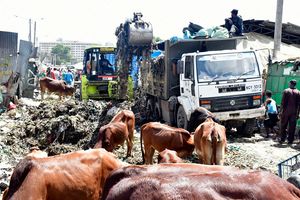
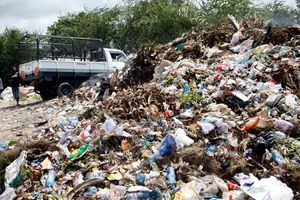
How Nairobi's only landfill became an environmental catastrophe
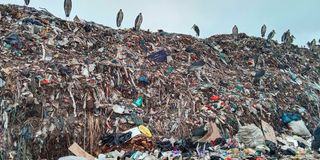
Scavengers at Dandora dumpsite.

What you need to know:
- The question is no longer whether the dumpsite poses a crisis—it’s whether leaders will finally act to address it before the damage becomes irreversible.
The acrid smoke hits you first—a thick, choking cloud that burns the throat and stings the eyes. Then comes the stench: rotting food, decomposing matter, and toxic fumes that hang heavy in the air around Nairobi's Dandora dumpsite.
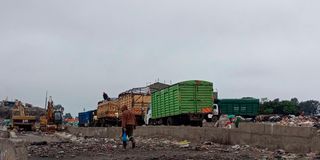
Trucks waiting to offload waste at Dandora
Every day, hundreds of trucks operated by Nairobi County and private contractors weave through the capital's estates, markets, and collection points, all heading to the same destination: a sprawling environmental disaster that was supposed to have closed 23 years ago.
Also read: Waste pickers: The unsung heroes tackling plastic pollution crisis
Designated in 1977 as Nairobi's official landfill for a city of 700,000 residents, Dandora was never designed to handle waste from today's 4.5 million inhabitants. Declared full in 2001, it has continued to grow into a toxic mountain that towers over densely populated neighbourhoods, exposing hundreds of thousands of residents to daily health hazards.
A landscape of environmental destruction
A visit to Dandora reveals environmental degradation on a staggering scale. The site sprawls across more than 30 hectares—roughly 74 acres—of contaminated land that borders the Dandora and Lakisama estates and Korogocho slums. The ground disappears beneath layers of rotting food scraps, plastic bags, discarded electronics and industrial waste.
Scavenger birds wheel overhead, diving for scraps alongside people who pick through the rubbish with bare hands, searching for materials to sell. Millions of flies create a constant, buzzing soundtrack while stray dogs forage freely through the hazardous terrain. The soil beneath is heavily contaminated, and leachate—a foul-smelling toxic liquid—seeps into open drains and footpaths, spreading pollution throughout surrounding communities.
The environmental impact extends far beyond the site's boundaries. During the rainy season, toxic runoff mixes with the Nairobi River, which feeds into Galana River—water that is crucial for farming communities downstream and sustains wildlife in Tsavo National Park before emptying into Indian Ocean.
Pollutants spread along informal roads and open spaces, while stagnant pools serve as breeding grounds for disease-carrying mosquitoes. Livestock often roam and feed among the decaying waste, potentially entering the food chain. The air around the dumpsite is thick with acrid smoke from periodic burning, creating a perpetual haze of toxic fumes.
The human cost
For residents living in the shadow of Nairobi's waste mountain, the health consequences are severe and constant. Community members report persistent coughing, breathing difficulties, headaches, and eye irritation. Prolonged exposure has been linked to long-term respiratory illness and other chronic health problems. "When we moved to Dandora, the children would cough endlessly, day and night," said one resident who declined to be named. "Though it has improved somewhat, we still find ourselves coughing from time to time."
Healthcare workers at nearby facilities confirm the pattern. A clinician at Dandora Health Centre, speaking anonymously, reported widespread health complaints. "Besides persistent coughing, patients with asthma routinely attend our health centers," the clinician explained. A teacher at the nearby James Gichuru Comprehensive School corroborated these accounts, describing chronic health issues among students and staff.
Twenty-five years of broken promises
The site's environmental crisis has deep roots in policy failures and broken promises. Mohammed Hassan, 49, has witnessed the deterioration firsthand since beginning work at Dandora in 1998. A father of four from Isiolo County, he has spent decades salvaging metal for recycling—work that once provided income for informal workers while diverting valuable materials from the landfill."Previously, we could recover so much scrap metal and other recyclables before they mixed with other waste," Mohammed explains. "Now, private yards take most of it before it even comes here. What reaches Dandora is mostly disposable and organic waste that can't be reused. It just piles up."
This shift has intensified the environmental burden. "It used to be that what we took out reduced the waste," he says. "Now everything is dumped. It makes the site even bigger and more dangerous."
Despite years of public pressure and repeated declarations that the site would close, Dandora continues to receive thousands of tonnes of waste daily from households, markets, industries, and institutions across the city.
Legal victories, political failures
In 2021, Justice Kossy Bor of the Environment and Land Court delivered what seemed like a breakthrough ruling. The judge ordered Nairobi Metropolitan Services (NMS) to decommission Dandora and relocate it to another site within six months. In the interim, NMS was directed to manage waste in a manner that protected human health and the environment.
The case was brought by residents and environmental groups who argued that operating an overflowing landfill violated their constitutional right to a clean and healthy environment by exposing them to toxic air, contaminated water, foul odours, and disease.
Despite the court's clear directive, relocation plans remain trapped in bureaucratic limbo, hampered by funding shortfalls and political inaction. Meanwhile, illegal dumping sites continue proliferating across Nairobi, spreading land degradation and pollution to other parts of the city.
Empty promises, absent solutions
Government officials continue to offer plans while delivering little action. According to Nairobi County Environment Chief Officer Geoffrey Mosiria, the government plans to launch a formal recycling programme at the dumpsite.
"The initiative is at an advanced stage, with processes ongoing and awaiting procurement," Mosiria claims. "Back in 2001 when Nema declared the site full, the county had very limited machinery. That has now improved."
The county's long-term vision includes generating power and gas from the site, but Mosiria acknowledges these remain largely theoretical. "We have better plans for the site, including proposals to generate both power and gas," he says, "although these remain largely talk with little progress on the ground."
Beyond recycling: The need for systemic change
Critics argue that recycling initiatives, while beneficial, cannot address the fundamental crisis. The dumpsite's toxic legacy and continued operation expose the failure of Nairobi's waste management system at every level—from inadequate collection and sorting to the absence of proper disposal facilities.
Environmental groups continue calling for a comprehensive waste management strategy that includes waste reduction at source, stricter regulation of illegal dumping, and the creation of properly engineered landfills located far from residential areas. Such solutions require political will, adequate funding, and coordinated planning—resources that have been conspicuously absent for over two decades.
The environmental damage extends throughout the Nairobi River catchment, contaminating water sources and worsening the city's broader environmental crisis. Wind-carried plastic litter spreads across surrounding areas, clogging drains and hanging from power lines and buildings like toxic confetti celebrating governmental failure.
A symbol of environmental injustice
For now, Dandora stands as a stark symbol of Nairobi's deepening environmental crisis and the devastating consequences of policy failures. The site represents more than poor waste management—it embodies environmental injustice, where the city's most vulnerable residents bear the health costs of inadequate infrastructure and broken promises. While some workers at the dumpsite deny health connections—possibly fearing closure would eliminate their livelihoods—the evidence of environmental damage is overwhelming. Until long-promised reforms move beyond rhetoric to reality, the health and dignity of thousands living and working near the site will remain buried beneath the capital's mounting waste.
The question is no longer whether Dandora poses an environmental and health crisis—it's whether Nairobi's leaders will finally act to address it before the damage becomes irreversible.