Inside Homa Bay’s fight to end preventable maternal deaths
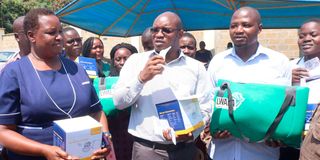
Homa Bay County Health Chief Officer Kevine Osuri and other county officers display a penguin sucker and other medical equipment donated by Lwala Community Alliance.

What you need to know:
- Deaths of teenage mothers highlight persistent gaps in maternal healthcare despite ongoing reforms in Homa Bay
- Efforts to reduce maternal deaths show progress, but critical gaps in equipment and care remain.
Velma Anita had a plan.
The 19-year-old Form Four student at Nyajanja Mixed Secondary School in Rangwe knew her due date, December 7, 2022, was cutting it close to her Kenya Certificate of Secondary Education examinations. So she prepared for every possibility, including informing her school that she might have to take her papers from a hospital bed. It is not unheard of. Exam materials have been delivered to maternity wards before.
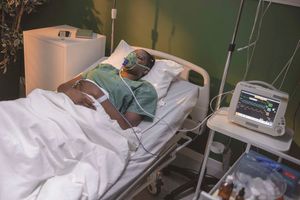
On November 26, 2022, Anita was admitted to Homa Bay County Referral Hospital, showing signs of labour. Two days later, doctors performed a caesarean section. Her age partly drove the decision; she was a teenager with an underdeveloped pelvis, making a normal delivery too risky. The surgery went well. She was taken back to the recovery ward with her baby boy.
She never left that ward alive.
Her family accused hospital staff of negligence, saying she had not received adequate care after the procedure. A medical report later confirmed the surgery had been successful but noted that her condition deteriorated afterwards. She developed postpartum complications. Nurses recorded her blood pressure at 90/50 mmHg, below the healthy threshold of 90/60 mmHg.
She complained of lower abdominal pain, which doctors initially attributed to normal post-surgical discomfort. Hospital management said they could not establish the cause of the sudden drop. Health workers maintained they had done everything possible to save her. The county government suggested she may have experienced preterm pregnancy complications.
Anita's death did more than devastate her family. It pulled back a curtain. In the weeks that followed, more women came forward with similar stories, and public debate erupted over the state of maternal healthcare in Homa Bay.
Critics directed their anger at Governor Gladys Wanga, accusing her administration of presiding over a failing health system. The governor ordered two separate investigations, one by the county health department and another by the curative services committee of the hospital's board. She later engaged Anita's family directly.
But Anita's death, as painful and public as it was, was not the only one.
Three years earlier, in 2019, a 19-year-old named Mareen Akinyi died in Akele village, Homa Bay Town East, after delivering at home with the help of a traditional birth attendant. She had not sought hospital care during her pregnancy. The delivery itself was successful. Then came the bleeding.
By the time her family rushed her to hospital a day later, it was too late. Doctors said her condition had deteriorated beyond saving. She died of postpartum haemorrhage. Her child survived and is now being raised by her mother, Mary Adoyo.
Neonatal mortality
"We rushed to hospital a day after she delivered. But doctors said her condition had deteriorated and she could not be saved," Mary says.
One went to hospital, the other stayed home, and yet both died, leaving behind children who would never know them.
Maternal death in Homa Bay is not a new story, but the numbers still carry weight. According to the 2022 Kenya Demographic and Health Survey, the region recorded a neonatal mortality rate of 32 deaths per 1,000 live births, against a national average of 21. Infant mortality stood at 41 per 1,000 live births, compared to the national figure of 32. Under-five mortality was recorded at 61.
Kenya has committed to the United Nations Sustainable Development Goal of reducing maternal mortality to fewer than 70 deaths per 100,000 live births by 2030. This target demands improved maternal healthcare, skilled delivery, and quality postnatal care. Dr Edward Serem, head of the Division of Reproductive, Maternal, Newborn, Child and Adolescent Health at the Ministry of Health, says that commitment is firm.
"Skilled delivery is the only way we can reduce maternal deaths in the country. Community health promoters play a critical role in ensuring women deliver successfully. We expect to see better outcomes in our health facilities, especially on reproductive, maternal, and newborn health," he says.
Governor Wanga says her administration has made inroads. Data from Homa Bay County Teaching and Referral Hospital shows that between January and November last year, 2,835 deliveries were recorded, including 193 involving HIV-positive mothers. Of these, 2,825 resulted in live births, meaning 10 infants died within the facility during that period. There were 22 reported cases of eclampsia, three ruptured uteri, 64 cases of obstructed labour, and one case of sepsis in 2025. Hospital management says most of these complications were successfully managed.
The governor does not claim the work is done. "No life should be lost during delivery. I made a commitment to end deaths in maternal wards, and that is what I am working to achieve," she says.
One of the persistent problems is equipment, or the lack of it. When a delivery goes wrong, the difference between life and death can come down to whether the right tools are within reach. In many facilities, they are not.
Earlier this year, the county received 44 midwife kits from Lwala Community Alliance, a move health officials described as a meaningful boost to frontline care. The kits contain life-saving medicines, sterile instruments, gloves, delivery sheets, and supplies specifically designed to manage complications such as postpartum haemorrhage, the same complication that killed Mareen Akinyi.
Julius Mbeya, co-chief executive officer of Lwala Community Alliance, says midwives are often working in overstretched facilities with little to fall back on.
"The kits give midwives the tools to act swiftly, prevent infections, and provide safe, dignified care. Each kit provides essential medicines and equipment to manage complications like postpartum haemorrhage and support safe, dignified care," he says.
The county is also deploying community health promoters to encourage expectant mothers to seek skilled care early, a direct response to cases like Akinyi's, where women arrive at hospitals too late, or not at all.
According to the KDHS 2022 report, 91 per cent of births in Homa Bay are attended by skilled personnel, slightly above the national average of 89 per cent. Health Chief Officer Kevin Osuri says regular maternal and perinatal death surveillance reviews have helped the county identify and close specific gaps.
"We have managed to narrow down our response. We can now pick out the gaps that endanger the lives of our mothers and newborns," he says.
Dr Osuri describes hospitals in Homa Bay as increasingly safer, and says women can expect proper care when they come to deliver.