Inside the two health bills that will see quality care for mothers, children, and family
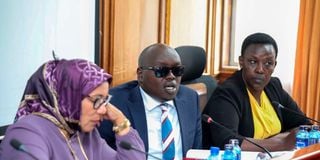
Nominated Senator Beatrice Ogolla (right) and other senators at a past event. Ms Ogolla has sponsored the Maternal, Newborn and Child Health Bill 2023.

What you need to know:
- When Paul Kibichiy Biego, MP for Chemusei, took the floor, he shared a personal story about the loss of his child, expressing hope that the legislation would ensure parents receive better attention during and after childbirth.
Members of Parliament have proposed merging two related health bills that seek to enhance quality care for mothers, newborns, and reproductive health within the family unit. The proposal emerged during a meeting convened by two parliamentary caucuses: the Parliamentary Caucus on Children and the Parliamentarians for Global Action Caucus.
The meeting was chaired by Suba North MP Millie Odhiambo, who is also a sponsor of one of the bills under discussion: the Family Reproductive Healthcare Bill, 2024. The second bill, the Maternal, Newborn and Child Health Bill, 2024, was proposed by Nominated Senator Beatrice Ogolla. While the latter bill is currently before the National Assembly, the former has not yet undergone any readings.
Also read: Forgotten by SHA: Teenage mothers detained in hospitals over bills they cannot afford to pay
During the Wednesday caucus, Millie hinted at the possibility of a merger, noting that the two bills are related and could ideally serve a common purpose. Both bills address a wide range of issues, including family-centred health services, obstetric violence, quality maternal and newborn care, inclusivity for persons with disabilities, the right to referral and to query diagnoses, respectful treatment by healthcare workers, fatherhood-centred reproductive health services, safe motherhood, and access to preconception information. Specific clauses, however, remain subject to change depending on amendments introduced at various stages of the legislative process.
When Paul Kibichiy Biego, MP for Chemusei, took the floor, he shared a personal story about the loss of his child, expressing hope that the legislation would ensure parents receive better attention during and after childbirth. He recounted that when his fourth child was born, the baby’s grandmother noticed the infant had turned yellow, a sign of jaundice. The child was later diagnosed with cerebral palsy. Although Paul and his family informed the attending gynaecologist, he said the doctor dismissed their concerns.
“He brushed it off,” Paul told the caucus. “What amazed me is that a doctor could be told that and still release such a child to go home, only for them to develop cerebral palsy.”
He believes that proper care and follow-up after the jaundice was detected could have prevented future complications. “To this day, I don’t know who to blame or what measures I should have taken because of negligence,” he said. “The child became 95 per cent dependent on others. We lost my child when they were only eight. The practitioner ought to have taken such things seriously.”
Millie noted that her bill would extensively address the challenges men face regarding reproductive health. “By the nature of our society, we fear talking about those issues. We want to provide a framework that brings what we have culturally into the modern world,” she said.
Mary Emaase, MP for Teso South, also emphasised the importance of a clause mandating the collection of data, stating that it would support sound decision-making and help ensure quality healthcare services are delivered across the country.
While the discussions were largely progressive, some members expressed regret that such measures had not been introduced earlier. “It is unfortunate that we are still talking about these things in the 21st century. In my county (West Pokot), this happens every day. Most of our mothers suffer because they lack information,” said Rael Kasiwai Aleutum, Woman Representative for West Pokot County.
Dagoretti MP John Kiarie also weighed in, noting that some proposals in the bill are sometimes perceived as inconsistent with African culture. “As we go out, we ought to remind people that some of the things we call African were actually never African; they were introduced by colonialists. In true African culture, there was a place for both men and women, and there was empowerment for both sexes,” he said.
In response to the Maternal, Newborn and Child Health Bill, Prof Moses Obimbo, lead of the End PPH initiative and an obstetrician-gynaecologist, raised concerns about the bill’s potential to criminalise healthcare practice. While acknowledging its positive elements, he warned that the proposed penalties, including jail terms and fines for healthcare workers, could have unintended consequences.
Prof Obimbo noted that existing mechanisms, such as those under the Kenya Medical Practitioners and Dentists’ Council (KMPDC), already review cases of malpractice and negligence. Doctors found to have violated ethical guidelines are sanctioned, and civil and criminal proceedings follow established legal procedures. “The proposed bill will instil fear in practice. This may cause more practitioners to shy away from providing the care they are trained to deliver,” he cautioned.
“Doctors are trained to provide good care for their patients. If you instill fear in them, making them worry that even their best efforts could lead to penalties when a patient experiences adverse outcomes, some may choose to avoid practicing altogether. This ultimately undermines the goal of ensuring that people have access to quality care and skilled health professionals,” he explained.
He further noted that some negative outcomes stem from systemic issues rather than individual failures. While guidelines and protocols from both the World Health Organization and the Ministry of Health already exist, he expressed concern that they may not lead to meaningful change unless they are actively and consistently implemented.
“Health system failures contribute to maternal deaths such as delays in deciding to seek care, delays in reaching a health facility, and delays in receiving quality services once there,” he said. “We need to address these challenges systemically. Are doctors adequately skilled, or is there a knowledge gap? Are the necessary supplies and commodities available?”
He also emphasised the importance of continuous training and retraining for healthcare workers, as well as raising awareness about maternal health conditions.
As an example, he mentioned the End PPH initiative, which is organising an international run to raise awareness about postpartum haemorrhage, excessive bleeding after childbirth. “Postpartum haemorrhage is not just a medical issue; it is a community issue. The community must take ownership to ensure that no woman dies from it,” he said. The Run for Her event is scheduled to take place on September 27 this year in various parts of the country.
Melinda Mugambi from Kelin, representing civil society at the Caucus, also called for a more objective approach to the proposed fines and penalties for healthcare workers. “We have cases where structural issues contribute to obstetric violence. We should think through the underlying conditions that lead to these violations such as understaffing or lack of necessary amenities,” she said. “We should not simply penalise a doctor when their working conditions were not appropriate.”
Dr John Jack Omondi of MSI Kenya (formerly Marie Stopes) stressed the need for a family-focused reproductive rights approach at the community level, as proposed in the Bill. “Passing the legislation is only the beginning. We must ensure that commitments are translated into adequate financing, quality services, skilled health workers, functioning facilities, and essential commodities,” he said.