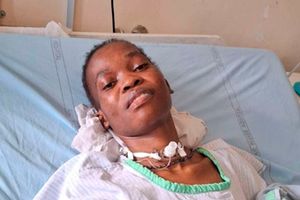
More than 100 women detained at Mama Lucy Hospital over unpaid bills

Mama Lucy Kibaki Hospital in Nairobi.

What you need to know:
- The CEO confirmed that over 100 women are awaiting bill clearance, putting about Sh2 million in revenue at risk daily.
- He placed the responsibility squarely on patients to register for SHA.
When Nancy Akoth arrived at Mama Lucy Kibaki Hospital at 8pm bleeding and in pain, she was unaware she was miscarrying. Far from her imagination was the reality that awaited her: being held captive by the hospital over a bill she could not pay.
Nancy, 35, is one of over 100 women currently unable to leave the hospital due to unpaid medical bills.
That morning of October 23, she had woken up feeling dizzy and with blood stains in her inner clothing. Unaware that she was pregnant, she ignored it, and decided to wait and observe her body.
“Around 6.30pm, I started bleeding heavily and left for the hospital at 7pm. By the time I arrived, my head was aching, the bleeding had worsened, and my belly was hurting.
With a history of high blood pressure and ulcers, I thought I was having a major crisis related to the two,” she explains.
In her pocket, she had only Sh3,000. She was informed that the total bill would eventually come to about Sh15,000 and that she needed to register for the Social Health
Insurance (SHA) and pay the annual premium of Sh6,000 in order for SHA to cater to the bill.
“I didn’t have extra money to top it up,” she explained. Her condition worsened, she fainted, and later learned she had been pregnant and was miscarrying. After treatment, she was discharged on Saturday with a Sh15,030 bill. Despite borrowing Sh6,000 from friends and pleading with hospital social workers, she remains detained. "We share beds here, up to three of us on each bed, while others are forced to sleep on benches along the corridors or sit up all night,” Nancy said.
Her story is not unique.
Harriet Nandera, a 32-year-old Ugandan, is facing a Sh163,000 bill after surgery for an ectopic pregnancy. “I sleep on the bench at night, and feel pain on the surgical wound due to the cold,” she said, worried about her two children waiting at home under her neighbour’s care.
"I was two months pregnant when the pain started. My colleagues rushed me to the hospital, but my husband is unemployed and can't help. Now I'm sleeping on a bench at night, and the cold makes my surgical wound ache."
Discharged
Villan Moshi, a 29-year-old Tanzanian, underwent similar surgery and now owes the hospital Sh135,600. “I’m even more lonely after my man also fled when he heard about what happened,” she shared, also describing nights spent on a bench.
“I have one child at home, who is now under the care of my neighbour,” she said, noting that she was discharged on October 23, three days after admission.
The situation caught the attention of Lawrence Omondi, executive director of Machozi ya Mwisho Institute, a maternal health rights organisation. He called for the patients' release, urging the hospital to stop detaining them and to find a fairer way to address unpaid medical bills.
He asserted that detaining mothers is "extremely illegal" and a "violation of rights," infringing on their freedom and right to maternal healthcare.
“We view this detention as a part of a larger, systemic problem,” Omondi said. “We have written a letter to the CEO of Mama Lucy Hospital demanding the immediate release of all detained mothers. Poverty is not a crime.”
However, the hospital's Chief Executive Officer Frederick Obwanda denied the accusations of detention, arguing that the hospital is merely ensuring financial viability and adherence to national health policy.
"First, the use of the word 'detained' is incorrect. I am not holding them. The only conversation we are having is that it is time to go home, so before you leave, kindly take care of your bill," Obwanda stated.
He confirmed that over 100 women are awaiting bill clearance, putting about Sh2 million in revenue at risk daily. He placed the responsibility squarely on patients to register for the Social Health Authority (SHA). “In seven days, we're talking about losing 10 million, hence the need for all of us as citizens to do what is right. There is a plan, and the plan is to register for social health insurance,” said the CEO, adding: “The mothers who are claiming that we've detained them—that is incorrect. In a normal system, you have nine months of pregnancy to register. But here is a case where you find so many of us don't want to register for SHA, but they also want us to offer the same services,” he noted.
The CEO explained that despite a dedicated team going ward-to-ward to encourage registration, some women still refuse to register for social health insurance. "Our position is clear: if you decline to register for SHA, you must pay for services in cash," he said. "With 3,000 patients a day, if we allowed everyone to be treated for free, this institution would collapse within a week. We simply cannot sustain that."
When asked what happens to patients who are not Kenyan citizens (such as from Tanzania or Uganda) and cannot pay their medical bills, the CEO stated that they are classified as indigents and a clear system pathway exists to handle their cases.
"There's a very clear pathway that the system handles them. As an institution, we follow that pathway, and we still take care of them."
On the range of unpaid medical bills, he explained that costs vary by service. "Some patients have relatively low bills of Sh10,000 to Sh20,000, depending on the procedure," said Obwanda. "However, those who underwent surgery face higher costs, around Sh80,000 to Sh120,000. The highest bills are for critical care, such as time spent in the ICU."
Obwanda also refuted the claims of poor patient welfare. "There are no women who are sleeping on the floors at Mama Lucy Kibaki Hospital. Everybody has a bed and we will take care of them with the dignity that is needed," he said, adding that the average stay for non-payers is two days, not weeks.
The CEO also acknowledged the hospital's struggle with debt collection, stating” "We do not want the hospital to move away from its core function and turn into a debt collection agency."
As a solution, he pointed to the "Mama Lucy Care option," which uses donor funds to aid the genuinely poor, but emphasised that the ultimate solution lies in citizens showing "discipline" by registering for public health insurance.