Kenya confirms second Ebola case as contact tests positive
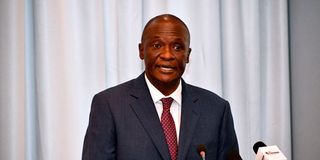
Dr Patrick Amoth, Health Director-General.

Kenya has confirmed a second case of Ebola, a close family member of the country's first patient, who fell ill while already in quarantine.
Dr Patrick Amoth, the Director General for Health, announced that the person is a 39-year-old man who developed fever, fatigue, and joint pains on October 13. The patient had been under daily monitoring as a contact of the first case.
The quarantine team moved him immediately and took a specimen, which tested positive for Bundibugyo Ebola at both the National Virology Reference Laboratory and the KEMRI-CDC laboratory, with matching results. He is now in a designated treatment centre, where trained teams are giving him supportive care.
“Because he was already in quarantine, his illness was detected early. Early supportive care improves his chances of recovery, and isolating him at the first symptom limits the chance of passing the virus to others. This is the response working as designed. The Ministry will share updates on his progress,” said Dr Amoth.
Dr Amoth added: “Contact tracing and monitoring are working. Both cases are linked, and there is no evidence of spread in the wider community.”
Kenya's first case, announced on October 6 by Health Cabinet Secretary Aden Duale, was a Kenyan citizen who had lived in the Democratic Republic of Congo for seven years. He fell ill about a month earlier, was treated at several facilities in the DRC, and travelled to Kampala by road before arriving in Nairobi on Saturday, October 3.
He died at the Nairobi Hospital, and samples tested positive for the Bundibugyo strain at both the National Virology Reference Laboratory and KEMRI.
At that time, Mr Duale said 28 contacts, including family members and health workers, had been identified and were being followed up.
Dr Amoth also announced that the ministry has listed 128 contacts of the first case and, as at October 13, had traced 113. Of these, 108 are in quarantine in Kenya, with daily clinical and temperature checks for 21 days from their last possible exposure.
The other five are outside Kenya, and authorities in those countries have been informed as required under the International Health Regulations (2005), while tracing of the remaining 15 continues. Teams are also assessing everyone who has been in contact with the second patient since his symptoms began, including quarantine staff and health workers.
“Any contact who develops symptoms will be isolated and tested immediately. Infection prevention and control has been reinforced at all quarantine and treatment sites, and health workers have the protective equipment they need. all health workers should apply strict infection prevention and control measures, "whatever condition they are managing,” said Dr Amoth.
At least 667,675 travellers have been screened at 26 points of entry, including almost 4,000 in the past 24 hours. On testing, the ministry said five designated laboratories are processing samples, including two mobile laboratories at the Lwakhaha and Busia borders. Samples can be referred from every county, and confirmed results are available within six to 12 hours.
For treatment, up to 241 isolation beds are available in five hospitals in Nairobi, Eldoret and Mombasa, including up to 50 intensive care beds at Moi Teaching and Referral Hospital. CS Duale also said 4,917 health workers have been trained in Ebola management, and a surge team of 343 trained responders is on standby, including 102 who served in the 2014-2016 West Africa Ebola outbreak response.
While the World Health Organization has been informed about the second case, the ministry confirmed that Kenya will continue to keep its borders and economy open, imposing no limitations on travel, trade, or public gatherings.
“We appeal to the public to stay calm but remain vigilant. Ebola is not spread through the air; it spreads through direct contact with the blood or body fluids of a person who is sick with, or has died from, the disease. Anyone with fever, unusual tiredness, muscle or joint pains, vomiting, diarrhoea or unexplained bleeding should seek care promptly at the nearest health facility. Please respect the privacy of the affected family, rely only on official Ministry of Health updates, and call the toll-free line 719 for information,” said Dr Amoth.
Dr Ahmed Kalebi, an independent pathologist and public health researcher, termed the confirmation “a serious development” while hoping that there are no further infections, and particularly no community transmission beyond the initial contacts. Dr Kalebi noted that while early detection shows that surveillance worked for this patient, it does not yet establish that the entire transmission chain is contained.
“The Ministry reports no evidence of wider community spread but also confirms that 15 of the 128 listed contacts remain untraced. Finding and assessing these individuals remains an urgent priority. Those who shared exposure to the deceased with this second patient warrant particularly close attention. Their exposure histories should be reviewed, with heightened vigilance for even mild symptoms and prompt isolation and testing if they become unwell. Anyone exposed to the second patient after his symptoms began also requires individual risk assessment and appropriate monitoring,” said Dr Kalebi.
“Following the three-day gap in public situation updates, the Ministry of Health needs to provide daily updates covering all quarantined contacts, including how many remain symptom-free, how many have developed symptoms or undergone testing, and how many have completed monitoring. These updates should also account for contacts still being traced and those outside Kenya, while protecting individual privacy. Even when there are no new cases, a daily situation report is essential. Silence creates an information vacuum, fuels speculation and makes public reassurance harder to sustain,” he added.
Dr Amoth stated that a single national command is leading the response, which follows the Public Health (Declaration of Formidable Epidemic Disease) Order, 2026, and the Public Health (Ebola Disease) Rules, 2026, on October 12. The ministry also published detailed rules on screening, isolation, reporting and burials. The rules define Ebola disease broadly, covering any orthoebolavirus, including the Ebola, Sudan, Bundibugyo and Taï Forest viruses.
The rules designate the Kenya National Public Health Institute as the lead technical institution, coordinating surveillance, laboratory diagnosis, contact tracing and response through a national Incident Management System. They also require that measures be proportionate and respect human dignity and rights.
Everyone entering or leaving Kenya must be screened and complete a truthful health declaration. Port health officers can arrange separation, testing, isolation or quarantine, while those who refuse screening may be referred to immigration officers, though Kenyan citizens cannot be refused entry. Contacts are quarantined and monitored for 21 days, with early release possible after two negative tests. Quarantine cannot be imposed merely because someone arrived from an affected country.
Anyone who suspects a case or death must report it immediately, and testing is restricted to the national reference laboratory and designated labs. Medical officers of health may order isolation or quarantine in writing, setting out the grounds and duration, and the state pays for government facilities while private-facility patients pay unless placed there by written direction. Transport operators must report suspected cases on board.
The rules also require that victims be buried quickly and safely by trained personnel in sealed body bags, without washing or embalming, with next of kin consulted and cultural observances allowed where safe. Repatriating a body outside Kenya is prohibited. Defying lawful requirements, giving false information or helping someone leave quarantine is an offence punishable by a fine of up to Sh50,000, up to six months in prison, or both. The rules must be reviewed at least every three months and lapse after 12 months unless revoked earlier.
Follow our WhatsApp channel for breaking news updates and more stories like this.