Kenya faces four active health emergencies as Mpox, Ebola, measles, and polio collide
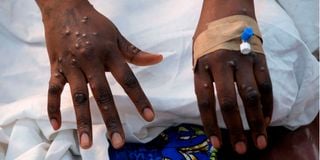
The hands of a patient with skin rashes caused by the Mpox virus.


What you need to know:
- Kenya has recorded 1,298 cumulative confirmed M-pox cases and 19 deaths across 40 of the country’s 47 counties.
- In the latest update, two new cases were reported in Nairobi and Machakos.
- Mombasa remains the hardest-hit county with 452 cases, followed by Nairobi (320), Busia (115), Makueni (85), Kiambu (44), Kilifi (38), and Nakuru (31).
Kenya’s health authorities are currently responding to four active public health events, according to a situation briefing issued by the Ministry of Health’s Division of Disease Surveillance and Response and the Kenya National Public Health Institute. The briefing consolidates daily updates on the status of an M-pox outbreak, a regional Ebola (Bundibugyo virus disease) emergency, a domestic measles outbreak, and a newly detected case of vaccine-derived poliovirus in Dadaab.
Kenya has recorded 1,298 cumulative confirmed M-pox cases and 19 deaths across 40 of the country’s 47 counties. In the latest update, two new cases were reported in Nairobi and Machakos. Mombasa remains the hardest-hit county with 452 cases, followed by Nairobi (320), Busia (115), Makueni (85), Kiambu (44), Kilifi (38), and Nakuru (31).
Genomic sequencing of 257 samples confirmed the circulating strain as sub-clade 1b, which, according to the World Health Organization (WHO), is historically found in Central Africa. This strain causes more severe illness and spreads easily through close human contact, including non-sexual household transmission.
Of 3,199 samples tested, 40 percent returned positive results. Eighteen cases were travel-associated, linked to Uganda, Rwanda, and the Democratic Republic of the Congo (DRC). The Ministry noted that children aged 10–15 and adults over 15 are the most affected groups, with males accounting for nearly half of all cases. The highest number of deaths has been recorded in Homa Bay, Trans Nzoia, Uasin Gishu, and Bungoma counties.
Health workers have vaccinated 10,697 people in Mombasa, Nakuru, and Busia, building on a previous campaign in July 2026 that reached 13,948 individuals with the MVA-BN vaccine. Of 1,376 identified contacts, 1,141 have completed the 21-day follow-up period.
This comes as Gavi, the Vaccine Alliance, prepares to launch a new global mpox vaccine stockpile later this month. The initiative will create a long-term mechanism to ensure rapid and equitable vaccine access for countries facing mpox outbreaks. Mpox vaccines will become the fifth vaccine managed by the International Coordinating Group on Vaccine Provision, joining yellow fever, meningitis, Ebola, and cholera vaccines.
Dr Sania Nishtar, CEO of Gavi, stated: “During the 2022 mpox outbreak, lower-income countries were left behind when it came to access to vaccines, and it was clear that a mechanism was needed to ensure this global public good could be accessed by those who need it most.” Kenya is set to benefit from this initiative.
WHO Director-General, Dr Tedros Adhanom Ghebreyesus, called the stockpile “an important step towards a more sustainable and equitable approach to mpox outbreak response,” adding that it will help countries access vaccines more quickly, saving lives and containing outbreaks before they spread further.
Catherine Russell, Unicef executive director, emphasised the importance of accelerating vaccine delivery to children, families, and communities most at risk, noting that “Mpox can be devastating for children, not just its physical effects, but also the stigma, interrupted learning, and fear that can come with being isolated from family and friends.”
To date, approximately 3.96 million people have been sensitised at points of entry, and more than 20,000 informational posters and banners have been distributed. Cumulatively, 11.4 million travellers have been screened across 26 points of entry. Over 2,500 healthcare workers have been trained under the National Mpox Training Plan.
Mary Muthoni, PS for the State Department for Public Health and Professional Standards, urged Kenyans to remain vigilant. “I know, unknown to many of you, if you go to Kenyatta National Hospital today, you will not miss an Mpox confirmed case. We are focusing on Ebola, but we do not have any confirmed case. We have deaths from Mpox,” she said. She further called on the public to maintain the highest hygiene standards, adding that “performance will be judged entirely by the measurable impact on the health and well-being of Kenyans.”
Kenya has recorded zero confirmed cases of Ebola Bundibugyo virus disease. The outbreak was declared a Public Health Emergency of International Concern by the WHO on May 17, 2026, two days after it was first declared in the DRC and Uganda on May 15.
According to the Ministry, the DRC has recorded 6,436 confirmed cases and 3,095 deaths, with 1,495 recoveries, and its outbreak remains active. Uganda has reported 20 cases, two deaths, and 18 recoveries, and is now listed as controlled. France has recorded one case with no deaths and one recovery. Regionally, the total stands at 6,457 confirmed cases, 3,097 deaths, and 1,514 recoveries.
All 224 samples tested in Kenya have returned negative. The country’s overall preparedness score has risen to 81 per cent, up from 66 percent in May, with improvements across all readiness metrics: points-of-entry screening (60 to 90 per cent), surveillance (75 to 92 per cent), infection prevention and control (27 to 73 per cent), coordination (67 to 83 per cent), logistics (50 to 65 per cent), and case management (36 to 45 per cent). A total of 543,346 travellers have been screened across 26 points of entry, including intensified screening at JKIA’s Gate 16 for arrivals from Uganda and the DRC.
The ministry has identified 25 counties as high-risk, with 12 classified as “very high” and 13 as “high.” So far, 4,913 health workers have been sensitised, and a surge capacity of 343 responders remains on standby.
On capacity, the briefing lists isolation beds at Kenyatta National Hospital (KNH) (eight), Moi Teaching and Referral Hospital (20, plus 30 surge beds) and Nairobi's NPS Hospital (49), alongside six designated treatment facilities: KNH, Kenyatta University Teaching, Referral and Research Hospital (KUTRRH), Utange, Alupe, Emali and Eldoret. Médecins Sans Frontières has set up a four-bed unit at Port Reitz, Mombasa. WHO has provided 1,000 PPE kits and 500 EVD kits, distributed to KNH, KUTRRH, Mombasa, Turkana and points of entry. India has donated 6,000 PPE kits, 475 thermometers, biosafety cabinets and face shields.
The briefing, however, flagged critical operational gaps, including inadequate holding and isolation facilities at points of entry, 23 facilities across 27 counties requiring upgrades to WHO standards, staffing shortfalls, personal protective equipment and Infection Prevention Control commodity shortages, malfunctioning thermo-scanners at some entry points, and a call centre operating only eight hours a day because of an agent shortage.
Kenya has also recorded 469 cumulative measles cases since January 2026. Out of this, 87 are laboratory-confirmed. People aged 10–15 account for 251 cases, or 56.2 per cent of the total. Nearly 60 per cent of the cases are male.
Ten counties have been affected by the outbreak, including Baringo, Marsabit, Wajir, Mandera, Nairobi, Tana River, Kiambu, Kilifi, Mombasa and Garissa.
However, the briefing says only six of 12 affected sub-counties remain active, including Lagdera, Kibra, Kaloleni, Likoni and Thika Town. The Public Health
Emergency Operations Centre has been fully activated, with county and sub-county coordination, enhanced active case-search surveillance, case management and infection-control measures in place, alongside continued community awareness campaigns on vaccination.
Even though Kenya successfully eradicated wild poliovirus around 2014, the country has newly detected a case of vaccine-derived poliovirus in a 48-month-old girl at Ifo 2 refugee camp in Dadaab sub-county, Garissa County. She is a newly arrived Somali refugee who entered Kenya from Somalia's Bay Region on July 7. The virus has been linked to the SOM-BAY-1 Beledweyne emergence group circulating in Somalia. The briefing confirmed that the virus has not spread to any other person.
Household investigators found WASH (water, sanitation and hygiene) vulnerabilities, including open defecation and the absence of a latrine. The ministry says the case highlights risks from cross-border movement, low immunisation coverage and poor sanitation in the area. In response, eligible children have received measles vaccination, vitamin A and deworming; stool samples have been collected from all children under five for polio surveillance; and authorities have launched a household investigation and enhanced acute flaccid paralysis surveillance, including follow-up vaccination for children who missed doses.
The ministry's overall assessment is that public health risk to Kenya remains low, but it flags Mpox community transmission as "ongoing" across 40 counties with low public risk perception; Ebola importation risk from the DRC outbreak as "moderate," citing cross-border trade, regional mobility and Kenya's role as a transport hub; measles resurgence risk as "elevated" given active transmission and immunity gaps in older age groups; and polio re-emergence risk as under "watch," citing refugee movement, low immunisation coverage and WASH gaps in Dadaab.