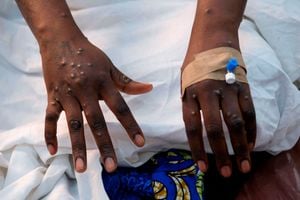
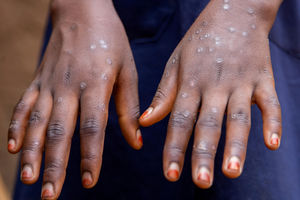
Kenya now Africa's deadliest mpox hotspot as outbreak spreads to 38 counties
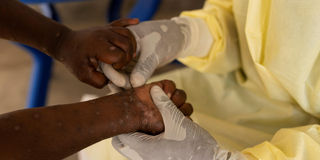
A nurse takes a sample from a child suspected to have mpox. Kenya has recorded 1,065 confirmed cases across 38 counties, with children among the age groups now affected.

What you need to know:
- As mpox spreads beyond high-risk groups into households, experts warn of sustained community transmission across multiple Kenyan regions.
- Despite global declines, Kenya’s rising mpox cases expose deep systemic challenges, including stigma, misinformation, and limited laboratory capacity.
Four of the seven mpox deaths recorded across Africa between February 15 and March 1 were in Kenya, making it the continent's deadliest hotspot in that period, according to a World Health Organisation (WHO) situation report that also placed the country third among nations with the most active cases.
The report listed Madagascar with 368 confirmed cases, the Democratic Republic of the Congo with 288 and Kenya with 78, followed by Burundi with 34 and Liberia with 24. These five countries are now driving the surge in active cases across the continent.
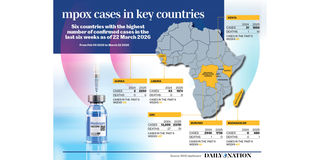
By late March, Kenya's Ministry of Health had recorded a cumulative 1,065 confirmed cases across 38 counties, with more than 8.8 million travellers screened at various points of entry since the outbreak began. Early transmission was concentrated along major transport corridors linking Mombasa, Nairobi, Nakuru, Kisumu, Busia and Malaba.
All of this is unfolding even after the continent-wide emergency was officially declared over in January. The crisis, for Kenya at least, has not eased.
Mortality surge
The most concerning development is the spike in deaths recorded during the six-week window between February and mid-March, a period when Kenya was among the very few countries on the continent reporting multiple fatalities.
WHO says all age groups are now affected, including children and young adults. While early cases were concentrated among mobile populations such as truck drivers and sex workers, the virus has since moved into households.
"Transmission of mpox continues mostly within sexual networks, affecting both women and men, followed by household transmission, and in some historically endemic areas, affecting all age groups. All clades of monkeypox virus continue to circulate. Unless mpox outbreaks are rapidly contained and human-to-human transmission is interrupted, there is a risk of sustained community transmission in all settings," WHO warned.
Through its Global Outbreak Alert and Response Network, WHO deployed 18 experts between January 1, 2025 and March 18, 2026 to the DRC, Kenya, Malawi, the Republic of the Congo, South Sudan and Uganda to support response efforts in data management and analytics, epidemiology and surveillance, laboratory services, case management, infection prevention and control, and risk communication and community engagement. WHO also continues to support the implementation of transmission studies and vaccine safety and effectiveness research.
Globally, mpox remains a public health concern. Between January 2025 and February 2026, the WHO recorded 56,356 confirmed cases and 227 deaths across 100 countries. In February 2026 alone, 46 countries reported 1,184 cases and four deaths, with Africa accounting for more than half of all cases.
The Americas, Africa, South-East Asia and the Western Pacific all recorded declines in February compared to January, while Europe saw a rise in cases and the Eastern Mediterranean reported no change. Across Africa, transmission persists in multiple countries, although overall weekly case numbers have slightly declined in recent weeks. From January 2025 to mid-March 2026, 30 African countries reported 46,476 cases and 214 deaths.
The report also highlighted the virus's multiple transmission pathways, including close physical contact and household spread, which increase the risk of rapid transmission within families and communities. Different strains are circulating simultaneously, contributing to varying outbreak patterns across regions. No clear differences in transmissibility between strains have been confirmed, though certain variants appear to affect specific populations more heavily.
The clade Ib strain, which was prevalent in Africa last year, is now dominant in several regions including Europe, where countries such as Austria, Belgium, Portugal, Spain and the United Kingdom are experiencing community transmission, including within sexual networks.
Low public risk perception
A study published in the PubMed Central Journal, examining the current status, containment measures, challenges and future direction of the outbreak, found that all mpox-related deaths in Kenya were recorded among HIV-co-infected individuals, noting that people living with HIV constitute a vulnerable group needing much closer care to contain the outbreak.
The study also noted that those who died appeared to have had a severe strain of the virus or had delayed seeking medical attention. Even though the Ministry of Health responded by conducting public awareness campaigns and water, sanitation and hygiene interventions, particularly in high-risk counties, the response was initially hampered by low public risk perception and inadequate resources.
"The number of cases is steadily increasing, undermining the effectiveness of control measures, probably due to high cross-border mobility and failure to identify all high-risk individuals," the study said.
On the broader obstacles, it identified unequal vaccine access as a key driver of increased cases and deaths in countries with limited supply or delayed vaccination rollouts, describing the inequity as reflecting systemic gaps in the global distribution of health resources.
"Vaccine disparities represent not only logistical failures but also ethical shortcomings in justice and global solidarity, where populations in low-resource settings are consistently last to receive lifesaving interventions," the study said.
Misinformation is also compounding the problem, particularly on social media. On X, formerly Twitter, large volumes of misleading or false information continue to circulate about how the virus spreads, its severity and its origins, undermining public trust in health interventions and institutional strategies to combat mpox.
Mpox-related stigma is contributing to delayed healthcare-seeking, non-disclosure of the disease, discrimination in some health settings and mental health consequences. Inadequate infrastructure and limited laboratory capacity remain critical gaps, with shortages of genomic sequencing platforms, testing kits and bioinformatics expertise delaying the identification of circulating clades and slowing the implementation of public health interventions.
Although AfricaCDC, WHO and other partners pledged to increase vaccine availability across the continent, logistics challenges, including cold chain requirements and transport constraints, continue to impede equitable distribution.