Kenya pressed to protect wetlands for new bird species from Austria
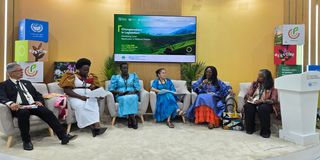
Dr Musonda Mumba (second right), the secretary-general of the Ramsar Convention on Wetlands, speaking at a panel discussion during COP16 in Riyadh, Saudi Arabia

What you need to know:
- In the urgent effort to protect land, combat desertification, and address drought, one ecosystem makes all these possible: wetlands.
IN RIYADH, SAUDI ARABIA
Kenya has been urged to do more to protect its wetlands and water towers so that new bird species migrating from Austria do not lack water.
Dr Musonda Mumba, the secretary-general of the Ramsar Convention on Wetlands, made the plea at the ongoing world’s biggest UN land summit (COP16) in Riyadh, Saudi Arabia. It comes after recent findings that twice a year, billions of birds migrate long distances across the globe, linking breeding grounds in arctic and temperate regions with non-breeding sites in temperate and tropical areas.
The over two billion bird species include passerines, storks, ducks and raptors migrating from their breeding grounds in Europe, central and western Asia to tropical zones in Africa, including Kenya. Raptors include vultures, eagles, hawks and falcons.
Addressing thousands of delegates at the summit that seeks to combat drought, desertification and land degradation, Dr Mumba praised afforestation efforts by President William Ruto. “In the urgent effort to protect land, combat desertification, and address drought, one ecosystem makes all these possible: wetlands. Lake Naivasha, for example, is where we not only have flowers but also have flamingos and other bird species that migrate all the way from Europe through this ecosystem.
“We don’t want a situation where the birds that are increasingly arriving in Kenya from Austria and other parts of Europe find no water,” said the renowned scientist, who holds a PhD in wetland hydrology and conservation from the University College London. “I must compliment efforts by the Kenyan government, which I am well aware has been talking to the government of Austria as thousands of bird species migrate from Austria to Kenya because of harsh climate conditions in Europe.”
But how do these bird species travel all the way to Kenya? First, the birds flying from their breeding grounds must negotiate ecological barriers posed by mountains in Europe such as the Ural Mountains and the Alps, seas and deserts as they fly south towards the Mediterranean Sea. They then make use of the narrow straits and land bridges to connect from Europe into Africa and in so doing, they connect the continents biomes twice every year using three major routes.
The Western flight route is through Italy and Spain across the Straits of Gibraltar, over the Atlas Mountains and the western Sahara into west and central Africa. The Central route is from western and central Europe through Greece to the Mediterranean Sea, across the Sahara into central and southern Africa. The third route is from eastern Europe and Asia through the Middle East down into East Africa and Southern Africa.
In an interview with the Nation on the sidelines of COP16, Dr Mumba noted that covering only about six per cent of the Earth’s surface, wetlands are among the planet’s most productive ecosystems. It is also why in 2012, the Kenya Water Towers Agency, the brainchild of former president Mwai Kibaki, was set up to coordinate the protection, rehabilitation, conservation and sustainable management of water towers.
“For us at the Ramsar Convention, what we envision is to provide guidance because the disappearance of water is not only a national disaster but a global disaster. More recently, we saw a report that shows that hydrological cycles in the skies have been disrupted and this has not left Kenya immune because we have seen extreme droughts in the absence of water and extreme floods, so how we manage our ecosystem is extremely important,” she said.
“In degraded ecosystems, things like early marriages and sex for water happen more during drought events like we have seen in Malawi and this is why we at the Ramsar Convention are working with partners like UN Women and the Saudi Green Initiative from the Kingdom of Saudi Arabia to have local community initiatives for water harvesting and agro-ecological projects that support young women so that they have something to do that generates income, instead of selling their bodies for water because it is tragic,” Dr Mumba added.
Mr Ibrahim Thiaw, Executive Secretary of the UN Convention to Combat Desertification, pointed out that protecting wetlands is not just about preserving nature—it’s a critical strategy in the fight against climate change.
“Unfortunately, despite the world knowing these facts, wetlands are lately disappearing due to land conversion, pollution, and unsustainable practices. Each hectare of degraded land is one less hectare of natural resilience lost and when we lose wetlands, we lose an essential piece of the sustainability puzzle that is very much needed to restore land and ensure water security, the conversation around wetlands must be front and center,”Mr Ibrahim observed.
He further points out that land degradation is often framed through images of barren soils and dust storms but land isn’t an isolated entity.
The executive secretary of UNCCD said wetlands, through their natural hydrological cycles, replenish soils, maintain groundwater reserves, and filter pollutants, preserving the quality of both land and water.
This is why without these ecosystems; the world will see a cascade of degradation—from soil erosion to dwindling water sources.
“The impacts are profound, not only for nature but for the millions of people who rely on healthy land and water for their livelihoods.