Kenya’s Ebola battle: The wins, gaps and 42-day countdown
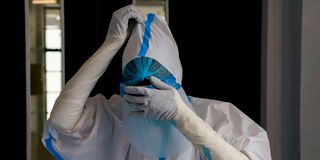
A medic wears a protective mask at Nairobi Hospital where an Ebola patient was isolated immediately upon arrival and treated at the hospital's East Wing Isolation Facility, but later died, in Nairobi, on October 7, 2026.

Fifty-two people are still in quarantine and are expected to go home this week.
When they do, Kenya will end the monitoring phase of an Ebola outbreak that infected nine people and killed two. The Ministry of Health says every case traces back to one cluster, with the first patient having travelled from the Democratic Republic of Congo.
Health Cabinet Secretary Aden Duale says there has been no new confirmed infection since October 19, and no evidence of transmission beyond that cluster.

Health CS Aden Duale at a past event.
The releases are being done in phases. Twenty contacts were discharged on October 26 after completing 21 days of monitoring without developing symptoms. A further 46 are expected to be released on Tuesday, November 3, bringing the total number discharged to 66. The remaining 52 will be released later. Altogether, 118 Kenyans were placed in quarantine, while seven patients remain in isolation centres receiving treatment.
Duale said the government hopes to discharge five of the seven patients still receiving treatment if they test negative for a second time.
The patients have already returned one negative test result, and a second test was conducted on November 2. The strongest result is the contact tracing. The Health ministry says all 135 contacts linked to the first case were identified and traced. Nine of them were outside Kenya, and the countries concerned were notified under the International Health Regulations.
“All our 135 contacts were traced, and those in Kenya have been followed up daily,” said Ministry of Health Director General Dr Patrick Amoth.

Dr Patrick Amoth, Health Director-General.
Dr Ahmed Kalebi, an independent pathologist, says the tracing was the biggest success. It kept everyone who was known to have been exposed under watch. This lowered the chance of the virus spreading without being noticed. He also says the government deserves credit for treating the outbreak as an urgent national security matter.
This is his strongest evidence that the approach worked: “All eight people infected after the first patient were already in quarantine when they fell ill. They could be spotted and moved for treatment inside the response system, which limited exposure in the community.”
Dr Kalebi adds: “Kenya deserves credit for keeping the recognised outbreak within one connected cluster of nine people only.”
He says health workers’ training, laboratory capacity and designated isolation facilities were in place before the imported case arrived. The National Virology Reference Laboratory and Kemri confirmed the diagnosis locally.
Dr Amoth gave the figures. Kenya has 211 beds for isolation and treatment, close to 5,000 trained health workers and five testing laboratories.
These include mobile units on the Uganda border, which give results in six to 12 hours. More than 700,000 travellers have been screened at points of entry.
Prof Shem Otoi, an infectious disease modelling expert, lists six things Kenya got right.
“Early contact tracing, essential medicines for managing patients such as monoclonal antibodies and good partnership among stakeholders. Then there was modelling ahead of time with lessons from DRC and Uganda, mainstream media follow-up on how the disease was evolving and where transmission stood. There are also lessons from Covid-19. Those are the things we got right,” he said.
The success does not answer every question.
“Successful containment does not erase the questions surrounding the index patient’s arrival and initial care,” Dr Kalebi says.

Pathologist Dr Ahmed Kalebi during a past interview in Nairobi.
The first patient was a Kenyan who travelled from DRC through Uganda and died on October 5. Official reports describe hospital isolation on October 3 and sample collection two days later.
“That interval warrants explanation, though it does not by itself establish negligence or the exact timing of transmission,” Dr Kalebi says.
He wants a clear account of what happened at JKIA, during transport and at the receiving hospital.
Quarantine was not immediate either, he says. It took several days to put all the arrangements in place. Four of the eight people infected after the first patient were health workers. The other four were close family members. Dr Amoth said the health workers caught the virus while on duty, before anyone suspected the disease.
“Protecting those who protect us through infection prevention and control, provision of personal protective equipment, and high index of suspicion and deployment of care must be a continental priority,” he said.
The medicine situation is still uncertain. Dr Amoth said there is still no licensed vaccine or specific treatment for the strain. Kenyan patients depend on experimental medicines, and the supply is not guaranteed. Rwanda has, however, donated 500 doses of an antiviral for Bundibugyo.
The outbreak has also affected Kenya beyond the borders. On October 30, Saudi Arabia barred its citizens from travelling to Kenya and suspended all visa categories for Kenyan travellers. It also bars entry to anyone who has been in Kenya in the past 21 days.
Kenya’s Ministry of Foreign and Diaspora Affairs called the measures disproportionate and unsupported by the situation on the ground. It asked Riyadh to give WHO the scientific justification within 48 hours. Saudi Arabia says its decision followed assessments by its public health authorities. WHO recommends surveillance, contact tracing and screening at entry points over travel restrictions.
The government has not said when the restrictions will be lifted.
Not over yet
Going home is not the finish line.
“Completing 21 days without symptoms is an important milestone, but it is separate from formally declaring the outbreak over,” Dr Kalebi says.
Declaring the outbreak over requires the applicable WHO 42-day period after the last case’s relevant endpoint.
According to WHO, declaring the end of an Ebola outbreak takes more than treating the sick and monitoring their contacts. Health authorities must also confirm that the virus is no longer passing from person to person.
The agency said the key benchmark is 42 consecutive days without a confirmed or probable case after the last potential exposure to the final case.
“The acute phase of the outbreak is defined by the propagation of the virus within communities through transmission of the virus from one person to another. This phase will be considered to have been interrupted when no confirmed or probable Ebola virus disease (EVD) cases are detected for a period of 42 days since the last potential exposure, the last case occurred,” WHO said.
The countdown begins at different points depending on the final patient’s outcome. The count starts after the patient’s recovery is confirmed by two negative Polymerase Chain Reaction (PCR) blood tests, taken at least 48 hours apart. If the patient dies, it starts after a safe burial.
Even after the 42 days end and an outbreak is declared over, WHO recommends continued surveillance for at least six months. This includes testing people who die under suspicious circumstances in the community, while infection prevention measures and emergency preparedness plans remain in place.
WHO also advises continuing medical care and testing of Ebola survivors for at least 18 months after the last confirmed patient recovers.
Even after Kenya is declared Ebola-free, Dr Kalebi has three priorities for the future. “Better use of travel history and clinical assessment at entry points and receiving hospitals. Standing capacity for safe isolation, protective equipment and trained staff, and consistent public reporting.”
He also calls for a transparent review of the airport, hospital and quarantine response, aimed at learning and accountability, while protecting patient and staff confidentiality.
He has simple advice for the people leaving quarantine.
“As the remaining contacts complete monitoring, they should return home with support and without stigma,” Dr Kalebi said.
Follow our WhatsApp channel for breaking news updates and more stories like this.