Kenya’s rare mule population gains attention amid donkey crisis
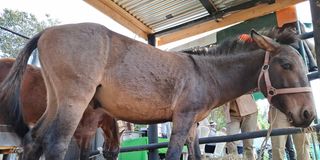
A mule, bred from a male donkey and a female horse, grazes on hay at the just-concluded Nakuru ASK National Show, hosted by Farming Systems Kenya, where farmers were introduced to the benefits of using working equids in agriculture.

What you need to know:
- The growing crisis surrounding donkeys adds weight to Dr Emmanuel Cheruiyot's appeal.
- Dr Cheruiyot highlights the ongoing menace of theft and bush slaughter, with many animals killed for their skins, which are sold in overseas markets.
As Kenya’s donkey population plummets due to rampant theft and illegal slaughter, experts are turning their attention to one of the country’s rarest livestock breeds: the mule.
A mule is the sterile offspring of a male donkey (jack) and a female horse. According to Dr Emmanuel Cheruiyot, a veterinary officer with Farming Systems Kenya (FSK), the country is home to fewer than 100 mules, a number he directly attributes to the animal’s inability to reproduce.
“Unlike horses and donkeys, mules are sterile, meaning their population cannot increase naturally,” Dr Cheruiyot explains.
He notes that because of their limited numbers, very little research has been conducted on mules in Kenya, leaving significant gaps in understanding their full potential. With the donkey population under severe threat, he is urging veterinarians and researchers to study the animals more closely, particularly their capabilities and whether expanding their use could benefit the agricultural sector.
“I encourage veterinarians and other scholars to come and do research on the mule, its capabilities, and breeding potential,” he says, adding that the conversation has become increasingly urgent.
Despite their scarcity, Dr Cheruiyot says mules possess a valuable combination of traits: the strength of a horse and the hardiness of a donkey. Because they inherit dominant characteristics from their mothers, mules are considerably stronger than donkeys while remaining smaller and more manageable than horses.
“In terms of strength, the mule is stronger than the donkey because it takes more of the genes of the mother. It falls somewhere between the donkey and the horse, just slightly below the horse but well above the donkey,” he notes.
The growing crisis surrounding donkeys adds weight to his appeal. Dr Cheruiyot highlights the ongoing menace of theft and bush slaughter, with many animals killed for their skins, which are sold in overseas markets.
“We are talking about the menace of donkey theft and bush slaughter, which has led to a massive decline in their numbers. Many are stolen and illegally slaughtered, with their skins ending up in overseas markets,” he says.
Beyond their physical strength, mules are also known for their resilience to disease and physical defects, thanks to strong immunity. From a veterinary perspective, Dr Cheruiyot believes that strategic mule production could help fill the gap left by declining donkey populations, offering farmers durable working animals capable of transporting goods and supporting farm activities.
Both donkeys and mules, he notes, remain indispensable in many rural communities, where they are relied upon for carrying produce, transporting water and firewood, and sustaining everyday farm operations.
FSK Executive Director Kenneth Wamuga echoes these concerns, emphasising that the rarity of mules has left many Kenyans unaware the animal even exists. He observes that public interest continues to grow as more people discover the mule is a cross between a donkey and a horse.
“Most people did not know there is a cross between a donkey and a horse called a mule. Once they see one, they become interested in learning about its characteristics and ask many questions,” he says.
Unlike neighbouring Ethiopia and South Sudan, where mules are commonly used as working animals, Kenya’s mule population remains largely undocumented due to its small size. Wamuga notes that mules offer significant advantages over donkeys: they are stronger, more resilient, and have hoof structures better suited for heavy work.
The renewed interest, he says, comes as Kenya struggles with a declining donkey population fuelled by the illegal skin trade, a persistent threat despite the government's ban on commercial slaughter. Although licensed slaughterhouses have been closed, illicit operations have shifted to remote bush areas. In response, Farming Systems Kenya is working closely with security agencies to apprehend those involved.
“The issue of the donkey skin trade remains a major challenge. Even after the closure of slaughterhouses, illegal slaughter continues in the bushes. We are ensuring those involved are brought to book,” he says.
Wamuga also commends Nakuru County for enacting an Animal Welfare Act, which has strengthened protection for working animals, and calls on other counties and lawmakers to adopt similar legislation to improve animal welfare nationwide.
Meanwhile, Agriculture Cabinet Secretary Mutahi Kagwe, speaking during an agricultural tour at the Nakuru ASK show, raised alarm over the illegal slaughter, warning that it poses a serious public health risk. Animals killed outside approved inspection systems often enter the food chain without veterinary checks.
“If two people slaughter a donkey, it is assumed they cannot finish eating it themselves. That means they intend to sell that meat. That meat has not been inspected; we do not know whether the donkey had diseases. It is very dangerous for people to slaughter animals under such circumstances,” Kagwe said.
He stressed that the concern extends beyond donkeys, as the illegal slaughter of any animal exposes consumers to potentially catastrophic health risks. “Whenever you practice that, you are threatening people’s health. You are exposing them to potentially catastrophic results when they eat uninspected meat of unknown origin,” he warned.