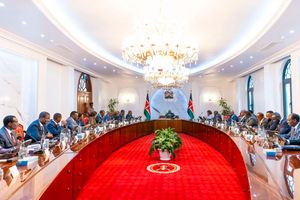
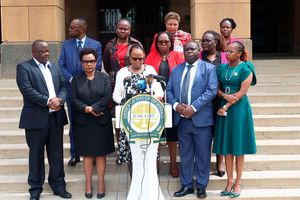
The Attorney-General has filed a fresh application at the Court of Appeal seeking to suspend a High Court judgment that declared the composition of President William Ruto's Cabinet unconstitutional for failing to meet the two-thirds gender rule.
The State says enforcing the judgment before its intended appeal is heard could disrupt government operations through fresh appointments, parliamentary vetting and administrative changes. It wants the court to halt implementation of the June 30 judgment, which ordered the President to correct the gender imbalance within 120 days.
"Compliance through changes to Cabinet membership may entail nominations, parliamentary approval, appointments and administrative transitions. If those processes are undertaken before appellate determination, they may alter the very composition of Cabinet which forms the subject matter of the intended appeal," the Attorney-General says.
The application is dated November 18 and was filed by Principal State Counsel Christopher Marwa. The respondents include rights groups and activists led by Katiba Institute and the Kenya Human Rights Commission.
Earlier application withdrawn
The filing comes weeks after the Attorney-General filed a similar application on October 6 to suspend the same judgment. The Court of Appeal declined to certify that application as urgent, and the State withdrew it on November 18 after the judges raised procedural concerns. No stay was granted.
The dispute arose after President Ruto dismissed most Cabinet Secretaries on July 11, 2024, following nationwide protests over the Finance Bill. He later nominated ministers for parliamentary approval, retaining several of the former Cabinet Secretaries.
Four consolidated petitions were filed challenging the nominations, vetting and appointments. The petitioners argued that the Cabinet, as an appointive public body, had to meet the gender threshold, rather than wait for Parliament to enact legislation. They also challenged the transparency and fairness of the 2024 nomination and approval process.
In its judgment dated June 30, 2026, the High Court upheld most of the appointment process but found the Cabinet's gender composition unconstitutional.
At the time of the judgment, the Cabinet had 25 members: the President, the Deputy President, the Attorney-General and 22 Cabinet Secretaries. Eighteen were men and seven were women.
Article 27(8) of the Constitution requires the State to ensure that no more than two-thirds of the members of any elective or appointive public body are of the same gender.
"A declaration is made that the current composition of the Cabinet does not comply with Article 27(8) of the Constitution because more than two-thirds of its members are of the same gender," the High Court stated in its final orders.
It directed the appointing authority to make Cabinet appointments that comply with the provision within 120 days. It also declared that Article 27(8) is "immediate, mandatory and fully enforceable" in appointive bodies, including the Cabinet.
The 120-day deadline expired on October 28. The judgment remains in force. The fresh application asks the appellate court to stay its operation, implementation and enforcement pending determination of the intended appeal.
The Attorney-General argues that the High Court misinterpreted the relationship between Article 27(8) and Article 152. Article 152 defines the Cabinet as the President, the Deputy President, the Attorney-General and between 14 and 22 Cabinet Secretaries, and gives the President power to nominate Cabinet Secretaries subject to National Assembly approval. The State also challenges the finding that the gender requirement applies immediately.
In an affidavit, Principal Administrative Secretary in the Executive Office of the President Arthur Osiya says compliance could require new Cabinet nominations, parliamentary approval, appointments and administrative transitions. He argues that these steps could take effect before the appeal is decided and alter the Cabinet under challenge.
"The application therefore seeks to preserve the position obtaining at the date of judgment pending appellate determination," Mr Osiya states.
Mr Marwa says the matter raises "questions of grave public interest affecting the entire Country" because Cabinet decisions are central to running the Government. The application asks the Court of Appeal to suspend the High Court orders or issue other interim directions.
The State further argues that if the appeal succeeds after Cabinet changes and parliamentary approvals, the previous position may not be fully restored. The application is pending determination.