Kenya takes centre stage as Africa charts climate future in Ethiopia

President William Ruto at the Second Africa Climate Summit in Addis Ababa, Ethiopia on September 8, 2025.

President William Ruto is leading Kenya's charge at the second African Climate Summit 2.0 (ACS2.0) that opened Monday in Addis Ababa, Ethiopia, as the continent seeks to transform climate challenges into economic opportunities.
The three-day summit, dubbed Africa's largest climate gathering, brings together thousands of delegates with Kenya playing a pivotal role through President Ruto's leadership of the Committee of African Heads of State and Government on Climate Change (CAHOSCC).
For Kenya, this summit is a continuation of the momentum built during the inaugural African Climate Summit held in Nairobi in September 2023. That historic gathering, hosted by Kenya, resulted in the landmark Nairobi Declaration that positioned Africa as a solutions hub rather than just a victim of climate change.
“The Nairobi Declaration was our moment,” said Ali Mohamed, Kenya's special climate envoy, who is accompanying President Ruto to Addis Ababa. “As we convene for ACS2, our charge is clear — to transform that 2023 ambition into action by scaling capital, unlocking value chains and forging alliances that anchor Africa's competitiveness in the global green economy.”
The summit comes at a crucial time for Kenya's green economy ambitions. The country has been positioning itself as East Africa's renewable energy hub, with significant investments in geothermal, wind, and solar power. The continental goal set in Nairobi — scaling renewable energy to 300GW by 2030 — is seen to align with Kenya's energy expansion plans and could unlock billions in investment for Kenyan projects.
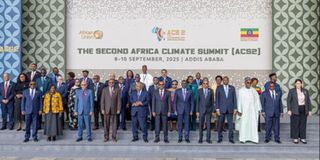
Delegates at the Second Africa Climate Summit in Addis Ababa, Ethiopia on September 8, 2025.
Dr Fitsum Assefa, Ethiopia's Minister of Planning and Development and National Coordinator of ACS2, emphasised that the summit is about “positioning Africa as the continent of homegrown solutions” — a vision that resonates with Kenya's own approach to climate innovation.
“Africa is disproportionately affected by climate change, contributing less than four percent of global emissions, yet bearing some of its harshest impacts,” Dr Assefa noted. This reality hits close to home for Kenyans who have witnessed firsthand the devastating effects of prolonged droughts followed by severe flooding.
Yet the summit also seeks to highlight Africa's extraordinary potential, including “the youngest population in the world, vast renewable energy resources, and innovative communities driving locally rooted solutions” — strengths that Kenya says it exemplifies with its tech innovation ecosystem and renewable energy leadership.
With just two months until COP30 in Brazil, President Ruto wants to position Kenya at the forefront of Africa's climate finance negotiations during the Addis Ababa talks. The continent is pushing for the promised $1.3 trillion annually by 2030 from developed nations — money that could transform Kenya's infrastructure and energy sectors.
This follows June's climate talks, dubbed SB-62 in Bonn, which ended with glimmers of hope but also gaps regarding climate finance commitments. For Kenya, securing predictable climate funding could accelerate projects from the Standard Gauge Railway's green upgrades to massive solar installations in northern counties.
Mohamed Adow, Executive Director of Power Shift Africa, sees the summit as crucial for addressing “Africa's major challenges, notably hunger, poverty, conflict, debt, energy poverty, and infrastructure deficiencies” — issues that resonate deeply with ordinary Kenyans struggling with high living costs and unreliable power supply.
“Africa has immense potential,” Adow said. “This summit must resolve the paradox of lack in abundance — the most arable land, mineral resources, abundant renewable energy potential, and a vibrant and educated human capital.”